TCPA Rules for Legal Lead Generation, Lead Quality, and Compliance
October 28, 2026 by Mohr Marketing
TCPA rules for legal lead generation require consent that matches the outreach and identifies the seller when prior express written consent applies. For covered telemarketing calls and texts using an autodialer or an artificial or prerecorded voice, consent must authorize that seller to contact the consumer. FCC lead-generation rules also require consent to be specific to each seller.
A lead can look complete in a CRM and still expose a law firm to risk if the consumer wasn’t told who might contact them or how. Clear disclosures and reliable records matter because the business making the call or sending the text must be able to show that it obtained consent.
This guide explains when consent applies to calls and texts, what a compliant lead-form disclosure should clarify, and how FCC rules affect lead generation and sharing. It also covers the records and quality checks that help legal marketers decide whether an inquiry is ready for outreach, not merely ready to buy.
Key Takeaways
- Match consent to the seller and the type of outreach before using a lead for covered marketing calls or texts.
- Marketing texts are subject to Do-Not-Call protections, and consumers must have a clear way to revoke consent.
- Make lead-form disclosures clear, visible, and specific, then preserve records that show how and when consent was obtained.
- Federal Communications Commission rules limit telemarketing calls to 8 a.m. through 9 p.m. in the called party’s local time.
- Review how leads are generated and documented before scaling campaigns; the FCC’s lead-generation rules make consent quality central to compliance.
Do lead generators have to verify TCPA?
Yes. Legal lead generators should collect and document consent because the caller or texter bears the burden of proving it. For covered telemarketing calls and texts, prior express written consent must identify the seller and authorize the communication.
These TCPA rules for legal lead generation also affect how comparison-shopping websites collect consent, what evidence they retain, and whether later messages match the consumer’s interaction.
Written Consent for Calls and Texts
Prior express written consent is written authorization for a seller to make covered telemarketing calls or send covered texts. For wireless numbers, the TCPA requires this consent for telemarketing using an automatic telephone dialing system, artificial voice, or prerecorded voice.
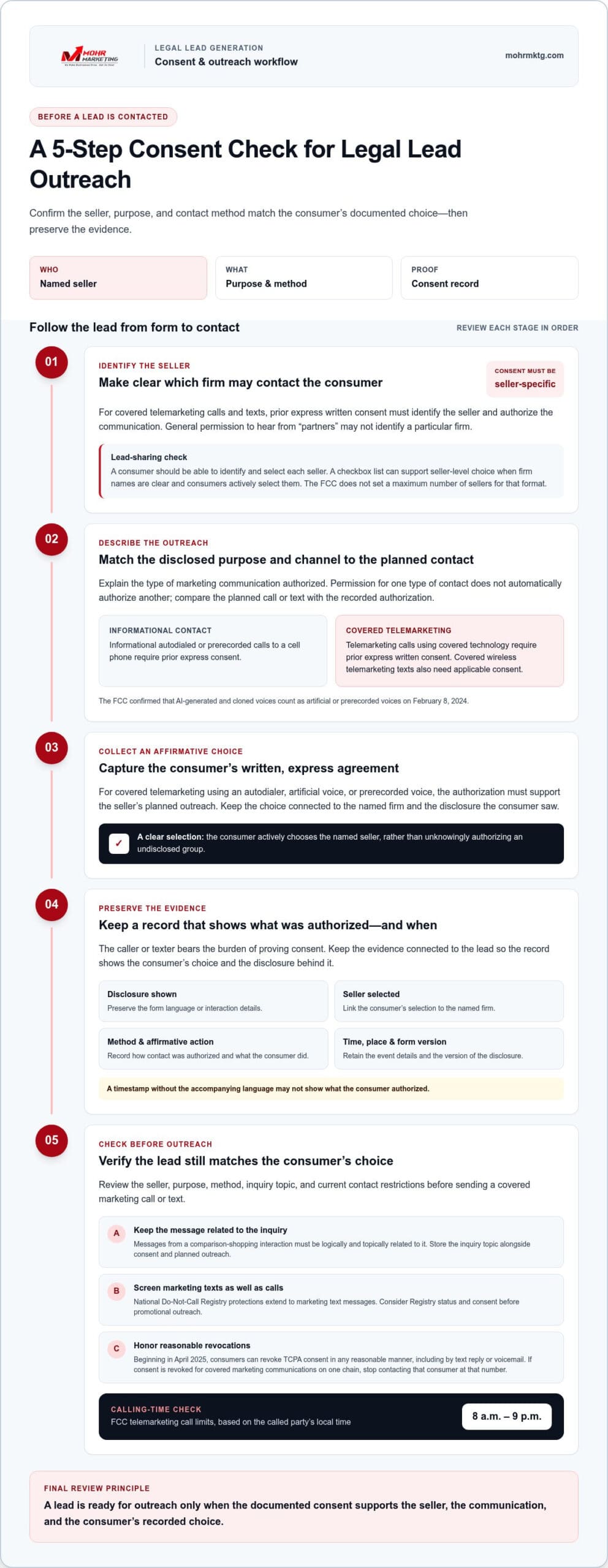
Seller-specific authorization matters when a consumer submits one legal inquiry but several firms may want to respond. Consent should identify the seller and explain the type of marketing communication authorized. A general statement agreeing to hear from “partners” may not show that the consumer authorized a particular firm.
For example, a form requesting information about a motor vehicle accident should make clear which law firm may contact the consumer and through which covered channels. The consumer’s written, express agreement must support the seller’s planned outreach.
Consent Collection and Lead Generators
Lead generators collect consent through forms, calls, or other digital interactions, then document how the consumer authorized contact. A comparison-shopping website may let consumers select sellers from a checkbox list; the FCC does not set a maximum number of sellers for that format.
The practical distinction is seller-level choice. Consumers should be able to identify and select each seller, rather than unknowingly authorizing an undisclosed group. A checkbox list can support that choice when seller names are clear and consumers actively select them.
For instance, a legal-services comparison form can show participating firms beside separate checkboxes. The resulting record should link the consumer’s selection to the named firm. This approach makes consent more attributable than broad, preselected permission covering unspecified companies.
Consent Records and Communication Scope
A consent record documents who may contact the consumer, how, what they agreed to, and when and where consent occurred. Lead sellers should preserve the form or interaction details so the caller can demonstrate consent if challenged.
Keep the evidence connected to the lead: the disclosure shown, the seller selected, the communication method, and the consumer’s affirmative action. A timestamp without the accompanying language may not show what the consumer authorized. Saving the form version helps link the event to its disclosure.
Consent also has a scope. Messages resulting from a comparison-shopping interaction must be logically and topically related to it. A request about an accident, for example, does not naturally support unrelated marketing. The FCC left “logically and topically associated” open to interpretation by courts and juries.
Records should make that relationship clear. Store the inquiry topic alongside the consent event and the seller’s planned outreach.
Covered Calling and Messaging Methods
TCPA protections apply to specified calls and texts, including covered autodialed calls and prerecorded or artificial-voice telemarketing. The FCC confirmed that AI-generated and cloned voices count as artificial or prerecorded voices on February 8, 2024.
Texts matter too: the FCC and courts interpret TCPA “calls” to include text messages. Marketing texts sent using covered methods therefore require applicable consent. Written messaging is not automatically outside telephone consumer protection rules.
Distinguish the communication method from its purpose. Informational autodialed or prerecorded calls to a cell phone require prior express consent; telemarketing calls using covered technology require prior express written consent. Permission for one type of contact does not automatically authorize another.
Before outreach, compare the planned call or text with the recorded authorization. This simple review helps align the seller, purpose, and method with the consumer’s documented choice.
Does the TCPA apply to text messages?
Yes. Federal Do-Not-Call Registry protections extend to marketing texts, and the TCPA covers certain calls and messages.
For legal leads, do-not-call rules restrict telemarketing to registered numbers unless consent or an established business relationship applies. Federal Communications Commission rules limit telemarketing calls to 8 a.m. through 9 p.m. in the called party’s local time.
Registry Protections for Marketing Texts
The FCC extended National Do-Not-Call Registry protections for voice telemarketing to marketing text messages. A number on the Registry therefore requires screening before a law firm sends promotional outreach, not just before a call center makes voice calls.
Distinguish marketing texts from communications directly responding to a consumer’s inquiry. If someone requests information about a legal matter, document the interaction and consent for any follow-up. Consider Registry status and consent before sending a promotional text.
Opt-outs also apply across communication channels. Beginning in April 2025, consumers can revoke TCPA consent in any reasonable manner, including by text reply or voicemail. If a consumer revokes consent for covered marketing communications on one chain, the caller must stop contacting that consumer at that number, rather than treating the request as limited to that chain.
For SMS, a straightforward instruction such as replying “STOP” gives consumers a clear opt-out route. The Federal Communications Commission says businesses must honor do-not-call and consent-revocation requests within a reasonable time, no later than 10 business days after receipt. Record the request and suppress the number from applicable outreach.
List Scrubbing and Reassigned Numbers
List scrubbing compares lead records with applicable do-not-call sources and reassigned-number data before outreach. Businesses should screen against the National Do-Not-Call Registry, state do-not-call lists, and the Reassigned Numbers Database.
This step helps identify numbers to suppress or review before a campaign uses them. For example, a law firm can screen a newly acquired lead file before importing it into a calling or texting workflow. Recheck suppression status as lists change, and save the screening result with the lead record.
Internal controls matter too. Maintain a written do-not-call policy, train callers to recognize requests, and make sure internal suppression lists reach every team handling calls or texts. A consumer’s request should not get lost when a lead moves between intake staff and an outreach team.
Apply these controls to both automated and manual workflows. A documented suppression process helps legal marketers manage Registry restrictions, consumer opt-outs, and changing phone-number data. For help aligning legal lead campaigns with intake workflows, discuss your lead generation needs.
Clear and conspicuous lead-form disclosures
A lead form should explain why it collects telephone information and what contact the consumer agrees to receive. Keep the consent language visible beside the submit action, readable on mobile, and separate from general privacy terms.
For TCPA purposes, a disclosure should clearly identify the seller and communication purpose before submission. It should also specify the method, such as calls or text messages, rather than rely on a broad promise to receive “offers.” If express written consent is required, the form should capture the consumer’s affirmative agreement in writing.
Placement affects whether consumers can see the disclosure clearly. Put the language near the submit button, make it readable on a phone screen, and avoid hiding key terms behind tiny links. Consumers should not have to open a privacy policy to discover that submitting an accident inquiry authorizes marketing calls or texts.
A privacy policy and terms of use serve different purposes from a consent disclosure. They can explain data handling and website conditions, but should not obscure who may contact the consumer, why, or how. Keep the consent statement distinct and avoid pre-checked boxes. The consumer’s own action should show agreement.
Records should preserve the disclosure shown at submission, along with the consent event and its source. Keep these records secure and accessible for review. Retain enough context to link the form language, the consumer’s selection, and the resulting lead. A timestamp alone may not show what the consumer saw or agreed to.
Telemarketing calls can also require disclosures during the conversation. Connecticut Senate Bill 1058 requires telemarketers to disclose the caller’s identity, the call’s purpose, and the represented entity within the first 10 seconds of a telephonic sales call. That state example shows why a compliant lead form does not replace clear identification during a call.
Review each form from the consumer’s perspective: identify the seller, find the consent language, understand the purpose, and locate the submit action. Then confirm that the saved record reflects that exact experience. This helps legal marketers distinguish permission to respond to an inquiry from permission for broader promotional messages, while supporting consumer protection under the Telephone Consumer Protection Act.
Balancing lead quality, conversion, and compliance
Legal marketing works best when firms assess lead relevance alongside consent and outreach controls. A larger inquiry count cannot make up for records that don’t support compliant follow-up.
Compliance Workflows and Staff Training
A compliance workflow connects lead review, consent details, outreach decisions, and staff responsibilities. It matters because intake teams and callers need consistent rules for handling the same lead.
For each inquiry, staff can review the consumer’s requested legal topic, the seller identified in the consent, and the authorized contact method. Train intake employees to distinguish a request for information from permission for broader marketing. Use sample scenarios, such as a person asking about an accident but declining promotional texts.
Route leads with incomplete or mismatched information for review instead of treating them as ready for every campaign. Keep the applicable disclosure and consent record available to the staff member handling the call. This workflow helps protect conversion quality: teams can prioritize inquiries that fit the firm’s practice and have a clear basis for follow-up.
Federal and State Compliance Practices
Federal and state requirements work together, so a campaign needs controls that account for both. Federal Communications Commission rules limit telemarketing calls to 8 a.m. through 9 p.m. in the called party’s local time.
The federal TCPA does not preempt state telemarketing laws, so state requirements may add obligations. California’s CCPA and Florida’s mini-TCPA are examples legal marketers may need to consider. The FTC’s Telemarketing Sales Rule can also apply to telemarketing campaigns.
Base your review on the consumer’s location and planned communication, not only the firm’s office location. For instance, a call campaign reaching consumers in different states may require state-specific review of disclosures and outreach practices. Document the rules applied to each campaign, then train staff to follow the approved process.
Business Impacts of Compliance
Compliance affects campaign efficiency by determining which inquiries can move into outreach and how teams handle them. A lead that matches the firm’s case criteria but lacks a usable consent record can create intake friction and delay follow-up.
Evaluate campaign performance using qualified inquiries, documented authorization, and appropriate dispositions, not raw submission volume alone. If a source produces many inquiries but weak case fit or unclear consent, refine the form language, targeting, or lead-routing criteria. This keeps conversion decisions tied to both legal relevance and readiness for outreach.
Clear procedures also help staff respond consistently when consumers change their preferences. Record suppression decisions and make them visible to teams handling later communications. A disciplined process supports consumer protection while helping firms focus on leads that fit their practice and can be handled through an appropriate contact workflow.
FCC lead generation rules
The FCC’s lead-generation rules focus on whom a consumer authorizes to make covered marketing calls or send texts. For legal marketers, the central question is whether consent clearly identifies each seller and supports the planned outreach.
Prohibited Lead Generation and Attorney Marketing
The TCPA restricts covered telemarketing calls and texts made without the required consent. In particular, telemarketing calls to wireless numbers using an automatic telephone dialing system or artificial or prerecorded voice require prior express written consent.
This does not mean every attorney advertisement or legal inquiry is prohibited. The compliance risk arises when a campaign uses covered calling or messaging methods without consent that supports contact by that seller. For example, a consumer who requests information from one firm has not necessarily authorized an undisclosed group of firms to market by phone.
Lead generators should link the consumer’s action to the seller, purpose, and communication method. If a form collects a personal injury inquiry, its records should show which firm the consumer selected and what contact they authorized. This gives the calling firm a basis to assess the lead before outreach.
One-to-One Consent Requirements
The FCC’s one-to-one consent rule requires prior express written consent for no more than one identified seller to deliver covered telemarketing messages. In 2026, legal marketers should treat each firm’s authorization as seller-specific, rather than relying on a broad consent to contact from multiple partners.
A comparison-shopping website may present a checkbox list without a prescribed maximum number of sellers. However, consumers must be able to select each seller individually, and the record should preserve their selections. A checked box for one law firm does not establish consent for another firm on the same list.
Apply this rule to lead sharing before a campaign begins. Match each lead’s consent record to the firm receiving it, then compare the authorized contact method with the planned call or text. The FCC also requires marketing messages resulting from comparison-shopping consent to be logically and topically related to the interaction that prompted consent.
For example, a consumer seeking help after a vehicle collision may receive related legal marketing from a selected seller, but the inquiry does not support unrelated promotions. The FCC did not define “logically and topically associated,” leaving its interpretation to courts and juries. A clear record of the consumer’s topic and seller selection helps show the connection.
Build consent review into lead acceptance and routing. Preserve the consumer’s selection, the disclosure presented, and the resulting action. If the seller or message falls outside that documented scope, do not treat the lead as authorization for that outreach.
Mohr Marketing: Personal Injury Leads
Mohr Marketing provides Personal Injury Leads for firms seeking new case inquiries, alongside Motor Vehicle Accident (MVA) Leads, Signed Retainers, and Legal Intake Services. These offerings can support different stages of a firm’s intake process, from generating potential case opportunities to managing legal inquiries.
Consider these services when your firm needs personal injury or MVA opportunities, signed cases, or intake support aligned with its growth priorities. As you assess a lead source, evaluate case fit and the consent information tied to each inquiry before outreach. This connects acquisition decisions to both intake needs and compliance procedures.
Contact Mohr Marketing to discuss your legal lead generation needs.
Make Compliance Part of Your Growth Plan
A reliable lead program treats consent quality as an operating standard, not a final review. Clarify ownership across marketing, intake, and outreach so each team understands how its decisions affect the next handoff.
Use the TCPA rules for legal lead generation as a framework for reviewing the full consumer journey. Examine how campaigns describe contact, how inquiries move between teams, and how staff respond when consumers change their preferences. Update processes when campaign channels or lead sources change.
This approach can help your firm pursue growth without separating acquisition from responsible follow-up. Clear accountability gives teams a stronger foundation for informed decisions and ongoing improvements to campaign operations.
Build with discipline and put your next campaign on firmer ground.
Frequently Asked Questions
What are TCPA-compliant leads, and why does TCPA compliance matter?
TCPA-compliant leads have consent and records that support the intended outreach to the consumer. For example, a firm should be able to connect an inquiry to the named seller, the disclosure presented, and the authorized contact method. Compliance matters because the caller or texter may need to demonstrate consent. A lead’s legal-topic fit alone doesn’t establish permission for every firm or communication channel.
What is TCPA in marketing?
The Telephone Consumer Protection Act, or TCPA, is a federal law governing certain telephone marketing practices. Congress enacted it in 1991, and it is codified at 47 U.S.C. § 227. In a marketing campaign, it affects covered calls and texts, including outreach using autodialed or artificial or prerecorded voices. Marketers should assess the technology, purpose, destination number, and consent before a campaign contacts consumers.
Does the EBR apply to autodialers and AI voice?
An established business relationship may affect certain Do-Not-Call restrictions, but it does not replace consent required for covered automated telemarketing. The relationship depends on the consumer’s prior interaction with the business. A purchase or transaction within the preceding 18 months, or an inquiry or application within the preceding three months, can be relevant under the stated TCPA definitions. Keep those records separate from consent documentation.
Does the TCPA cover AI voice calls?
Yes. The Federal Communications Commission confirmed that AI-generated and cloned voices are artificial or prerecorded voices under the TCPA on February 8, 2024. A law firm using generated voice technology should therefore assess the call under rules governing artificial or prerecorded voice outreach. The technology’s human-like sound does not make it a live caller. The applicable consent depends on the call’s purpose, number type, and method.
What should businesses consider before sharing consumer data with buyer companies?
Consumers should know which companies may contact them and be able to select each seller individually. For example, a comparison form can list law firms with separate, unchecked selections. Preserve the consumer’s action and the disclosure tied to each selected firm. A data transfer alone does not show that the consumer authorized every recipient to call or text, so match each record to the company receiving it.
TCPA penalties: How much does a violation cost?
Statutory damages can be $500 per violation, and a court can increase damages to $1,500 per call or text for a knowing or willful violation. The amount is not a fixed campaign charge; it depends on the violation and legal outcome. For a law firm reviewing exposure, count the calls or texts at issue and preserve consent, outreach, and suppression records for each consumer.
What counts as a “telephone solicitation”?
In practical terms, a telephone solicitation is a call intended to market or promote goods or services to the person answering. For a law firm, a call promoting legal services differs in purpose from a response limited to a consumer’s request for information. The campaign’s purpose and content matter. The FTC’s Telemarketing Sales Rule can also apply to telemarketing campaigns, alongside applicable TCPA requirements.
What are the TCPA calling hours?
Telemarketing calls are permitted from 8 a.m. through 9 p.m. in the called party’s local time. A national campaign should schedule calls using the recipient’s local time, not just the caller’s office time. For example, a call window that is permitted in one time zone could fall outside the permitted hours for a consumer elsewhere. Apply the restriction when setting campaign schedules.

Recent Posts
- TCPA Rules for Legal Lead Generation, Lead Quality, and Compliance
- HIPAA compliant marketing for law firms and penalty risks
- Compliance for Multi-State Legal Advertising: Rules, Claims, and Contacts
Categories
- AI and Lead Generation
- Business Financing
- Call Verified MVA Leads
- Car Accident Help
- Car Accident Settlements
- Claimant Funding
- Compliance Program
- EMS-EMT Reports
- Geotargeting
- Google Maps Ranking
- Healthcare Practice Growth
- Law Firm Growth
- Law Office Operations
- Lead Generation
- Lead Generation For Attorneys
- Lead Generation For Chiropractors
- Lead Generation For Criminal Attorneys
- Lead Generation For D&A Treatment Centers
- Lead Generation For DUI Attorneys
- Lead Generation For Eye Doctors
- Lead Generation For Family Law Practices
- Lead Generation For PI Law Firms
- Lead Generation For Plastic Surgeons
- Leads For Healthcare Professionals
- Leads For Insurance Industry
- Legal Leads
- Legal Marketing
- Legal Updates
- Mass Tort Leads
- Medicare and Medicaid Leads
- Merchant Funding Leads
- Mold Leads
- Online Marketing Strategies
- Pre-Settlement Funding
- Signed MVA Cases
- Tort Updates
- Truck Accident Leads and Signed Cases
- Truck Accident Settlements
- Web Design