Compliance for Multi-State Legal Advertising: Rules, Claims, and Contacts
October 26, 2026 by Mohr Marketing
Accurate wording alone won’t keep a legal ad compliant. Compliance for multi-state legal advertising means assessing the ad’s overall impression under ABA Model Rule 7.1 and accounting for standards set independently by 51 U.S. jurisdictions. A claim can mislead through its context, omissions, or implied promise, even when individual statements are technically true.
That makes cross-state campaigns more complex than reusing the same approved message everywhere. Rules can affect claims about results, awards, specialization, and testimonials, as well as how a firm identifies itself and preserves advertising materials. A national campaign must account for the jurisdictions it reaches.
This guide explains how to identify potentially misleading claims and understand the differences that shape lawyer advertising across state lines. You’ll see how general professional-conduct rules interact with state requirements, and why reviews should cover the entire campaign, including digital content and outreach. The goal is practical: clearer claims, fewer compliance gaps, and a more reliable process for marketing across jurisdictions.
Key Takeaways
- Assess an advertisement’s overall impression, not just whether each individual statement is accurate.
- Compare state requirements before running the same claims, testimonials, or award references across jurisdictions.
- Review disclosures, responsible-attorney details, and contact methods as part of the ad, not as afterthoughts.
- Keep advertising records and account for marketing activity handled on your firm’s behalf.
- Understand how legal intake and signed-retainer services can support the next step after compliant advertising generates inquiries.
How Can Law Firms Avoid Making False or Misleading Claims?
Review each ad’s overall impression, not just the accuracy of its individual statements. Before publishing or reusing claims in a campaign that crosses state lines, compare the rules that apply in each jurisdiction.
State Advertising Rule Variations
State advertising rules are jurisdiction-specific requirements that supplement a lawyer’s professional-conduct obligations. They matter because a single campaign can reach audiences governed by different standards.
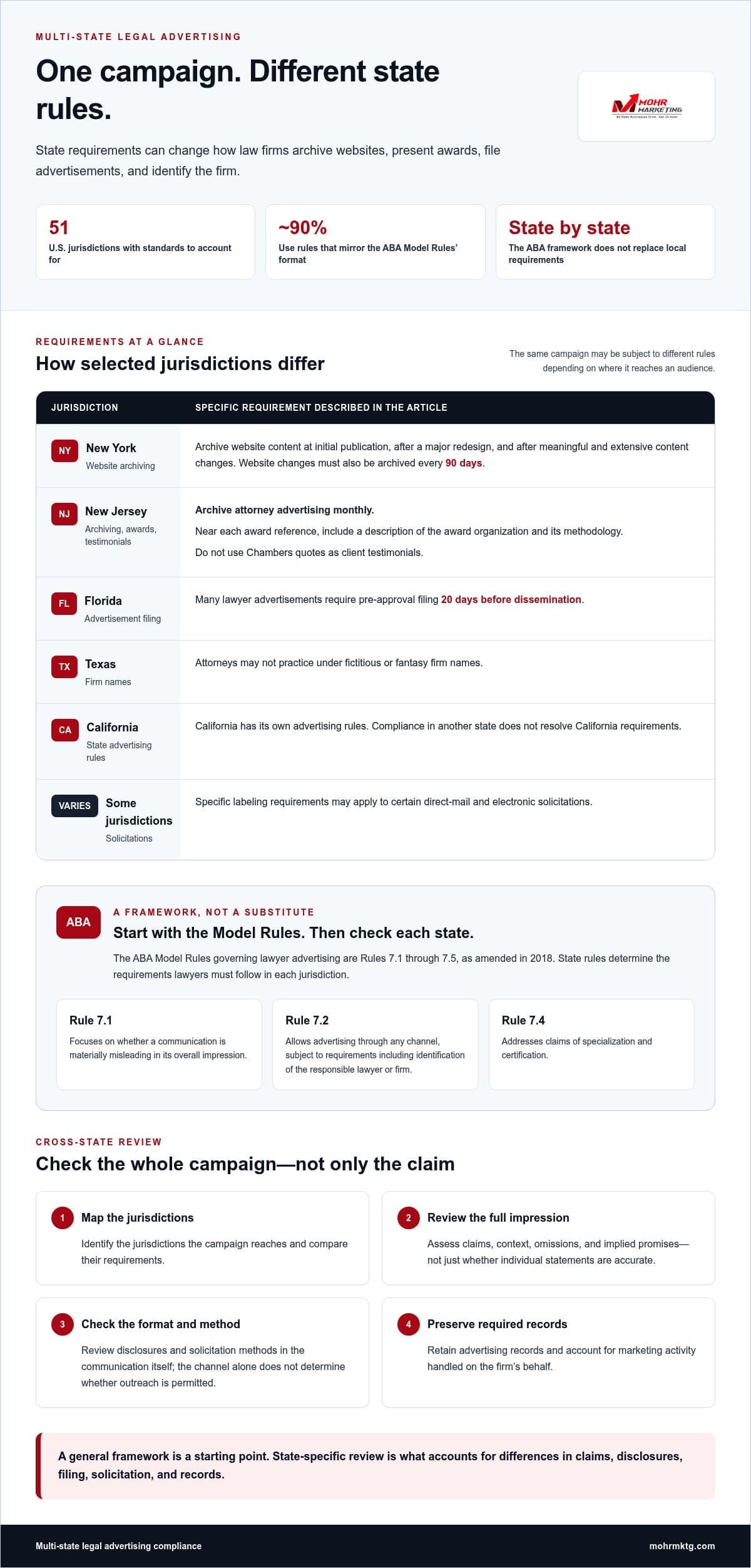
In New York, Rule 7.1(k) requires archiving website content at initial publication, after a major redesign, and after meaningful and extensive content changes. The state also requires law firms to archive website changes every 90 days. New Jersey requires monthly archiving of attorney advertising. It also requires a description of an award organization and its methodology near each award reference, and forbids using Chambers quotes as client testimonials.
Florida requires pre-approval filing for many lawyer advertisements 20 days before dissemination. Some jurisdictions impose specific labeling requirements on certain direct-mail and electronic solicitations. Texas prohibits attorneys from practicing under fictitious or fantasy firm names. California has its own state advertising rules, so a national campaign should not assume that compliance in another state resolves California requirements.
ABA Model Rules and State Requirements
ABA Model Rules provide a framework, but state rules determine the requirements lawyers must follow in each jurisdiction. Roughly 90% of U.S. jurisdictions have adopted rules that mirror the ABA Model Rules’ format, yet state-specific provisions still matter.
The ABA Model Rules governing lawyer advertising are particularly Rules 7.1 through 7.5, as amended in 2018. Rule 7.1 focuses on whether a communication is materially misleading in its overall impression. Rule 7.2 allows advertising through any channel, subject to requirements such as identifying the responsible lawyer or firm and restrictions on referral-fee arrangements. Rule 7.4 addresses claims of specialization and certification.
For a law firm advertising across state lines, use the ABA framework as a starting point, then compare each state’s rules on claims, disclosures, and records. New Jersey’s restrictions on awards and testimonials illustrate why a general framework cannot replace a state-by-state review.
Solicitation Rules and Penalties
Solicitation rules govern direct efforts to obtain legal work, and their application can differ by state and communication method. ABA Model Rule 7.3 restricts live, person-to-person solicitation for pecuniary gain while permitting mass-market advertising and written or digital outreach.
The 2018 revision to ABA Model Rule 7.3 extended the in-person solicitation prohibition to live telephone and real-time electronic contact. Email, text messages, and social media ads still require careful review: the channel alone does not determine whether a communication is permitted. Consider its audience, delivery method, and whether it involves live, real-time contact.
There is no single nationwide penalty for violating lawyer advertising rules. Consequences depend on the applicable state’s disciplinary process and the conduct involved. Before releasing an ad, identify the jurisdictions it reaches, review its claims and solicitation methods against their rules, and retain required advertising records, including New York website archives.
What Are the Key Legal Advertising Rules for Lawyers?
Lawyer advertising rules govern claims, disclosures, and how firms present results. For state-specific requirements and filing fees, consult the relevant state bar association’s advertising rules and filing instructions.
Claims, Disclaimers, and Results-Based Marketing
Claims, disclaimers, and results-based marketing should give prospective clients a fair picture of the services and outcomes advertised. A statement can be technically accurate yet create an unjustified expectation because of how it is presented or what context it leaves out.
Review each claim in the context of its headline, images, testimonials, and call to action. A past case result, for example, should not imply that another client will get the same outcome. A disclaimer may clarify context, but it should be clear, close to the claim, and readable in the ad’s format. A brief disclosure buried at the bottom may not offset a strong promise in the headline.
Superlatives such as “best” or “leading” also require scrutiny. Consider what a reasonable reader would understand and whether the firm can support that impression. Apply the same review to website copy, search ads, and social media posts. A platform’s short format does not make an unsupported claim less consequential.
Attorney Identification and Required Disclosures
Attorney identification and required disclosures tell the audience which lawyer or firm is responsible for an advertisement. ABA Model Rule 7.2 permits lawyer advertising through virtually any channel and requires proper identification of the responsible attorney or firm.
Include the necessary disclosure in each format rather than assuming a linked website provides it. A social media post, video, or landing page may be viewed on its own, so the responsible lawyer or firm should be identifiable in that communication. Keep the name consistent in the ad and on its destination page. This also helps distinguish the firm from a directory, publisher, or other campaign participant.
State rules can add specific language. Missouri marketing materials must conspicuously include: “The choice of a lawyer is an important decision and should not be based solely upon advertisements.” Certain advertisements and written communications in Louisiana must comply with Louisiana State Bar Rule 7.7. Treat these as state-specific review points, not universal disclaimers.
Specialization, Testimonials, and Filing Requirements
Specialization claims, testimonials, and filing requirements are areas where state rules can materially change an ad’s permitted wording. ABA Model Rule 7.4 limits specialization claims and requires a lawyer claiming certification to name the certifying organization.
Testimonials need context. A client’s experience can mislead if it suggests similar results are typical or likely. New Jersey’s attorney advertising committee may request proof that a testimonial came from a client or former client. The state also permits rankings only when they are based on a bona fide, rigorous, and independent inquiry into a lawyer’s fitness and qualifications.
Filing procedures also vary. Florida requires pre-approval filing of many lawyer advertisements 20 days before dissemination. Before launch, identify the states the campaign reaches, then review each state bar’s filing instructions, applicable disclosure language, and any required review period. Keep the approved version aligned with the version actually published.
Lawyer advertising identification and contact requirements
Every advertisement should identify the responsible lawyer or firm and meet the recordkeeping and labeling rules of the jurisdictions it reaches. The ABA framework is a starting point, but state requirements determine what firms must include in each campaign.
Advertising Identification and Contact Details
Identification requirements make clear which attorney or firm is responsible for an advertisement. ABA Model Rule 7.2 requires responsible-attorney disclosure in every advertisement, regardless of medium.
Apply that rule to every communication, including a standalone social media ad or landing page. Don’t assume readers will follow a link to find the firm’s name. Clearly associate the responsible lawyer or firm with the ad, and review the displayed details whenever campaign copy or creative changes.
For a multistate campaign, map the jurisdictions targeted and compare their applicable rules before release. State bar requirements may add details beyond the model rules. A consistent identification process helps firms clearly name the responsible party while preparing for jurisdiction-specific enforcement and recordkeeping obligations.
Labeling and Archiving Requirements
Labeling and archiving rules specify how certain ads must be marked and which records a firm must preserve. They matter because the same communication can trigger different requirements in Florida, New York, and New Jersey.
Florida’s Subchapter 4-7 requires certain direct-mail and electronic solicitations to display the words “ADVERTISING MATERIAL” in specified locations. Apply the label to the relevant communication itself, not merely to a linked page. The requirement is specific to the categories and locations defined by that rule.
New York Rule 7.1(k) requires law firms to archive website content at initial publication, after a major redesign, and after meaningful and extensive content changes. New York law firms must also archive website changes every 90 days and keep copies of most advertisements for at least three years. New Jersey requires monthly archiving of attorney advertising. A records process should capture each version and its publication context.
Jurisdiction-Specific Campaign Requirements
Jurisdiction-specific requirements are state ethics obligations that may apply based on where a firm operates and where its advertising is directed. One approval process may not cover every state audience.
New Jersey’s Rules of Professional Conduct apply to firms based there and firms based elsewhere that have New Jersey offices. The advertising standards are independently set by 51 U.S. jurisdictions, so model rules alone cannot settle every campaign question.
For each campaign, identify the target jurisdictions, responsible attorney, communication type, and recordkeeping needs. Match each version to the applicable rules before distribution, then preserve the final creative and disclosures alongside required archives. This makes it easier to show which version appeared in each jurisdiction and respond to an enforcement inquiry with organized records.
False or misleading claims, omissions, and unjustified expectations under Rule 7.1
ABA Model Rule 7.1 focuses on an advertisement’s overall impression, including what it leaves unsaid. Review each claim from the consumer’s perspective before publishing it.
Misleading Claims and Omissions
A claim or omission is misleading when it creates a materially inaccurate impression about a lawyer or the services offered. A statement can be literally true yet misleading in context.
Assess the headline, supporting text, images, and disclaimers together. For example, an ad highlighting a substantial past recovery may imply that similar outcomes are typical, even if it never says so. Omitting context about the individual circumstances can reinforce that impression. A disclaimer should clarify the claim, not try to undo a promise that dominates the ad.
Consumer protection rules matter, too. The FTC Act prohibits deceptive advertising, while the Lanham Act allows competitors to bring false-advertising claims when advertising causes commercial harm. These are distinct legal frameworks, so firms should assess both professional-conduct rules and applicable advertising standards.
Use a practical review: identify the ad’s main takeaway, test whether the evidence supports it, and look for omitted qualifications that could change a reader’s understanding. Apply the same review to website pages, paid search copy, and social posts. A claim that seems balanced on a landing page may create a different impression when shortened for an ad.
Practice Area and Specialization Claims
Practice-area and specialization claims describe a lawyer’s focus, experience, or credentials. Be precise because consumers may interpret confident wording as a formal qualification or measurable distinction.
ABA Model Rule 7.4 limits claims of specialization and requires lawyers claiming certification to name the certifying organization. Distinguish a practice focus from a certification. For example, describing work in a practice area is different from representing that an outside organization certified the lawyer as a specialist.
Testimonials and reviews also require context. A client’s favorable account can create an unjustified expectation if it suggests readers should expect a similar result. Review the full testimonial, its placement, and any accompanying language. New Jersey’s advertising committee may request proof that a testimonial came from a client or former client.
Comparative claims also need clear support. Statements such as “more successful” or “the leading firm” raise questions about the comparison, its basis, and its scope. Specify what is being compared and remove claims the evidence cannot substantiate. For every result, review, or ranking, assess the message consumers are likely to take away, not just the words used.
Advertising compliance for multi-state law firms
A multistate law firm can review and approve advertising by mapping its target jurisdictions, assessing each campaign asset against applicable rules, and documenting approval. Compliance for multi-state legal advertising works best as an ongoing review, not a final approval hurdle. Revisit the process when claims, format, platform, or distribution changes.
Make each review specific to the campaign. A national template may need different disclosures, firm-name treatment, or solicitation controls in each state. The ABA Model Rule framework helps organize the review, but state requirements govern the details. Assign responsibility for checking those differences before publication, not after an ad reaches a new audience. A documented process connects compliance for multi-state legal advertising to how your firm actually markets.
- Map the reach. List the jurisdictions targeted by each website page, social post, paid placement, and direct communication.
- Review the message. Check claims, omissions, testimonials, rankings, and implied results in the complete ad format.
- Check the channel. Assess whether the platform or delivery method changes disclosure, solicitation, or filing requirements.
- Keep the record. Preserve approved creative and note material changes, publication, and review decisions.
Tie records to the version that was published. A landing page may change after an ad is approved, or a platform may display only part of the original message. Compare the live asset with the approved copy, including disclosures and destination pages. Law firms remain accountable for marketing conducted on their behalf by lead-generation platforms, affiliates, and directory listings.
Review firm identity separately. ABA Formal Opinion 512 does not prohibit trade names outright, but Texas and Louisiana prohibit attorneys from practicing under fictitious or fantasy firm names. For a campaign using a trade name, evaluate the wording against the jurisdictions where the ad will appear. One state’s treatment does not settle the question elsewhere.
Build recurring reviews into campaign operations. Conduct compliance reviews at least annually, and revisit a campaign when it changes substantially. A new claim, landing page, target audience, or platform can change the ad’s overall impression. Maintain a version history so reviewers can identify what changed and which jurisdictions need renewed attention.
Document approval for each campaign version and target jurisdiction. This gives an American law firm a consistent regulatory process without treating any platform or format as a universal template. Apply the same review to marketing partners and the content they distribute for the firm.
Mohr Marketing: Personal Injury Leads
Mohr Marketing, LLC provides Personal Injury Leads for firms looking to connect advertising activity with relevant inquiries. When a campaign generates responses, Legal Intake Services can support the process of handling those inquiries and assessing potential cases.
For firms focused on motor vehicle accident matters, Mohr Marketing, LLC also offers Motor Vehicle Accident (MVA) Leads and Signed Retainers. These offerings address different stages of case acquisition, from connecting with prospective clients to receiving signed cases. They do not replace a law firm’s review of advertising claims or its responsibility for marketing conducted on its behalf.
Consider Legal Intake Services when your firm needs support managing incoming inquiries alongside its advertising efforts. Contact Mohr Marketing, LLC to discuss your firm’s needs.
Build Compliance Into Your Next Campaign
Treat compliance for multi-state legal advertising as an ongoing discipline, not a final approval hurdle. Assign clear ownership for reviewing campaign changes, preserve approved versions, and revisit the process whenever an ad reaches a new jurisdiction or platform. Keep the review connected to how your firm markets.
Mohr Marketing, LLC offers Mass Tort Leads for law firms developing campaigns in that practice area. Align marketing activity with your firm’s review process to keep campaign execution and professional obligations in view.
Set your next campaign up with clear review ownership and a documented approval process. Contact Mohr Marketing, LLC to discuss how its offerings may fit your firm’s marketing needs.
A clear process supports deliberate growth. Move forward with a defined set of standards for your advertising.
Frequently Asked Questions
How Does the American Bar Association Influence These Rules?
The American Bar Association provides model language that states can adopt or adapt; its model rules are not automatically binding in every jurisdiction. Its Rules 7.1 through 7.5, amended in 2018, offer a framework for advertising, payments, solicitation, specialization claims, and firm names. For a campaign, use that framework to identify issues, then compare the controlling rules where the lawyers practice and the ad appears.
What Are the Rules of Professional Conduct for Advertising?
Rules of Professional Conduct are jurisdiction-specific standards governing lawyers’ communications about legal services. Advertising reviews commonly focus on whether claims are misleading, how the responsible lawyer is identified, and whether solicitation or referral arrangements are restricted. For example, when adapting a general campaign for a new state, a firm should assess its headline, testimonials, and contact method separately. The state’s adopted rules, not a model rule alone, control.
What Role Does the State Bar Association Play in Regulation?
A state bar association can be a practical starting point for finding a jurisdiction’s advertising rules, filing guidance, and ethics resources, although regulatory authority and procedures vary. Some jurisdictions use advertising committees as part of this process. For example, New Jersey’s attorney advertising committee may request evidence that a testimonial came from a client or former client. Use bar materials to locate relevant obligations, then follow the governing rules.
Which state advertising rules apply when a law firm targets clients in multiple states?
Review the rules of every jurisdiction reached by the campaign, alongside requirements tied to the firm’s location or offices. Audience and distribution matter: a website visible nationally, a state-targeted ad, and a direct communication may raise different questions. For example, New Jersey’s rules apply to firms based there and firms based elsewhere that have New Jersey offices. Track campaign reach and firm presence separately.
Do attorneys need to register or file advertisements with state bars before publication?
Some advertisements require advance filing or review, but the requirements depend on the state and communication type. Florida requires pre-approval filing for many lawyer advertisements 20 days before dissemination. Certain Louisiana advertisements and written communications must comply with Louisiana State Bar Rule 7.7. Before publication, identify whether the specific format triggers a filing, which body receives it, and whether a review period affects the launch schedule.
What disclaimers are required for attorney websites, ads, testimonials, and past results in each state?
No single disclaimer satisfies every state or advertising format. Required language and context depend on the claim, medium, and jurisdiction. Missouri, for example, requires a particular lawyer-choice disclosure in marketing materials. A testimonial or past result may also need context to avoid implying that similar outcomes are expected. Review the entire communication, including mobile displays where a disclosure may be less visible.
What restrictions apply to lawyer referrals, lead generators, and paid legal directories across states?
Restrictions depend on whether an arrangement pays for advertising or involves a referral fee, and on the jurisdiction’s rules. ABA Model Rule 7.2 permits advertising through virtually any channel but restricts referral-fee arrangements to specified exceptions. A directory listing or lead-generation relationship should therefore be assessed by its actual structure and compensation, not its label. Review the agreement, consumer-facing language, and applicable state requirements before launching.

Recent Posts
- TCPA Rules for Legal Lead Generation, Lead Quality, and Compliance
- HIPAA compliant marketing for law firms and penalty risks
- Compliance for Multi-State Legal Advertising: Rules, Claims, and Contacts
Categories
- AI and Lead Generation
- Business Financing
- Call Verified MVA Leads
- Car Accident Help
- Car Accident Settlements
- Claimant Funding
- Compliance Program
- EMS-EMT Reports
- Geotargeting
- Google Maps Ranking
- Healthcare Practice Growth
- Law Firm Growth
- Law Office Operations
- Lead Generation
- Lead Generation For Attorneys
- Lead Generation For Chiropractors
- Lead Generation For Criminal Attorneys
- Lead Generation For D&A Treatment Centers
- Lead Generation For DUI Attorneys
- Lead Generation For Eye Doctors
- Lead Generation For Family Law Practices
- Lead Generation For PI Law Firms
- Lead Generation For Plastic Surgeons
- Leads For Healthcare Professionals
- Leads For Insurance Industry
- Legal Leads
- Legal Marketing
- Legal Updates
- Mass Tort Leads
- Medicare and Medicaid Leads
- Merchant Funding Leads
- Mold Leads
- Online Marketing Strategies
- Pre-Settlement Funding
- Signed MVA Cases
- Tort Updates
- Truck Accident Leads and Signed Cases
- Truck Accident Settlements
- Web Design