In-House vs. Outsourced Law Firm Marketing in 2026
October 2, 2026 by Mohr Marketing
The right answer to in-house vs outsourced law firm marketing may be a deliberate mix of both. Hiring internally keeps strategy and firm knowledge close, but a capable team requires more than salary spending. Outsourcing adds specialized execution, but it works best when priorities, communication, and performance expectations are clear.
If you’re weighing these options, the practical questions are how to control spending, preserve the firm’s voice, and determine whether marketing is producing qualified inquiries and signed cases. Cost alone is not enough to choose a model. Assign ownership where judgment and client insight matter, then match execution to the people and resources available.
This guide compares the trade-offs, costs, capabilities, and accountability of in-house, outsourced, and hybrid approaches. You’ll learn how to decide which functions to keep inside the firm, which to delegate, and how to connect marketing activity to intake and pipeline outcomes. The goal is a model that fits your firm’s growth priorities, not a team structure that looks good on paper.
Key Takeaways
- Compare in-house vs outsourced law firm marketing by the work each model can own and execute, not by headline cost alone.
- Keep firm-specific judgment and client insight closely connected to marketing, while assigning specialized execution according to your team’s capacity.
- Assess total investment by accounting for labor, benefits, tools, training, management, and access to specialist skills.
- Choose an in-house, outsourced, or hybrid structure based on growth goals, internal capacity, required expertise, and oversight.
- Set clear responsibilities and review reporting against intake and pipeline outcomes to make marketing accountability more concrete.
In-House vs. Outsourced Law Firm Marketing: What Is the Real Decision?
Law firms must grow case acquisition without losing control of the firm’s message or spending resources on marketing that fails to produce meaningful inquiries. The in-house vs outsourced law firm marketing decision is not simply whether to hire employees or engage an agency. It is about which capabilities the firm needs, who owns key decisions, and how the work will be evaluated.
In-house marketing is work planned or carried out by the firm’s employees. Outsourced marketing uses an external provider for some or all of that work. A hybrid arrangement combines the two: firm staff retain close control of priorities and client insight, while outside specialists handle selected execution. External providers can function as a business service provider, but the arrangement does not transfer ownership of the firm’s goals or client relationships.
For legal marketing, the distinction matters throughout the acquisition process. Campaign activity should connect to inquiries, intake, and the firm’s assessment of which matters to pursue. A practical starting point is to keep firm-specific judgment and client trust close to the practice, then assign specialist execution deliberately. Neither a large internal team nor a broad agency relationship is automatically the right answer.
What does in-house law firm marketing include?
Internal ownership can include setting positioning and priorities, approving messaging, and applying knowledge of the firm’s practice areas and client experience. One generalist may coordinate campaigns and communications, but that is different from having dedicated expertise across SEO, paid media, content, and analytics. Internal staff can also bring attorneys’ subject knowledge together with intake feedback, helping marketing reflect how inquiries are handled and evaluated.
What does outsourced law firm marketing include?
An external provider may advise on strategy, complete defined projects, or manage ongoing work. Project-based support has a set scope; ongoing management involves continuing campaign responsibilities; performance-linked arrangements tie some aspect of compensation to specified outcomes. Whichever model you use, define deliverables and reporting expectations clearly. The firm still determines its positioning, growth goals, and client relationships. External execution should support those decisions, not replace the firm’s judgment.
The decision becomes clearer when every function has an owner. For example, a firm may retain authority over practice-area priorities and approvals while assigning technical campaign work to specialists. Connect responsibilities and reporting to the path from marketing activity to inquiry and intake outcomes. That gives the firm a basis for comparing models by capability and accountability, not headcount alone.
Which Law Firm Marketing Functions Need Internal Ownership or Outside Expertise?
Marketing includes both firm-level decisions and specialist execution. The right division depends on your practice areas, campaign complexity, internal capacity, and growth objectives. A firm prioritizing a new practice area may need attorney input on positioning and content. A firm expanding campaigns may need consistent SEO or paid media support. In either case, outside execution needs clear direction from people who understand the firm and its clients.
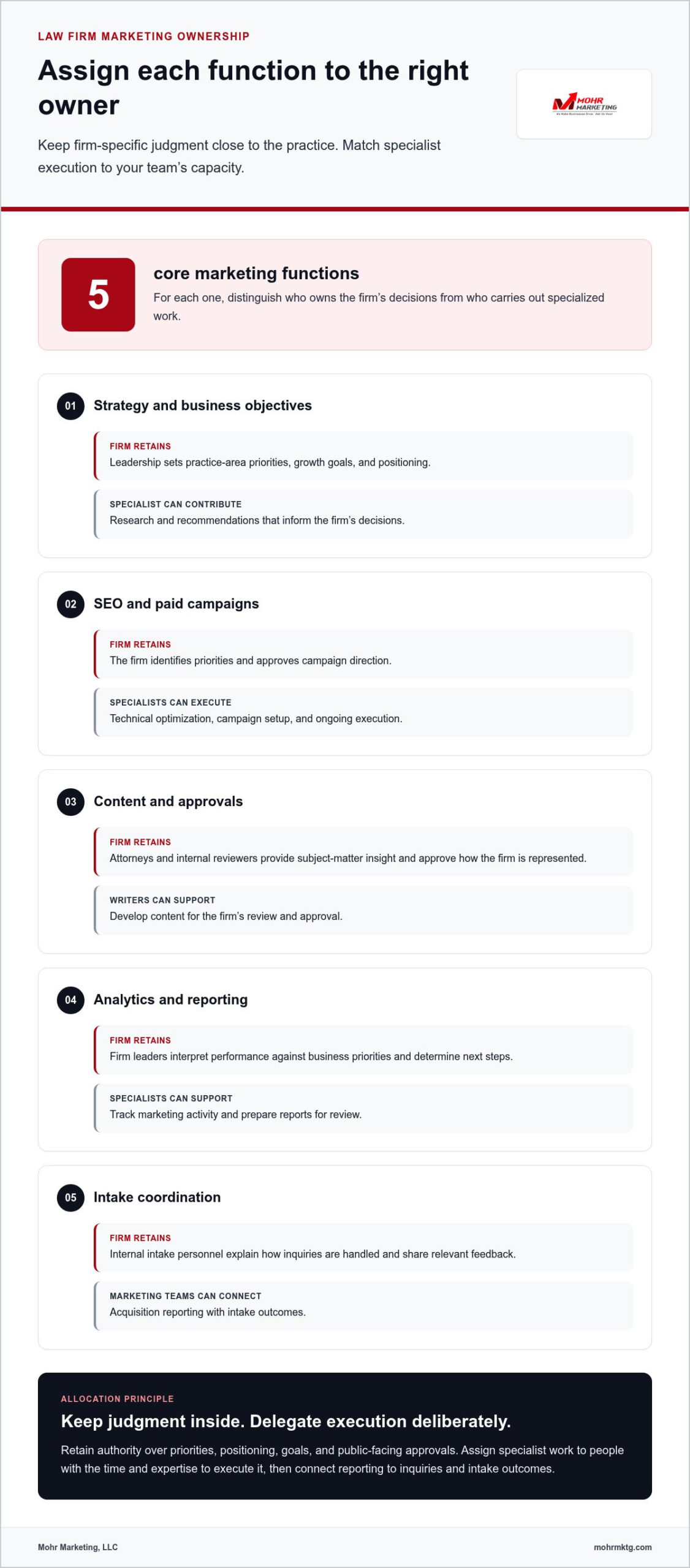
Use this capability matrix to assign responsibility. It distinguishes decisions the firm should retain from work that may be delegated:
- Strategy and business objectives: Firm leadership sets practice-area priorities, growth goals, and positioning. A specialist can contribute research and recommendations.
- SEO and paid campaigns: The firm identifies priorities and approves direction. Outside specialists can handle technical optimization, campaign setup, and ongoing execution.
- Content and approvals: Attorneys and internal reviewers provide subject-matter insight and approve how the firm is represented. Writers can help develop content for review.
- Analytics and reporting: Specialists can track activity and prepare reports. Firm leaders interpret performance against business priorities and determine next steps.
- Intake coordination: Internal intake personnel explain how inquiries are handled and share relevant feedback. Marketing teams can connect acquisition reporting with intake outcomes.
Which marketing decisions should the firm retain?
Keep authority over which practice areas to prioritize, how the firm is positioned, what goals matter, and who approves public-facing messages. Attorneys contribute legal and practice-area knowledge; intake personnel provide context on how inquiries are handled. This collaboration helps keep messaging accurate and aligned with the client experience. Clear internal ownership matters because an outside specialist cannot replace the firm’s judgment about its services, relationships, or growth priorities.
When can outside specialists add useful capacity?
Outside support can help when internal staff lack the time, technical expertise, or consistent capacity to execute a campaign. SEO requires ongoing work with site structure, content, and search visibility. Paid media involves campaign management and performance review. A specialist can carry out these activities against agreed priorities, while the firm retains approval and oversight.
Keep the boundary clear: campaign execution is not legal advice or case evaluation. Marketing specialists can report on campaign activity and inquiry patterns, but decisions about legal representation and whether a matter fits the firm remain with the firm. In-house vs outsourced law firm marketing works best when every function has an accountable owner and reporting connects activity to inquiry and intake outcomes.
To map responsibilities for a law firm marketing program, discuss your marketing and intake priorities with Mohr Marketing.
In-House vs. Outsourced Law Firm Marketing: Compare Total Investment and Accountability
A fair comparison looks beyond payroll or an agency invoice. In-house capacity involves staffing, tools, training, and management time. Outsourced support also requires a defined scope, onboarding, coordination, and review. The right comparison depends on what your firm needs done and what the engagement covers.
| Cost or responsibility | In-house model | Outsourced model |
|---|---|---|
| Labor and benefits | Compensation-related overhead, recruiting, and time to fill or replace roles. | Fees defined by the agreed scope, plus internal time spent coordinating the work. |
| Tools and technology | The firm selects, maintains, and trains staff to use marketing technology. | Responsibility depends on the engagement; clarify which tools are included and who manages access. |
| Training and ramp-up | Staff need time to learn the firm, its practice areas, and assigned marketing functions. | Onboarding requires sharing context, priorities, and approval processes with the provider. |
| Management and review | Leaders assign work, supervise staff, and review deliverables. | The firm still provides direction, feedback, approvals, and internal review. |
| Specialist coverage | Coverage depends on the skills and capacity of employees the firm has hired. | Specialist execution may be available within the agreed scope, but the firm retains decision authority. |
| Continuity and firm knowledge | Internal staff can build ongoing familiarity, though continuity depends on retaining and developing the team. | Knowledge must be transferred and maintained through clear documentation and regular communication. |
What belongs in a complete cost comparison?
For an internal team, account for compensation-related overhead, recruiting, training, marketing technology, and the management time needed to set priorities and review work. For an external engagement, assess the scope, onboarding, coordination, reporting, and internal review it requires. Neither structure eliminates management work. Compare what each model delivers against the needs and responsibilities defined for that arrangement.
How should firms evaluate marketing performance?
Separate activity from business outcomes. Website updates, content production, and campaign activity show what was done. On their own, they do not establish whether marketing is reaching qualified prospects or supporting intake.
Before work begins, define what counts as a qualified inquiry, who owns reporting, and how often performance will be reviewed. Then examine the path from inquiry through intake progress to signed-case outcomes, while accounting for the firm’s role in responding to and assessing inquiries. This gives the firm a clearer basis for reviewing both internal and outsourced work. For a closer look at the connection between intake and outcomes, see ROI of legal intake services.
How to Choose an In-House, Outsourced, or Hybrid Model for Your Firm
The right structure depends on what your firm needs marketing to accomplish, what your current team can sustain, and how much oversight the work requires. Use this decision process to identify where to build capacity and where to bring in outside support.
- Define the outcomes. Identify what marketing should support over your planning horizon, such as developing a practice area, increasing qualified inquiries, strengthening intake coordination, or improving visibility into signed-retainer outcomes. Set priorities before choosing a staffing model.
- Inventory internal capacity. List existing skills, available time, decision-makers, approval steps, and reporting needs. A staff member may understand the firm well but lack the time or specialist experience to manage every campaign function.
- Rank capability gaps. Separate essential expertise from tasks the firm can already manage. Prioritize gaps by their importance to business goals rather than adding roles or outsourcing functions by default.
- Choose ownership and execution. Consider an internal hire when ongoing coordination, institutional knowledge, and daily oversight are central needs. Consider outside support when specialized execution or consistent campaign capacity is the main gap. Use a hybrid model when the firm needs both internal direction and external expertise.
- Set the oversight model. Define who approves priorities and messaging, who handles execution, and how reporting will connect campaign activity with inquiry quality, intake progress, and signed cases. Review the arrangement as goals or capacity change.
What questions reveal the right marketing structure?
Ask what business outcomes marketing must support, which staff have the relevant skills and time, and who can approve work without creating delays. Determine what information leadership needs to review performance, including how inquiries move through intake. These answers show whether the primary gap is ownership, capacity, specialist expertise, or a combination.
How can a hybrid model preserve control and add capacity?
Outsourcing does not require surrendering strategic control. Firm leaders can retain ownership of positioning, practice-area priorities, approvals, and client relationship knowledge while delegating selected execution and reporting. Set collaboration points so attorneys and intake staff can provide relevant context. As internal capacity and business needs evolve, adjust which tasks stay with the firm and which receive outside support.
Judge the model by whether it creates clear accountability from marketing activity through inquiry and intake outcomes, not by whether every task sits under one roof. A tailored structure can keep firm judgment close while adding capacity where it is needed.
Build a More Accountable Law Firm Marketing System with the Right Partner
A marketing relationship is accountable when both sides know who owns each decision, what work will be delivered, and how progress will be reviewed. Set shared objectives before work begins. Assign the firm responsibility for priorities, approvals, legal decisions, and client relationships. Define the partner’s execution and reporting responsibilities, then establish a review cadence that connects campaign activity with inquiry quality and intake progress.
What should a law firm expect from an accountable marketing relationship?
Agree on reporting definitions in advance. For example, distinguish general inquiries from those that meet the firm’s agreed criteria, then track how they progress through intake and, where relevant, to signed retainers. Specify who verifies and reports each stage, and use review meetings to identify gaps rather than relying on activity metrics alone. Leadership retains control of legal decisions and client relationships throughout.
This structure makes the in-house vs outsourced law firm marketing decision easier to manage. An outside partner can support acquisition and intake without taking ownership of the firm’s strategy or judgment. The firm can assess whether execution and reporting support its objectives, then adjust responsibilities as needs change.
How can specialized legal marketing support fit the firm’s model?
Mohr Marketing is a legal and healthcare marketing partner founded in 1994, with more than 30 years of industry experience. Its services include managed SEO, PPC, and social media campaigns, along with verified legal inquiries, signed retainers, and legal intake support. These services can complement internal leadership by extending campaign execution and connecting acquisition activity with intake outcomes. The right scope depends on the firm’s goals and operating model.
For firms assessing mass tort acquisition, the related article “Mass Tort Lead Generation: A Roadmap to Scalable Growth in 2026” offers additional context. Law firms exploring signed-case acquisition can also review Mohr Marketing’s signed retainer marketing support.
Build the relationship around clear ownership, useful reporting, and regular review. Measure progress against the outcomes that matter to your firm, from verified inquiries and intake movement to signed retainers where applicable. No single structure fits every practice. The objective is a system that supports your growth goals while keeping firm judgment where it belongs.
Discuss your firm’s marketing model and growth objectives with Mohr Marketing.
Build a Marketing Model That Moves Your Firm Forward
The right in-house vs outsourced law firm marketing model is not defined by headcount. It is defined by clear ownership, the capabilities your goals require, and accountability for how marketing supports qualified inquiries, intake progress, and signed cases. Keep firm-specific judgment and client relationships under internal leadership. Delegate specialist execution where it adds needed capacity.
Compare the full commitment of each model, including staff time, tools, training, coordination, and oversight. Then set shared objectives, reporting expectations, and review processes so you can assess performance against meaningful business outcomes. A hybrid structure can preserve strategic control while adding outside expertise.
Founded in 1994, Mohr Marketing brings more than 30 years of industry experience. Its support includes managed SEO, PPC, and social media, as well as verified legal inquiries, signed-case offerings, and legal intake support. The right mix depends on your firm’s growth objectives and internal resources.
With clear roles and outcome-focused reporting, your firm can build a marketing system that supports growth while keeping decision-making where it belongs.
Frequently Asked Questions
Is in-house or outsourced marketing better for a law firm?
Neither model is right for every law firm. The choice depends on goals, internal capacity, and required expertise. In-house teams offer close access to firm knowledge and direct oversight. Outsourced specialists can add focused execution capacity. When comparing in-house vs outsourced law firm marketing, identify who will own strategy, carry out the work, coordinate with intake, and report on outcomes. A hybrid model can combine internal direction with outside expertise.
Can a law firm use both in-house and outsourced marketing?
Yes. A law firm can keep strategic decisions and firm-specific knowledge internal while outsourcing selected execution. For example, firm leaders may set practice-area priorities and approve messaging, while external specialists manage SEO or paid campaigns. Attorneys can contribute subject-matter insight, and intake staff can share feedback on inquiries. Define responsibilities and collaboration points so internal and external teams work toward the same objectives.
How should a law firm compare the cost of in-house and outsourced marketing?
Compare the full commitment of each model, not just salary against an agency fee. For internal staffing, include compensation-related overhead, recruiting, training, technology, and management time. For outsourced work, consider the agreed scope, onboarding, coordination, reporting, and internal review. Assess the specialist capabilities each option provides and the work left for the firm. The appropriate comparison depends on the firm’s needs and the responsibilities included.
Does outsourcing law firm marketing mean losing control of the firm’s brand?
No. Outsourcing execution does not require transferring control of positioning, priorities, or approvals. Firm leadership can set brand direction, provide practice-area context, and review public-facing messages, while a marketing partner carries out agreed work. Establish approval authority and a clear process for sharing feedback before campaigns begin. This allows outside support to contribute expertise while the firm retains ownership of how it represents its services and client relationships.
How can a law firm measure whether outsourced marketing is working?
Measure progress against agreed business objectives, not activity alone. Reports on campaign tasks or website engagement can show what was done, but firms should also define how they will assess qualified inquiries, intake progress, and signed-case outcomes where relevant. Agree on definitions, reporting ownership, and review intervals in advance. Consider how the firm’s intake process affects the path from inquiry to signed retainer when interpreting results.
What should law firms consider about advertising compliance when outsourcing marketing?
Make review and approval part of the engagement. The firm should identify who checks proposed claims, messaging, and campaign materials against the requirements that apply to its practice and jurisdictions before publication. Share approved guidance with the marketing partner, define who can authorize changes, and document the review process. External execution does not replace the firm’s responsibility to oversee how its services are represented in advertising. To discuss a marketing and intake model for your firm, contact Mohr Marketing.

Recent Posts
- In-House vs. Outsourced Law Firm Marketing in 2026
- Signs You Need a New Lead Generation Partner: A Law Firm Guide
- How to Find Plaintiffs for Mass Tort Cases: A Practical Guide
Categories
- AI and Lead Generation
- Business Financing
- Call Verified MVA Leads
- Car Accident Help
- Car Accident Settlements
- Claimant Funding
- Compliance Program
- EMS-EMT Reports
- Geotargeting
- Google Maps Ranking
- Healthcare Practice Growth
- Law Firm Growth
- Law Office Operations
- Lead Generation
- Lead Generation For Attorneys
- Lead Generation For Chiropractors
- Lead Generation For Criminal Attorneys
- Lead Generation For D&A Treatment Centers
- Lead Generation For DUI Attorneys
- Lead Generation For Eye Doctors
- Lead Generation For Family Law Practices
- Lead Generation For PI Law Firms
- Lead Generation For Plastic Surgeons
- Leads For Healthcare Professionals
- Leads For Insurance Industry
- Legal Leads
- Legal Marketing
- Legal Updates
- Mass Tort Leads
- Medicare and Medicaid Leads
- Merchant Funding Leads
- Mold Leads
- Online Marketing Strategies
- Pre-Settlement Funding
- Signed MVA Cases
- Tort Updates
- Truck Accident Leads and Signed Cases
- Truck Accident Settlements
- Web Design