Signs You Need a New Lead Generation Partner: A Law Firm Guide
October 1, 2026 by Mohr Marketing
What if the leads aren’t the problem, but the process that follows them? The signs you need a new lead generation partner go beyond inconsistent volume or a disappointing report. If inquiries aren’t tracked through qualification, intake, and signed cases, it’s difficult to tell whether your partner is limiting growth or your internal process is losing opportunities.
That distinction matters. Replacing a partner before diagnosing the bottleneck can disrupt a working acquisition channel, while staying with an underperforming one can drain time and resources. Assess lead quality against your firm’s case criteria, connect marketing activity to downstream outcomes, and examine how promptly and consistently your team follows up. Then use the evidence to decide whether to correct the process, renegotiate expectations, or replace the relationship. The goal is accountable acquisition support that fits your practice and priorities, not lead volume for its own sake.
Key Takeaways
- Look for recurring gaps in agreed lead volume, targeting, or practice-area fit. One weak period alone doesn’t establish a pattern.
- Trace each inquiry from campaign source through contact, qualification, and final disposition to locate where opportunities are being lost.
- Use consistent definitions and a scorecard to assess the signs you need a new lead generation partner, including verification, reporting, communication, and outcomes.
- Before making a change, document a baseline and set clear review criteria, reporting expectations, responsibilities, and escalation steps.
- Choose a replacement based on the diagnosed failure and your firm’s case criteria, not on promises of higher lead volume alone.
Signs Your Lead Generation Partner Is Missing the Mark
A single weak period doesn’t prove your lead generation partner is failing. Campaigns can fluctuate, and a short-term dip may have several causes. Stronger evidence includes recurring gaps between documented expectations and what the firm receives: inconsistent delivery, poor practice-area fit, inquiries outside agreed targeting, or reports that don’t show quality and disposition. Look for a pattern, then investigate it using consistent records.
Because lead generation covers how prospective clients are identified and attracted, the practical test for a law firm is whether delivered inquiries align with defined case criteria and can be tracked beyond initial delivery.
When lead quality and fit consistently fall short
Compare each inquiry with the firm’s written criteria, including practice area, relevant case characteristics, and geographic eligibility. Record mismatches by source, campaign, practice area, and final disposition. A recurring stream of inquiries outside those parameters points to a targeting or qualification issue. By contrast, an inquiry that met the agreed criteria but didn’t become a case may reflect case evaluation, client readiness, or follow-up. Don’t classify every unsigned inquiry as a bad lead.
When volume, visibility, or accountability remains unpredictable
Compare delivery patterns with documented expectations and note campaign changes that could explain a shift. Check whether reports identify each inquiry’s source, verification status, contact status, qualification result, and disposition. If the report provides only a total, the firm can’t tell whether the issue is volume, fit, or what happened after delivery. Request consistent fields and definitions before drawing conclusions.
Look for repeated shortfalls, not isolated variation. An occasional inquiry outside a defined case profile calls for review; the same mismatch recurring across reports, without a documented targeting change, is stronger evidence of a partner-side problem. Unexplained volume swings also warrant investigation, but don’t establish fault on their own. Verify the pattern against campaign activity, delivery records, and the firm’s intake outcomes.
Use this test: recurring, documented deviations from agreed criteria are evidence; a single fluctuation is a signal to investigate. If the partner’s reporting hides inquiry quality or disposition, that lack of visibility is itself an accountability gap. It may not prove poor acquisition, but it prevents the firm from evaluating performance with confidence.
Diagnose the Lead Generation Partner or the Firm’s Intake Process
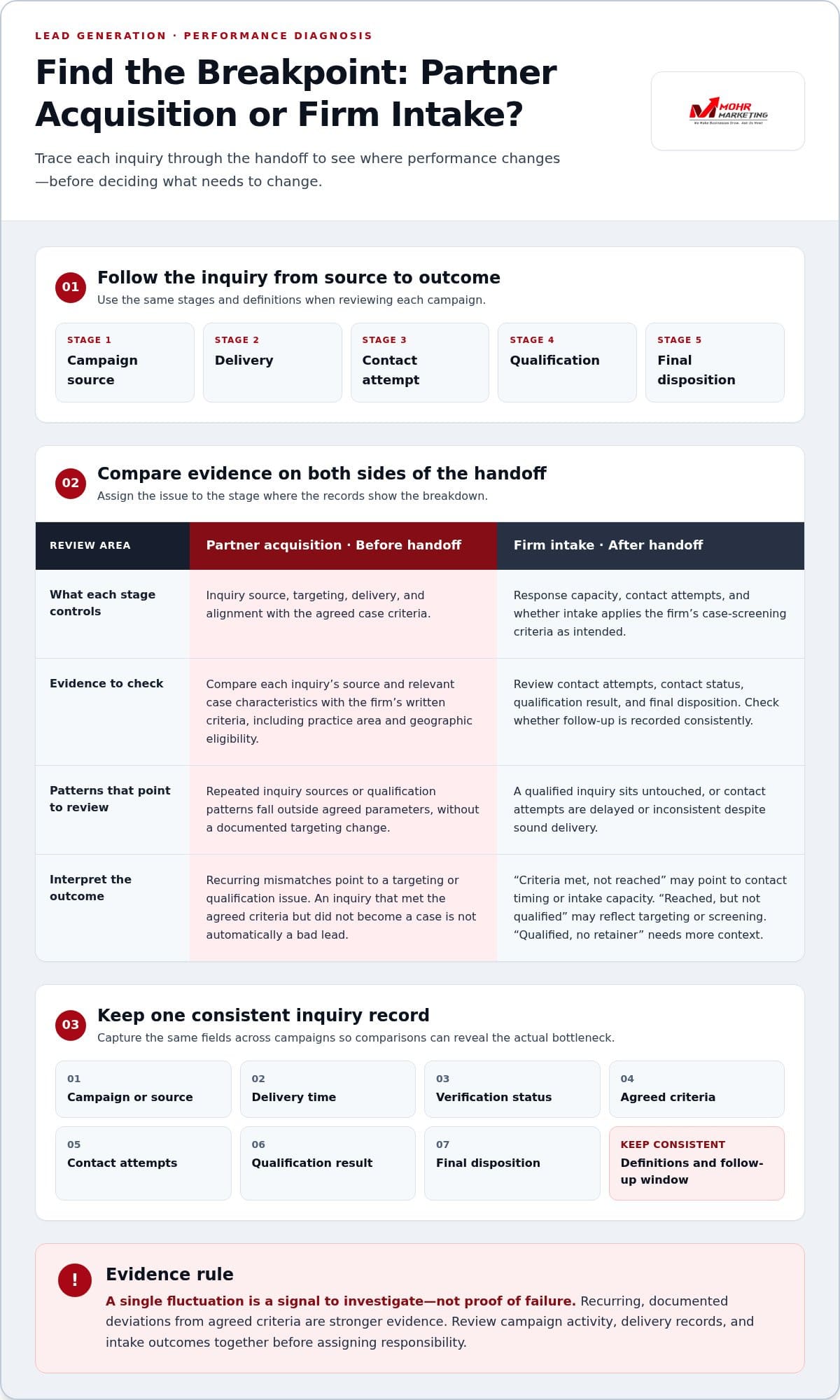
A missed opportunity can start before an inquiry reaches your firm or after it enters the intake queue. Separate those stages before deciding whether the acquisition partner is responsible. Map each inquiry from campaign source through delivery, contact attempt, qualification, and final disposition. The pattern should show where performance changes, not simply whether a lead eventually signed.
Trace each inquiry from source to disposition
Use a consistent record for every inquiry. Capture the campaign or source, delivery time, verification status, relevant agreed criteria, contact attempts, qualification result, and final disposition. Review the same fields and follow-up window across campaigns. If one campaign’s “qualified lead” means something different from another’s, comparisons won’t identify the actual bottleneck.
Keep definitions stable. Distinguish “criteria met, not reached” from “reached, but not qualified” and “qualified, no retainer.” The first may point to contact timing or intake capacity; the second may reveal a targeting or screening mismatch; the third needs more context before responsibility can be assigned. Avoid changing labels in ways that make results appear better or worse.
Identify whether the bottleneck sits before or after handoff
Start with what the provider can control: source, targeting, delivery, and whether inquiries align with agreed criteria. Then examine what happens after handoff: whether the firm has capacity to respond, whether contact attempts are recorded consistently, and whether intake staff apply the firm’s case-screening criteria as intended. A qualified inquiry that sits untouched suggests a different problem from a delivered inquiry that repeatedly misses the agreed profile.
Review stalled cases with both sets of records side by side. If delivery appears sound but contact attempts are delayed or inconsistent, investigate the firm’s intake workflow before replacing the partner. If inquiry sources or qualification patterns repeatedly fall outside agreed parameters, focus the review on acquisition. Conversion depends on both stages. Firms assessing the handoff can also consider how legal intake services support a consistent process.
Legal acquisition also requires attention to how advertising is presented. The Cornell Legal Information Institute’s overview of ethical guidelines for legal advertising provides context for evaluating marketing practices alongside performance. Keep that review distinct from the operational diagnosis: a strong intake process doesn’t resolve acquisition misalignment, and compliant marketing alone doesn’t ensure timely follow-up.
Diagnostic rule: assign responsibility to the stage where the records show the breakdown. That evidence helps distinguish signs you need a new lead generation partner from an internal intake problem and directs the next corrective step.
Evaluate a Lead Generation Partner with Evidence, Not Promises
Once you’ve located where results break down, evaluate the partner against a written scorecard. Use your firm’s documented goals and historical performance as the baseline, not broad industry benchmarks or a partner’s projections. The signs you need a new lead generation partner become clearer when you assess the same criteria consistently over time.
Score the relationship across five areas:
- Targeting: Do inquiries align with the firm’s practice areas and agreed case criteria?
- Verification: Are verification steps and any exclusions explained clearly?
- Reporting: Can the firm trace inquiries from source through disposition?
- Communication: Does the partner explain campaign changes and address documented gaps?
- Agreed outcomes: Are inquiry quality and signed-case results measured against explicit definitions?
Use a simple rating such as meets expectations, needs review, or does not meet expectations, and support each rating with records. This makes the review actionable. A low score for reporting, for example, calls for better visibility; recurring targeting gaps call for a discussion about campaign alignment.
What transparent legal lead reporting should make visible
Reports should show the source, applicable qualification criteria, delivery details, verification status, and current disposition. Ask for plain-language descriptions of how an inquiry is verified and which inquiries are excluded from the agreed definition. Define “qualified inquiry” in terms the firm can apply consistently, rather than relying on a label that may mean something different to each party.
Track signed retainers separately from inquiry delivery. An inquiry is an acquisition-stage measure; a signed retainer is a downstream outcome influenced by qualification and intake as well. Keeping both visible helps the firm assess delivery without confusing it with conversion.
How to compare acquisition models against firm priorities
Compare service models by what they deliver, what the firm manages, and which outcomes are measured. Pay-per-lead centers evaluation on delivered inquiries and their fit with agreed criteria. Pay-per-signed-case focuses on signed retainers, so the firm should understand how that outcome is defined and reported. Managed marketing emphasizes campaign management and performance review. The right comparison depends on the firm’s intake capacity and how much campaign oversight it wants to handle.
Don’t assume a model’s label proves its value. Match its measurement approach to the firm’s growth priorities, then compare results with the baseline. A partner’s promise matters less than clear definitions, verifiable reporting, and evidence tied to the firm’s case criteria.
Plan a Controlled Change Before Replacing a Lead Partner
Once the firm has identified where performance breaks down, make the next step measurable. Replacing a partner without a baseline can make it difficult to determine whether the change fixed the problem or simply shifted it. Set a firm-specific review period, document current performance, and agree on what evidence will trigger a correction, renegotiation, or transition. The signs you need a new lead generation partner should lead to a defined decision, not an abrupt change based on frustration.
Create a decision record and measurable review plan
Summarize the issue, include representative records, and note internal factors already reviewed, such as intake capacity and follow-up consistency. Then set targets based on the firm’s own case criteria and historical performance. Avoid treating a broad industry benchmark as a universal standard for your practice.
Document the plan so both parties can work from the same expectations:
- Criteria: Define the agreed inquiry, qualification, and signed-case measures.
- Reporting: Set the fields and cadence needed to review progress consistently.
- Ownership: Identify who reviews acquisition data, intake activity, and unresolved issues.
- Decision point: Specify when the firm will assess results and decide whether to correct, renegotiate, or transition.
A useful decision record ties each concern to evidence. Note whether a targeting issue appeared repeatedly, which records support that conclusion, and whether campaign changes or internal screening may explain it. This keeps the review focused on causes the next phase can address.
Reduce disruption during a partner transition
If the evidence supports a change, protect continuity before shifting activity. Document campaign information, lead definitions, reporting fields, and the status of open inquiries. Assign clear ownership for each active handoff so prospects don’t fall between teams during the transition. Keep the intake team informed about changes to inquiry sources or qualification criteria, and preserve a consistent method for tracking outcomes.
If the evidence points to a fixable gap, use the review plan to correct the current arrangement before making a final decision. If the same documented failure persists despite clear expectations and responsibility, a controlled transition may be more practical. In either case, judge the next phase against the baseline and the firm’s priorities, not a promise of more volume alone.
For information about Mohr Marketing’s legal acquisition services, visit the Mohr Marketing contact page.
Choose a Lead Generation Partner Built for Legal Acquisition
A replacement should solve the failure your review identified, not simply promise a larger volume of leads. If the issue was poor practice-area fit, prioritize alignment with your firm’s case criteria. If qualified inquiries stalled after delivery, examine intake support and handoff. The signs you need a new lead generation partner matter when they point to a capability the next partner can address and the firm can measure.
Match the partner’s capabilities to the firm’s acquisition goals
Before discussing execution, define the practice area, qualifying case characteristics, and delivery model the firm needs. Then match the service to the gap: inquiry acquisition can support a firm seeking prospective cases, signed retainers can align with a focus on retained matters, and managed marketing can address a need for campaign management. These are distinct approaches. Compare what each delivers and how performance will be reported against the firm’s priorities.
Mohr Marketing serves legal and healthcare practices and brings more than 30 years of industry experience. Its legal acquisition offerings include verified inquiries and signed-case options, as well as legal intake services and managed digital marketing. The company’s specialized focus and turnkey marketing and intake ecosystem support firms evaluating acquisition against defined criteria and downstream outcomes. No partner model removes the need to assess fit, reporting, and the firm’s own follow-up process.
Turn the assessment into a practical next conversation
Bring the documented baseline, written qualification criteria, and intake findings to the discussion. Identify which measures should improve, what information the firm needs in reporting, and how acquisition and intake responsibilities will be handled. Clear definitions and transparent verification help both sides evaluate inquiry quality consistently instead of relying on broad claims.
A focused conversation should establish whether the proposed approach addresses the diagnosed bottleneck. If the firm needs qualified inquiries, discuss targeting and verification. If it needs signed retainers, clarify how those outcomes are defined and tracked. If intake is the constraint, include handoff and follow-up requirements in the plan.
Mohr Marketing supports firms seeking accountable legal acquisition through verified inquiries, signed cases, legal intake services, and managed digital marketing. For details about these services, visit the Mohr Marketing contact page.
Make Your Next Acquisition Decision Measurable
The signs you need a new lead generation partner should point to a documented acquisition problem, not just a disappointing stretch. Trace inquiries through intake, compare results with agreed case criteria, and use consistent reporting to decide whether to correct the relationship or move on. The right partner should address the gap you identified, with clear measures for inquiry quality and downstream outcomes.
Mohr Marketing brings more than 30 years of industry experience to legal lead generation, signed-case, and intake services. Its data-driven marketing approach emphasizes verification and transparency, helping firms assess acquisition activity against defined priorities. This gives your team a more disciplined basis for planning growth.
With clear criteria and accountable reporting, your firm can make its next move with greater confidence and focus on sustainable growth.
Frequently Asked Questions
What are the clearest signs you need a new lead generation partner?
The clearest signs are recurring gaps between agreed expectations and delivered results. Examples include inquiries that repeatedly fall outside documented case criteria, inconsistent delivery without clear explanations, or reporting that doesn’t show source, verification status, and disposition. One weak period alone isn’t conclusive. Look for a pattern across consistent records, and check whether campaign changes or internal intake issues could explain the shortfall before deciding to replace the partner.
How can a law firm tell whether poor results come from its partner or intake team?
Trace inquiries from campaign source through delivery, contact attempts, qualification, and final disposition. Acquisition concerns may show up as repeated targeting mismatches or delivery gaps against agreed criteria. Intake concerns may appear when appropriate inquiries aren’t contacted consistently or case screening doesn’t follow the firm’s standards. Use the same definitions for each stage, then compare provider records with the firm’s intake records to identify where opportunities stall.
How often should a law firm review lead generation partner performance?
Set a regular review cadence with the partner and use it consistently, rather than relying on occasional impressions or a single weak period. The right interval depends on the firm’s delivery expectations, campaign activity, and the time needed to assess inquiry outcomes. Review sooner if targeting or campaign plans change, or if a documented issue needs attention. Agree on when results will be assessed and when the firm will decide on next steps.
What should a law firm measure when evaluating a lead generation partner?
Measure performance against the firm’s written goals and agreed definitions. Track inquiry source, delivery, verification status, alignment with case criteria, contact attempts, qualification, and disposition. Review inquiry delivery separately from signed retainers so acquisition activity isn’t confused with downstream conversion. Keep the measures and review window consistent across campaigns. This creates a useful baseline for identifying repeated gaps without relying on unsupported industry benchmarks or changing labels.
Should a law firm replace its lead generation partner if conversion rates are low?
Not automatically. Low conversion can reflect acquisition fit, but it can also result from delayed follow-up, limited intake capacity, or inconsistent screening. First compare inquiry quality with the firm’s criteria, then examine contact and disposition records. If evidence shows recurring acquisition failures despite clear expectations, consider correction, renegotiation, or replacement. If the breakdown occurs after handoff, address intake before concluding the partner is responsible.
How can a firm change lead generation partners without disrupting lead flow?
Plan the transition before changing campaigns or handoffs. Document campaign information, lead definitions, reporting fields, active inquiries, and each inquiry’s status. Assign clear ownership for open follow-ups so no prospect is left without a responsible team member. Coordinate timing and communication between the current and incoming workflows, and keep the intake team informed about changes to sources or qualification criteria. Continue tracking outcomes consistently through the transition.
What should a legal lead generation partner explain about verification?
A partner should explain in plain language what verification means for the specific inquiry, which checks are performed, how the firm’s agreed criteria are applied, and what exclusions affect reporting. The firm should be able to see verification status alongside source and disposition, rather than receiving only a total lead count. Use consistent definitions in reports. Mohr Marketing describes its legal inquiries and signed-case offerings as verified, supporting a transparent, criteria-focused review.

Recent Posts
- Signs You Need a New Lead Generation Partner: A Law Firm Guide
- How to Find Plaintiffs for Mass Tort Cases: A Practical Guide
- Ozempic Lawsuit Leads: A 2026 Guide for Law Firms
Categories
- AI and Lead Generation
- Business Financing
- Call Verified MVA Leads
- Car Accident Help
- Car Accident Settlements
- Claimant Funding
- Compliance Program
- EMS-EMT Reports
- Geotargeting
- Google Maps Ranking
- Healthcare Practice Growth
- Law Firm Growth
- Law Office Operations
- Lead Generation
- Lead Generation For Attorneys
- Lead Generation For Chiropractors
- Lead Generation For Criminal Attorneys
- Lead Generation For D&A Treatment Centers
- Lead Generation For DUI Attorneys
- Lead Generation For Eye Doctors
- Lead Generation For Family Law Practices
- Lead Generation For PI Law Firms
- Lead Generation For Plastic Surgeons
- Leads For Healthcare Professionals
- Leads For Insurance Industry
- Legal Leads
- Legal Marketing
- Legal Updates
- Mass Tort Leads
- Medicare and Medicaid Leads
- Merchant Funding Leads
- Mold Leads
- Online Marketing Strategies
- Pre-Settlement Funding
- Signed MVA Cases
- Tort Updates
- Truck Accident Leads and Signed Cases
- Truck Accident Settlements
- Web Design