How to Find Plaintiffs for Mass Tort Cases: A Practical Guide
October 1, 2026 by Mohr Marketing
More inquiries do not necessarily mean more viable plaintiffs. Learning how to find plaintiffs for mass tort cases starts with a precise claimant profile, not a broad campaign. If outreach does not reflect the litigation’s criteria, your team may spend valuable time screening people who do not fit the case.
That is a familiar challenge for firms building a mass tort pipeline. You need enough reach to connect with the right population, but volume alone will not show whether inquiries are relevant, verifiable, or ready for intake. You also need a clear basis for deciding whether to manage acquisition internally or work with a specialist partner.
This guide explains how to define an actionable claimant profile, choose outreach channels that fit the audience, and assess inquiry quality before investing further resources. It also covers practical questions for evaluating a partner’s sourcing, verification, intake handoff, and reporting. Finally, it explains why firms should ask counsel to review campaign processes for applicable advertising requirements. The aim is a disciplined approach that aligns case criteria, audience intent, and inquiry review from the start.
Key Takeaways
- Learn how to find plaintiffs for mass tort cases by starting with counsel-defined criteria and distinguishing claimant acquisition from class action recruitment.
- Build a practical claimant profile by mapping exposure details and the questions potential claimants use when searching for information.
- Compare firm-run campaigns, specialist partners, and existing firm audiences by control, tracking, verification, workload, and reporting.
- Use a consistent inquiry review process, and remember that verification does not establish that a person has a legally valid claim.
- Assess acquisition partners against clear screening, handoff, reporting, and issue-resolution criteria, then set review checkpoints for any pilot.
How to Find Plaintiffs for Mass Tort Cases Starts with Case Fit
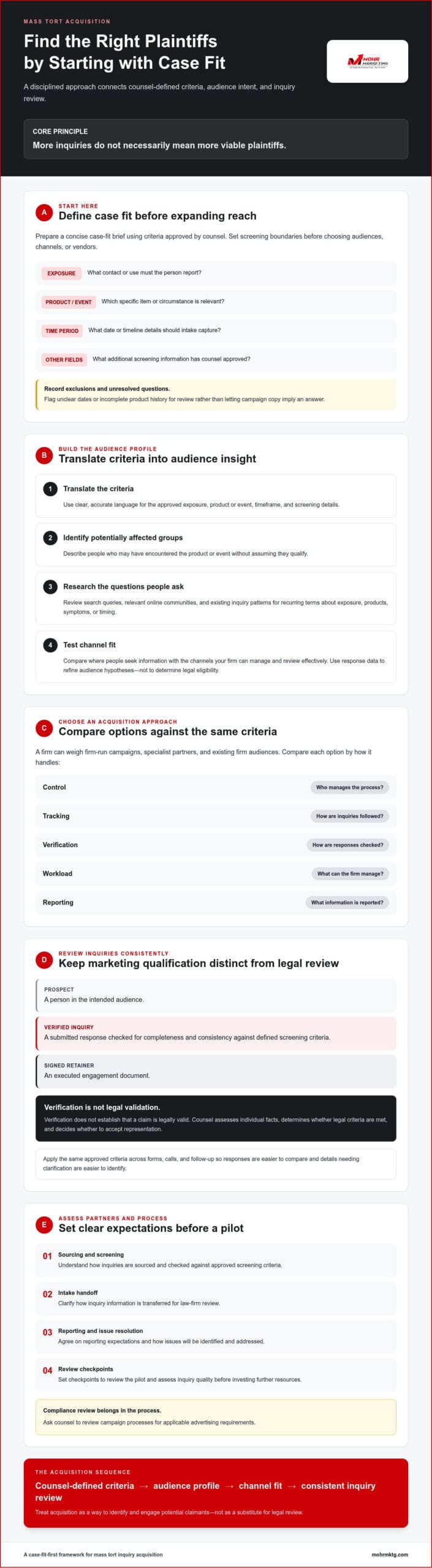
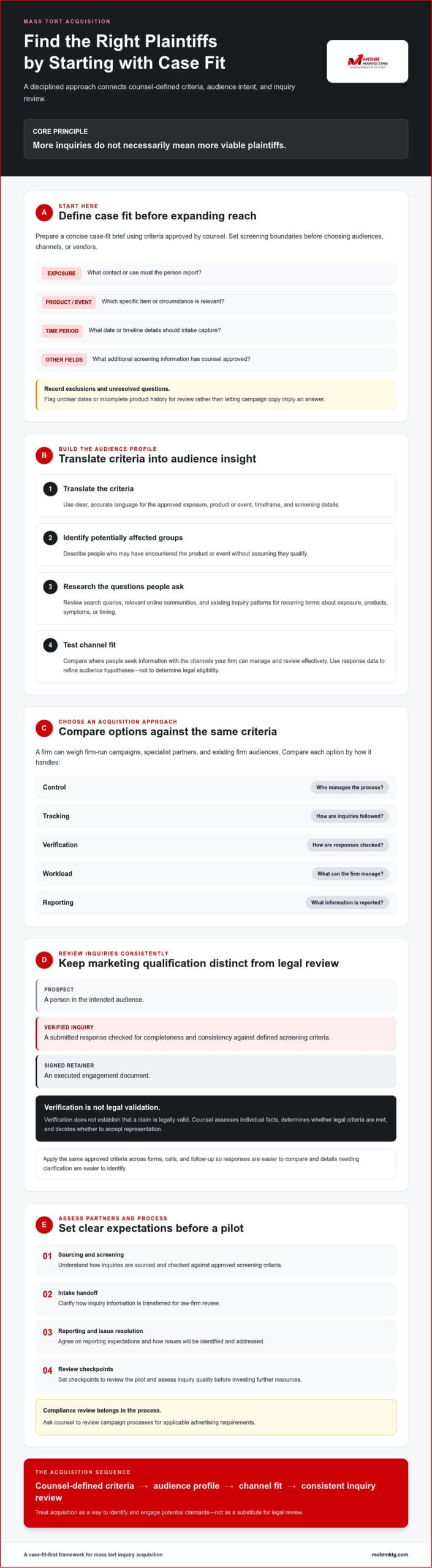
Effective acquisition begins with fit, not reach. First define who may match counsel-approved criteria. Then plan how to reach that audience and capture inquiries for review. This differs from class action recruitment: mass tort cases generally involve individual claims connected to a common product or event, while class actions proceed on behalf of a defined group. The procedures and questions for assessing potential participants differ. A neutral overview of a mass tort can help clarify the distinction.
Lead volume alone does not confirm legal eligibility, the merits of an individual claim, or whether a law firm will offer representation. Treat acquisition as a way to identify and engage potential claimants, not as a substitute for legal review. Before choosing audiences, channels, or vendors, prepare a concise case-fit brief that sets the campaign’s screening boundaries.
What does finding plaintiffs for a mass tort case involve?
The process moves from audience discovery to inquiry capture and then to law-firm review. Marketing may identify people who report relevant exposure or product use and collect responses to approved screening questions. That is a marketing qualification step, not legal analysis. Counsel determines whether a person meets legal criteria and whether to accept representation. For example, an inquiry may report product use during a relevant period, but counsel still needs to assess the individual facts.
Use these terms precisely: A prospect is a person in the intended audience. A verified inquiry is a submitted response checked for completeness and consistency against defined screening criteria. A signed retainer is an executed engagement document. Verification does not establish that a claim is legally valid.
Which case criteria should a firm define first?
Write down the known criteria before drafting campaign messages. Include the product or event, type of exposure, relevant time period, and any other screening fields counsel approves. Record exclusions and unresolved questions as well. If the firm has not decided how to handle an unclear date or incomplete product history, flag it for review rather than letting campaign copy imply an answer.
- Exposure: What contact or use must the person report?
- Product or event: Which specific item or circumstance is relevant?
- Time period: What dates or timeline details should intake capture?
- Other fields: What additional information has counsel approved for screening?
Apply the same approved criteria across forms, calls, and follow-up. Consistent questions make responses easier to compare and help your team spot details that need clarification. Firms considering mass tort signed cases should align the case-fit brief with internal review capacity and confirm campaign-specific criteria before acquisition begins.
Build a Mass Tort Plaintiff Profile Around Exposure and Search Intent
A case-fit brief gives audience research a clear direction. Use it to understand who may be affected, how they describe their experience, and what information they seek. Do not treat online behavior as proof of eligibility. This distinction matters: Mass tort actions involve numerous people harmed by a single act, but each inquiry still needs review against the specific case criteria.
Use this workflow to turn counsel-approved criteria into a practical audience profile:
- Translate the criteria. Identify the approved exposure, product or event, timeframe, and screening details. Use clear, accurate language.
- Identify affected groups. Describe people who may have encountered the product or event without assuming they qualify.
- Research their questions. Review search queries, relevant online communities, and existing inquiry patterns for recurring terms about exposure, products, symptoms, or timing.
- Test channel fit. Compare where people seek information with the channels your firm can manage and review effectively. Use response data to refine audience hypotheses, not to determine legal eligibility.
For example, one person may search for information about a product and a reported health concern, while another may be looking for general medical guidance. Those searches indicate different intent. Campaign language should address the information people seek without promising eligibility, using fear-based messaging, or implying a guaranteed recovery.
How can firms identify where potential plaintiffs are looking?
Look for recurring phrases in search queries, relevant online communities, and prior inquiries. Compare the language people use with the terms in the case-fit brief, then test whether each channel reaches the intended audience. Use these findings to shape a documented acquisition roadmap. Campaign data can show which messages attract relevant questions, but clicks alone cannot establish exposure or claim eligibility.
How should a firm turn case criteria into screening questions?
Translate each approved criterion into a plain-language question with clear response options. Keep initial forms focused on essential details, such as the product or event and an approximate timeframe. Route unclear or complex answers for human review. A case-specific resource, such as mesothelioma lead criteria, can illustrate how a defined case profile informs outreach without replacing counsel’s review.
Consistent wording helps teams compare responses across channels and identify gaps in the audience profile. If your firm is defining a campaign or reviewing its acquisition approach, you can discuss your mass tort acquisition goals with a specialist partner.
Compare Plaintiff Acquisition Channels by Reach, Control, and Verification
The right channel depends on the case population, counsel-approved messaging, and the firm’s capacity to manage inquiries. Search and social campaigns can reach people actively seeking information or engaging with related content. A specialist partner may provide acquisition and intake support. Existing firm audiences offer another route when the firm has an appropriate basis and approved process for communicating with them. No channel guarantees qualified plaintiffs.
Compare the options against the same operational criteria before committing resources:
When should a firm manage plaintiff acquisition internally?
In-house management may suit firms with campaign expertise, access to relevant data, and enough staff capacity to monitor inquiries and optimize activity. It offers direct control and close coordination with counsel over messaging and screening. Before assigning the work internally, account for the full workload: monitoring campaigns, documenting performance, and routing responses for review.
When should a firm evaluate an external acquisition partner?
Consider a partner if internal capacity or specialized acquisition experience is limited. Ask where inquiries originate, how the partner defines a qualified inquiry, and how screening works. Clarify how campaign data, consent records, and unanswered or inconsistent responses are handed off. Establish who contacts inquiries and tracks their progress. Mohr Marketing, LLC provides mass tort leads and signed retainers. Review its mass tort signed-case services against your firm’s criteria and intake capacity.
To assess how to find plaintiffs for mass tort cases, compare channels using consistent definitions and reporting expectations. The useful measure is not reach alone, but whether the channel and handoff process support the firm’s review workflow.
Verify Mass Tort Inquiries and Address Quality and Compliance Risks
A screening process works only when everyone applies it consistently. Set a quality-control sequence for each inquiry: check required fields, compare responses with counsel-approved criteria, flag inconsistencies or missing details, and route uncertain cases for human review. Record the outcome so the firm can distinguish incomplete information from a response that appears outside the screening parameters.
A verified inquiry is not an accepted case. Verification checks whether submitted information is complete and consistent with defined screening criteria. It does not establish legal eligibility, claim merit, or an attorney-client relationship. Counsel must review the individual facts and decide whether to accept representation.
What should firms verify before accepting an inquiry?
Confirm that required fields are present, contact information can be used for follow-up, and stated exposure details align with the approved screening criteria. Do not fill gaps with assumptions. Mark uncertain or incomplete answers for review. If you work with an acquisition partner, agree how duplicate, invalid, and out-of-scope inquiries will be identified, handled, and reported.
Ask for transparent sourcing and a documented handoff standard. The firm should be able to understand where inquiries originated, what checks were performed, which information was collected, and what remains unresolved. Define how duplicate records are matched and how disputed classifications are escalated. Without shared definitions, a reported “verified” inquiry may not mean the same thing to the firm and its partner.
How can firms assess compliance without assuming a universal rule?
Requirements can vary by jurisdiction and campaign. Before launch, have qualified counsel review advertising claims, disclosures, consent language, and follow-up procedures for the relevant jurisdictions. Do not assume a process acceptable in one context applies everywhere.
Review vendor workflows as well. Confirm that the firm can assess the materials and records needed for its review and documentation processes, and clarify who is responsible for flagging potential issues. This guide provides general marketing and intake considerations, not legal advice or a substitute for jurisdiction-specific counsel review.
For firms assessing how to find plaintiffs for mass tort cases, agree on verification standards before inquiries begin. Define the checks, exceptions, documentation, and escalation path in writing, then use those definitions to review internal campaigns and external partners.
Choose a Mass Tort Plaintiff Acquisition Partner and Set Next Steps
A partner should make acquisition easier to evaluate, not harder to inspect. Before selecting one, establish clear terms for how inquiries are sourced, screened, handed off, and reported. Compare those details with your case-fit criteria and your team’s capacity to review and follow up.
What questions should firms ask a potential acquisition partner?
Ask for specific, campaign-level answers. How are audiences identified? Which criteria are applied, and what does “verified” mean in the partner’s process? How are duplicates, incomplete responses, and out-of-scope inquiries identified? Confirm what data and records accompany each handoff, who handles follow-up, and how issues are escalated. Request written service definitions and campaign-specific terms before deciding.
- Source transparency: What channels generate inquiries, and what sourcing information will the firm receive?
- Screening: Which approved criteria are used, and how are uncertain answers flagged?
- Handoff and reporting: What information is transferred, how often are results reported, and how are duplicates handled?
- Issue resolution: Who reviews disputed or invalid inquiries, and how are decisions documented?
Compare service types carefully. An inquiry-based service provides potential claimant information for the firm to review. Signed-retainer acquisition refers to a different deliverable and should be assessed against its own definitions, execution process, and handoff terms. The two are not interchangeable. Mohr Marketing, LLC offers mass tort leads, signed cases, and legal intake services, not legal representation. Firms evaluating mass tort signed cases should confirm current scope and campaign-specific criteria directly.
How can firms start with a measurable acquisition plan?
Begin with one litigation opportunity and document its counsel-approved claimant profile, screening questions, and review workflow. Set baseline measures before a pilot begins, such as inquiry completeness, fit against approved criteria, contactability, and progression to a signed retainer. Agree on review checkpoints with the partner and intake team. Use those discussions to find process gaps before changing audiences or messaging. A pilot helps assess the workflow; it does not guarantee inquiry volume or outcomes.
Use the findings to decide whether the partner’s sourcing, verification, reporting, and handoff meet the firm’s needs. Keep counsel involved in reviewing campaign messaging and applicable requirements. A structured evaluation can show whether specialist support complements internal capacity.
Build a More Disciplined Mass Tort Acquisition Plan
Finding suitable plaintiffs starts with clear, counsel-approved case criteria. Use those criteria to shape an audience profile, select channels that fit the population, and apply consistent screening to every inquiry. Then evaluate partners on transparent sourcing, verification, reporting, and handoff, not reach alone.
A measured approach to how to find plaintiffs for mass tort cases helps firms assess inquiry quality and acquisition options without confusing marketing qualification with legal eligibility. Mohr Marketing, LLC serves law firms nationally with mass tort leads, signed retainers, and legal intake support. The company provides marketing and intake services, not legal representation.
With clear criteria and a review process your team can sustain, you can make informed decisions and build a stronger foundation for your next litigation opportunity.
Frequently Asked Questions
How do law firms find plaintiffs for mass tort cases?
Law firms start by defining counsel-approved case criteria, then use them to identify relevant audiences and select suitable outreach channels. Search and social campaigns, existing firm audiences, and specialist acquisition partners can each contribute. The process continues with inquiry capture, screening against the approved profile, and law-firm review. Marketing can identify potential claimants, but counsel determines legal eligibility and whether to offer representation.
What is the difference between a mass tort lead and a signed case?
A mass tort lead is an inquiry from someone who may fit a litigation’s screening profile and needs review. A signed case generally refers to an opportunity with an executed retainer, though firms should confirm exactly what a provider means by that term. A lead is not automatically eligible or represented, and a signed retainer is not a decision about the ultimate merits of a claim.
How can a law firm identify people who may qualify for a mass tort case?
Translate counsel-approved criteria into a clear profile covering relevant exposure, product or event, timeframe, and other approved screening details. Use these fields to shape campaign audiences and initial questions. Review responses for completeness and consistency, then route uncertain information for human review. Search behavior and initial answers can inform screening, but neither determines legal eligibility. Counsel evaluates each person’s circumstances.
Which marketing channels can reach potential mass tort plaintiffs?
Firms may use search and social campaigns, existing firm audience channels, or a specialist acquisition partner. Search can connect with people actively seeking information, while social campaigns may reach people engaging with related topics. Existing audiences offer another route, subject to the firm’s approved process. Choose channels based on the case population, messaging, tracking needs, verification plan, and staff capacity. No channel guarantees qualified inquiries.
How can firms verify mass tort inquiries before accepting them?
Check that required fields are complete, contact details are usable for follow-up, and stated exposure information aligns with counsel-approved screening criteria. Flag duplicates, inconsistencies, and unanswered questions for review rather than making assumptions. Document how each inquiry is classified and handed off. Verification means information has been checked against defined criteria; it does not establish legal eligibility, claim merit, or acceptance of representation.
What should a law firm ask a mass tort lead generation company?
Ask how audiences are sourced, what screening criteria are applied, and how the company defines and verifies an inquiry. Clarify how duplicates and out-of-scope responses are handled, what data and records accompany a handoff, and who is responsible for follow-up. Request transparent reporting, an issue-resolution process, and written campaign-specific service definitions. Compare the proposed workflow with your firm’s case criteria and intake capacity before proceeding.
Are mass tort advertising and plaintiff outreach subject to state-specific rules?
Applicable attorney advertising and outreach requirements can vary by jurisdiction and campaign. Before launch, have qualified counsel review campaign claims, disclosures, consent language, and follow-up procedures for the relevant jurisdictions. Ask vendors how their workflows support the firm’s review process, but do not treat a vendor’s involvement as a substitute for counsel’s assessment. This general information is not legal advice or a replacement for jurisdiction-specific review.

Recent Posts
- Signs You Need a New Lead Generation Partner: A Law Firm Guide
- How to Find Plaintiffs for Mass Tort Cases: A Practical Guide
- Ozempic Lawsuit Leads: A 2026 Guide for Law Firms
Categories
- AI and Lead Generation
- Business Financing
- Call Verified MVA Leads
- Car Accident Help
- Car Accident Settlements
- Claimant Funding
- Compliance Program
- EMS-EMT Reports
- Geotargeting
- Google Maps Ranking
- Healthcare Practice Growth
- Law Firm Growth
- Law Office Operations
- Lead Generation
- Lead Generation For Attorneys
- Lead Generation For Chiropractors
- Lead Generation For Criminal Attorneys
- Lead Generation For D&A Treatment Centers
- Lead Generation For DUI Attorneys
- Lead Generation For Eye Doctors
- Lead Generation For Family Law Practices
- Lead Generation For PI Law Firms
- Lead Generation For Plastic Surgeons
- Leads For Healthcare Professionals
- Leads For Insurance Industry
- Legal Leads
- Legal Marketing
- Legal Updates
- Mass Tort Leads
- Medicare and Medicaid Leads
- Merchant Funding Leads
- Mold Leads
- Online Marketing Strategies
- Pre-Settlement Funding
- Signed MVA Cases
- Tort Updates
- Truck Accident Leads and Signed Cases
- Truck Accident Settlements
- Web Design