Ozempic Lawsuit Leads: A 2026 Guide for Law Firms
September 30, 2026 by Mohr Marketing
A high count of ozempic lawsuit leads can look like momentum, but volume alone doesn’t show whether inquiries match a firm’s current criteria, include useful supporting information, or are ready for attorney review. Firms need a consistent way to distinguish a genuine opportunity from an unverified marketing claim.
That concern is justified. As of September 1, 2026, federal Ozempic litigation included separate multidistrict litigations involving gastrointestinal injuries and vision loss. The claims and allegations in these cases aren’t proof of liability, and screening criteria may change as litigation develops.
This guide explains how to evaluate lead relevance, check current case context, and connect acquisition quality with intake readiness. You’ll learn the difference between an inquiry, a qualified lead, and a signed case, then build a repeatable review process around your firm’s approved criteria. We’ll also cover how to assess supporting information and align marketing, intake, and case review so decisions rely on verifiable details rather than lead volume alone.
Key Takeaways
- Use a consistent source-check process to distinguish dated court developments from allegations, scientific evidence, and provider interpretation.
- Assess ozempic lawsuit leads by reviewing source transparency, consent records, screening details, delivery timing, and dispute procedures, not volume alone.
- Build an intake checklist around contact details, documented consent, lead source, timing, and firm-approved screening fields.
- Before expanding acquisition, confirm that current criteria, intake capacity, and responsibility for measurement are aligned.
Ozempic Lawsuit Leads in 2026: What Law Firms Need to Know
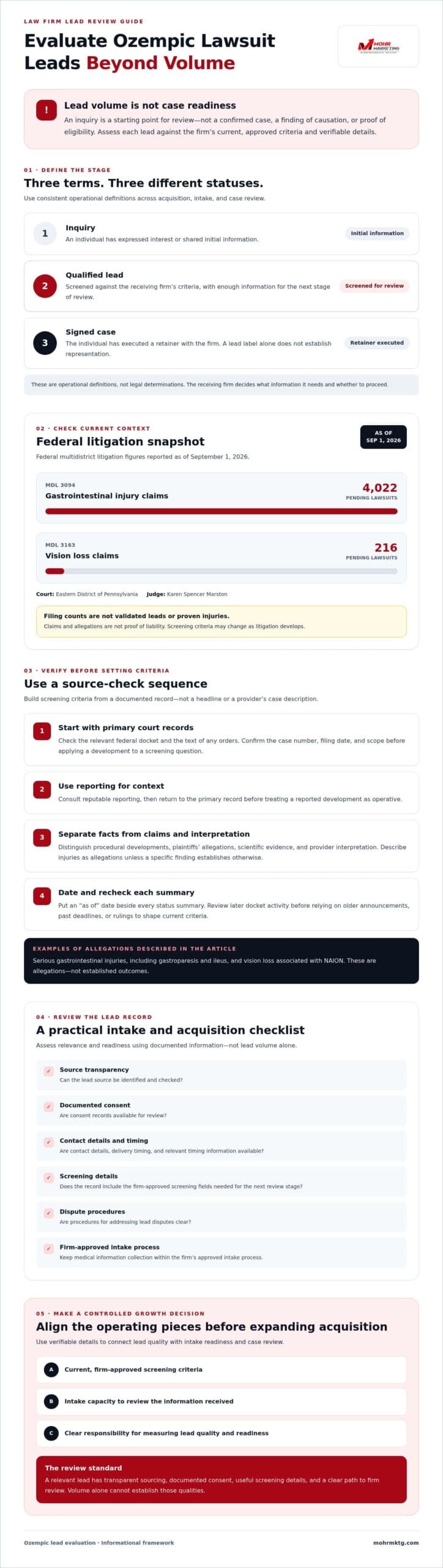
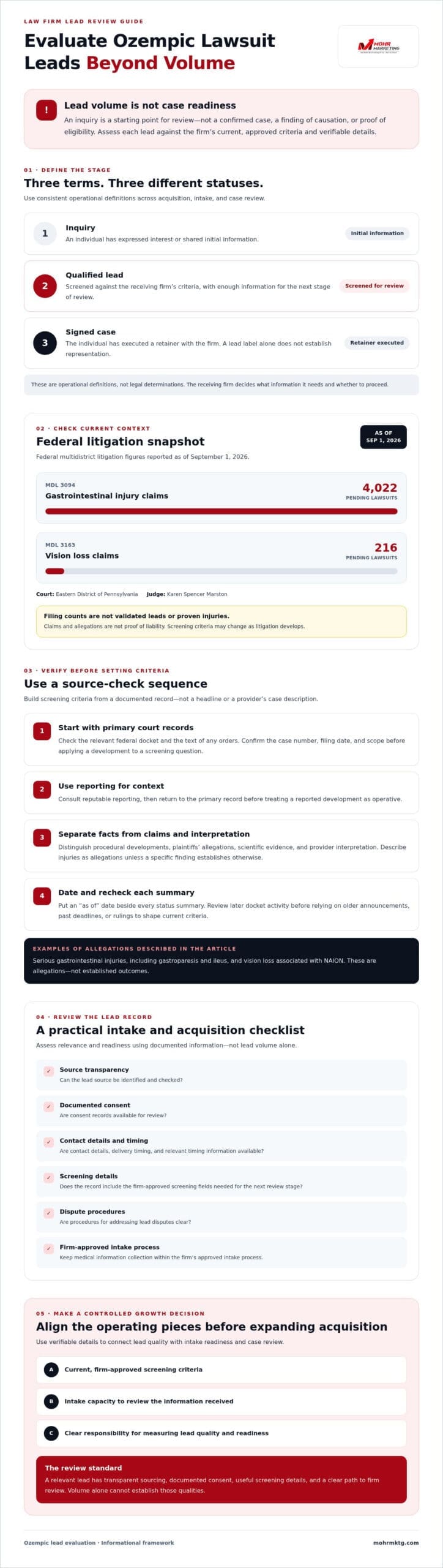
A lead is a starting point for review, not a legal conclusion. For law firms, an Ozempic lawsuit lead is an inquiry that must be assessed against the firm’s current, approved criteria; it is not a confirmed case, a finding of causation, or proof of eligibility. A prospect’s description of an injury is an allegation. It does not establish that Ozempic caused the condition or that a claim has merit.
What does an Ozempic lawsuit lead represent?
Use three distinct terms to keep acquisition and intake reporting consistent:
- Inquiry: An individual has expressed interest or shared initial information.
- Qualified lead: The inquiry has been screened against the receiving firm’s criteria and includes enough information for the next stage of review.
- Signed case: The individual has executed a retainer with the firm. A lead label alone does not establish representation.
These are operational definitions, not legal determinations. The receiving firm decides what information it needs and whether to proceed. Criteria for one matter shouldn’t be assumed to fit another. For example, materials on truck accident signed cases and verified call transfer leads concern a different case category, not Ozempic claims.
Keep medical information collection within the firm’s approved intake process. General background on Semaglutide (Ozempic) can help identify the medication, but it cannot establish an individual’s diagnosis, causation, or legal eligibility.
Which litigation details need a current check?
Litigation status is date-sensitive. As of September 1, 2026, federal multidistrict litigation in the Eastern District of Pennsylvania included MDL 3094 for gastrointestinal injury claims, with 4,022 pending lawsuits, and MDL 3163 for vision loss claims, with 216 pending lawsuits. Both were overseen by Judge Karen Spencer Marston. These figures describe filings, not validated leads or proven injuries.
Before publishing a status summary or setting screening criteria, check the court, docket number, leadership information, and relevant orders against primary court records. Then distinguish procedural developments from plaintiffs’ allegations, scientific evidence, and provider interpretation. For example, lawsuits allege serious gastrointestinal injuries, including gastroparesis and ileus, and vision loss associated with NAION. Describe these as allegations unless a specific finding establishes otherwise.
Put an “as of” date beside every status summary and recheck it before publication. Update internal criteria only after the firm reviews the current record and approves any changes. This helps prevent an outdated announcement or promotional claim from becoming an intake standard.
How to Verify Ozempic Lawsuit Updates Before Setting Lead Criteria
Build screening criteria from a documented record, not a headline or a lead provider’s description of a case. Check primary court records first, use credible reporting for context, and have the firm approve any criteria used in acquisition or intake.
Which sources should a firm check first?
Start with the relevant federal court docket and the text of any orders tied to the issue you’re assessing. A docket entry can show that an event occurred; the order explains what the court directed. Check the case number, filing date, and scope before applying a development to a screening question.
Next, consult reputable reporting for context, then return to the primary record before treating a reported development as operative. A leadership announcement dated April 26, 2024, for example, documents an appointment at that time. It doesn’t, by itself, establish the current leadership structure or case procedures. Treat older firm announcements and promotional claims as starting points for verification, not final authority.
How should firms handle changing claim information?
Separate procedural events from allegations, scientific evidence, and provider interpretation. The reported fact-discovery deadline for certain issues was July 2, 2025, and an August 15, 2025 ruling addressed gastric-emptying studies in certain gastroparesis claims. Before using either point to shape criteria in October 2026, review the actual orders and later docket activity. Don’t summarize a past ruling more broadly than its text supports.
Have counsel or the firm’s designated reviewer approve firm-specific criteria before campaign or intake changes go live. Describe drug-related injuries as allegations unless a finding establishes otherwise. This prevents a claimed association from being presented as proven causation.
Lead criteria should follow current, verified information, then be approved and versioned by the firm. Record each material update in a shared change log with:
- Source and publication or filing date
- Relevant order or docket entry, if applicable
- The specific criteria affected
- Reviewer and approval date
- Version date shared with marketing and intake teams
This creates an audit trail when teams need to explain why a question was added, changed, or removed. Firms assessing how acquisition and intake can work together may also contact Mohr Marketing, LLC to discuss their needs.
How to Compare Ozempic Lawsuit Leads Beyond Volume
Lead counts don’t show what a firm can verify or how much work remains before attorney review. Compare providers by the records behind each inquiry: where it came from, what consent documentation accompanies it, which screening fields were collected, when it will be delivered, and how duplicate or disputed records are handled.
What evidence should a lead provider explain?
Ask for precise definitions rather than broad claims. “Verified” might refer to confirmed contact details, while “qualified” may mean the inquiry matches screening fields. Neither term establishes legal eligibility or case merit on its own. Request appropriately handled sample records or documentation that shows what your team can review.
- Source: How was the inquiry generated, and what channel or campaign details are available?
- Consent: What consent information is captured, and can the firm review its documentation?
- Screening: Which fields are collected, and do they match the firm’s approved criteria?
- Delivery: When is information sent, and what handoff method is used?
- Disputes: How are duplicates, incomplete records, or other disputed items identified and addressed?
Also clarify what “replacement” means in the provider’s terms, including which records qualify and what documentation supports a request. Review definitions before comparing performance. Otherwise, providers may report different things under the same label.
How do leads, call transfers, and signed cases differ?
These deliverables have different handoff and review requirements. An inquiry gives the firm information to assess. A call transfer connects a prospect with the firm, but the receiving team still needs to capture and review relevant details. An executed retainer is a signed document, not a guarantee of a particular outcome. Confirm exactly what is delivered and what the firm still needs to verify.
| Deliverable | What the firm receives | What to confirm |
|---|---|---|
| Inquiry | Initial contact information and any recorded screening details | Source, consent records, fields, timing, and duplicate process |
| Screened lead | An inquiry reviewed against stated screening fields | Field definitions, supporting documentation, and what “screened” means |
| Signed retainer | An executed retainer for firm review | Document completeness, identity match, and the firm’s next review steps |
For firms comparing acquisition models, the mass tort signed cases page describes a distinct deliverable. Apply the same discipline to ozempic lawsuit leads: evaluate documentation and process, not implied conversion or case outcomes. A higher volume may add review work without showing that more inquiries meet the firm’s criteria.
How to Build an Ozempic Lead Review and Intake Checklist
A consistent intake checklist helps the firm assess each inquiry against the same approved process. It also gives marketing, intake staff, and reviewers a shared record of what arrived, what needs follow-up, and who owns the next step. Keep the checklist aligned with current firm criteria. A completed form doesn’t prove that an inquiry qualifies for representation.
Which intake fields support an informed review?
Start with the information needed to identify the inquiry and understand its origin. Collect details only through the firm’s approved intake process, especially medical information. Use firm-approved questions for medication history and reported concerns, and request supporting records only as directed by the firm. The goal is to support review, not promise qualification.
- Contact: Name and preferred contact details, with any verification status recorded.
- Source and consent: Campaign or referral source, how the person learned about it, and available consent documentation.
- Timing: Inquiry receipt date and time, first response, and subsequent contact attempts.
- Screening: Responses to the firm’s approved questions, clearly separated from reviewer conclusions.
- Supporting information: Records received or requested, with their status noted.
- Ownership and disposition: Assigned team member, next action, escalation status, and final outcome code.
For ozempic lawsuit leads, don’t collect additional health details simply because they might be useful later. Limit intake to the firm’s approved questions and route issues requiring legal assessment to the appropriate reviewer.
How should teams manage follow-up and quality feedback?
Assign ownership at each stage. Specify who handles the initial response, who tracks follow-up, and when an inquiry should be escalated for attorney review. Use consistent disposition codes such as “pending contact,” “awaiting requested information,” or “closed after review,” as long as they match the firm’s workflow. Clear codes make later analysis more useful than free-form notes alone.
Review outcomes with marketing on a defined schedule. Share documented patterns, such as missing source details or recurring incomplete fields, but don’t let informal feedback change screening criteria without review. Have the designated reviewer approve changes, then distribute the updated version to everyone handling acquisition and intake. For additional context on improving intake, see this guide to legal intake conversion guidance.
Turn Ozempic Lead Evaluation Into a Controlled Growth Decision
Expand acquisition based on operational readiness, not pressure to increase inquiry volume. Before treating ozempic lawsuit leads as a growth opportunity, confirm that the firm has current, approved screening criteria, documented sourcing expectations, enough intake capacity to review inquiries, and a clear owner for performance measurement. Without those controls, added volume can increase review demands without improving the firm’s ability to assess fit.
When should a firm pause before scaling?
Pause if the team can’t explain which criteria are current, what source or consent records accompany an inquiry, or who resolves questions about those records. Review intake capacity before increasing inquiries or adding a campaign. If legal or compliance questions arise, send them to the firm’s designated reviewers rather than letting marketing or intake staff make informal adjustments.
A measured approach supports consistent screening, clearer accountability, and better visibility into where inquiries stall. It also takes staff time for review and documentation, and tighter criteria may reduce the number of inquiries that move forward. Neither a larger lead count nor a screening label guarantees a signed case or outcome. Measure what the firm can verify, such as documented source information, completion of approved fields, and recorded intake dispositions.
What should a provider discussion establish?
Ask the provider to define each deliverable and explain its verification process, handoff method, available source and consent documentation, reporting, and process for resolving disputed records. Confirm what the firm must review after delivery. Terms such as “qualified” or “verified” aren’t substitutes for clear definitions and documentation the firm can assess.
Confirm campaign fit and availability directly before planning around an Ozempic-specific program. Mohr Marketing, LLC lists mass tort leads, signed retainers, and legal intake services among its offerings, but Ozempic-specific availability must be confirmed. Use the discussion to compare requirements and process, not as a promise of lead volume, case conversion, or results.
A controlled growth decision comes down to four checks: current criteria, documented sourcing, intake capacity, and measurement ownership. If those are in place, the firm can evaluate a potential campaign with defined expectations and a review process. If not, resolve the gaps first.
To discuss your firm’s mass tort lead and intake requirements, contact Mohr Marketing, LLC.
Make Lead Quality a Measured Growth Decision
Strong acquisition starts with current, firm-approved criteria. Verify litigation updates through primary records, assess the documentation behind each inquiry, and distinguish an initial lead from a screened prospect or signed retainer. Then align intake ownership and measurement before expanding activity.
That discipline helps firms evaluate ozempic lawsuit leads without treating volume or a provider’s claims as proof of case fit. Confirm campaign availability directly before considering an Ozempic-specific program.
Mohr Marketing, LLC reports more than 30 years of industry experience. Its listed services include mass tort leads, signed retainers, and legal intake services. A discussion can help firms clarify acquisition and intake requirements, deliverable definitions, and review processes.
With clear criteria and a coordinated review process, your firm can make its next growth decision with greater confidence.
Frequently Asked Questions
Are there Ozempic lawsuits in 2026?
Yes. As of September 1, 2026, federal multidistrict litigation in the Eastern District of Pennsylvania included MDL 3094, concerning gastrointestinal injury claims, with 4,022 pending lawsuits, and MDL 3163, concerning vision loss claims, with 216 pending lawsuits. These counts describe pending lawsuits, not findings of liability or proof that an individual inquiry meets a firm’s criteria. Check current court records before relying on these figures.
What are Ozempic lawsuit leads?
Ozempic lawsuit leads are inquiries from people who may be seeking information about a potential claim involving the medication. A lead is not a confirmed case. An inquiry becomes a screened lead only after review against the receiving firm’s criteria, and a signed case requires an executed retainer. The label itself establishes neither eligibility nor merit. Firms should define these stages clearly so acquisition, intake, and case review teams use consistent terms.
What injuries are alleged in Ozempic lawsuits?
Claims described in litigation allege serious gastrointestinal problems, including gastroparesis and ileus, as well as vision loss associated with non-arteritic anterior ischemic optic neuropathy, or NAION. These are allegations, not proof that Ozempic caused a particular person’s condition or that a court has found liability. Firms should check current claim descriptions and relevant orders, and keep alleged injuries distinct from established medical or legal findings.
How can a law firm verify Ozempic lawsuit leads?
Review each inquiry using the firm’s approved process. Check available contact details, source information, consent documentation, timing, and responses to the firm’s screening questions. Compare those records with current criteria approved by the firm, and route legal or medical questions to the designated reviewer. A provider’s “verified” label isn’t a substitute for supporting documentation. Record the review outcome consistently, and don’t treat a lead as qualified until the firm has assessed it.
Do Ozempic lawsuit leads guarantee a signed case?
No. A lead doesn’t guarantee that a person meets a firm’s criteria, signs a retainer, or has a claim that will succeed. An inquiry may lack information, fall outside the firm’s current screening standards, or require further review. Distinguish lead delivery from a signed retainer in provider discussions and reporting. Ask what the deliverable includes, what documentation accompanies it, and what review remains for the firm before making acquisition decisions.
What should law firms ask an Ozempic lead provider?
Ask how inquiries are generated, what consent records and source details are provided, which screening fields are collected, and what “verified” or “qualified” means. Clarify delivery timing, duplicate handling, dispute procedures, and the exact handoff or deliverable. Request documentation your team can review, not only performance claims. Confirm whether the provider currently supports the relevant campaign before assuming Ozempic-specific lead availability, and compare the process with your firm’s approved criteria and intake capacity.
How should firms respond to changing Ozempic litigation updates?
Check the relevant court docket and orders first, then use credible reporting for context. Separate procedural developments from allegations, scientific evidence, and provider interpretation. Have counsel or the firm’s designated reviewer assess whether an update affects approved screening criteria. Record the source, date, relevant order, reviewer, and any approved change in a shared log. Distribute the current version to marketing and intake teams so outdated criteria aren’t applied informally.
Recent Posts
- Signs You Need a New Lead Generation Partner: A Law Firm Guide
- How to Find Plaintiffs for Mass Tort Cases: A Practical Guide
- Ozempic Lawsuit Leads: A 2026 Guide for Law Firms
Categories
- AI and Lead Generation
- Business Financing
- Call Verified MVA Leads
- Car Accident Help
- Car Accident Settlements
- Claimant Funding
- Compliance Program
- EMS-EMT Reports
- Geotargeting
- Google Maps Ranking
- Healthcare Practice Growth
- Law Firm Growth
- Law Office Operations
- Lead Generation
- Lead Generation For Attorneys
- Lead Generation For Chiropractors
- Lead Generation For Criminal Attorneys
- Lead Generation For D&A Treatment Centers
- Lead Generation For DUI Attorneys
- Lead Generation For Eye Doctors
- Lead Generation For Family Law Practices
- Lead Generation For PI Law Firms
- Lead Generation For Plastic Surgeons
- Leads For Healthcare Professionals
- Leads For Insurance Industry
- Legal Leads
- Legal Marketing
- Legal Updates
- Mass Tort Leads
- Medicare and Medicaid Leads
- Merchant Funding Leads
- Mold Leads
- Online Marketing Strategies
- Pre-Settlement Funding
- Signed MVA Cases
- Tort Updates
- Truck Accident Leads and Signed Cases
- Truck Accident Settlements
- Web Design