Justifying Marketing Investment to Law Firm Partners: A Data-Driven Framework
September 27, 2026 by Mohr Marketing
Marketing spend is difficult to defend when reports stop at clicks, impressions, or website traffic. The more useful question is whether investment is creating qualified opportunities, signed cases, and collected revenue. That is the challenge at the heart of justifying marketing investment to law firm partners, especially when attribution is incomplete and intake performance varies.
Partners are right to expect a clear account of how firm resources are used. Evaluate marketing with the same discipline as other growth investments, not as an overhead line defended with activity metrics alone. A transparent framework connects each stage of the funnel while showing where the evidence is strong and where it remains uncertain.
This article explains how to build that business case. You will learn to compare channels using firm-relevant measures, distinguish lead volume from case outcomes, and account for intake in performance reviews. It also covers how to scope a practical test, agree on review intervals, and define decision criteria before spending begins. The result is a more credible basis for deciding what to continue, adjust, or stop.
Key Takeaways
- Frame marketing as a planned investment tied to firm objectives, not a collection of activity metrics.
- Build a consistent measurement model that tracks inquiries through qualified opportunities, signed retainers, and collected revenue.
- When justifying marketing investment to law firm partners, distinguish process measures from outcomes affected by client decisions and firm capacity.
- Give partners a clear proposal with budget assumptions, tracking methods, review timing, and criteria for continuing or adjusting the investment.
- Evaluate potential marketing partners on matter fit, verification practices, reporting transparency, and alignment with the firm’s intake process.
Why Justifying Marketing Investment to Law Firm Partners Requires a Business Case
Start with a firm objective, not a channel or a report full of activity. A practice seeking a different case mix may need a different plan from one focused on filling available capacity or building sustainable growth. Partners need to know what the investment is intended to change, which assumptions support it, and how results will shape the next decision.
That scrutiny is reasonable. Outcomes are uncertain, attribution can be incomplete, and the time between an inquiry and collected fees can make early results difficult to interpret. Marketing also competes with other uses of firm resources. A defensible business case acknowledges these constraints rather than relying on generic promises. Evaluate the available evidence against the firm’s objectives, capacity, and assumptions.
What law firm partners need to see before approving spend
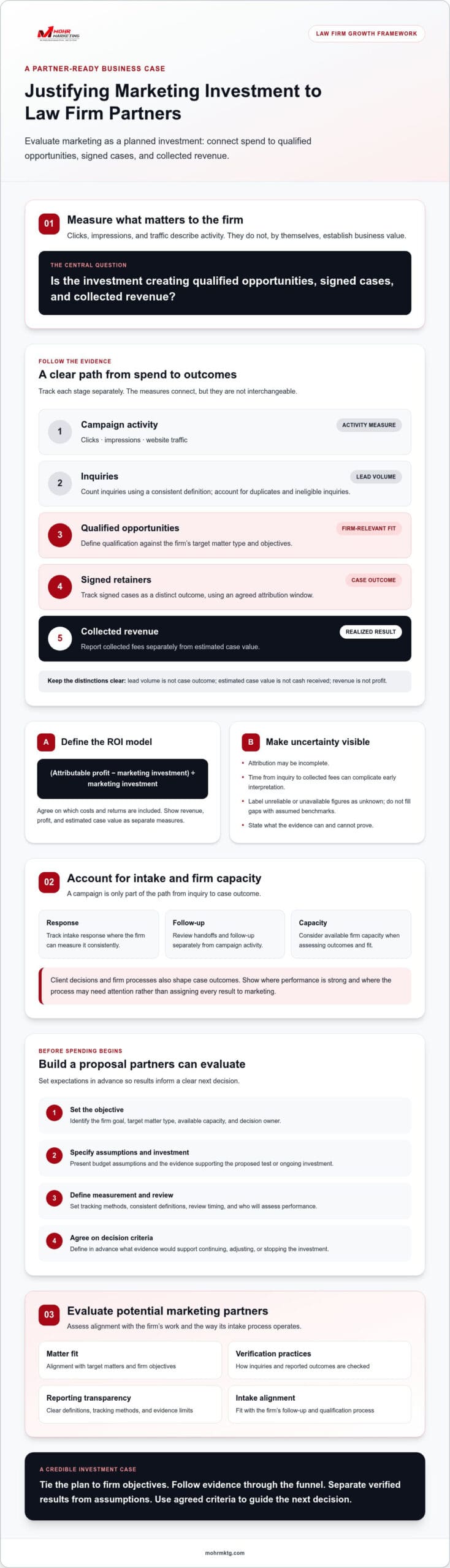
Before approving a test or ongoing investment, define the objective, target matter type, available capacity, and decision owner. Specify who will review performance and when. Then separate the stages being measured: campaign activity, inquiries, qualified opportunities, signed cases, and collected fees. These measures are connected, but they are not interchangeable.
Partners should also see the proposed budget assumptions, tracking method, and evidence that will inform a decision to continue, adjust, or stop. A basic Return on Marketing Investment (ROMI) framework compares marketing returns with the investment, but its usefulness depends on clear definitions and reliable firm data.
Why marketing metrics often fail to persuade
Impressions and clicks show that people encountered or engaged with a campaign. Raw lead totals show that inquiries were generated. Neither establishes whether those inquiries fit the firm’s target matters, became signed cases, or produced collected fees. When reports stop at activity, partners are left to infer business value.
Measurement can also break down after an inquiry arrives. Delayed follow-up, inconsistent qualification, or limited capacity may affect whether an opportunity advances. These factors can obscure a campaign’s contribution, but they do not make marketing solely responsible for a case outcome shaped by several firm processes. Track handoffs and outcomes separately to show where performance is strong and where the process may need attention.
When justifying marketing investment to law firm partners, present the proposal as a testable business decision, not a promise of guaranteed revenue. State the assumptions, identify what the firm can control, and be explicit about what the available evidence can and cannot prove. This gives partners a sound basis for assessing strategic fit before weighing campaign tactics.
Build a Law Firm Marketing ROI Model Around Qualified Cases
A useful ROI model follows the path from marketing spend to outcomes the firm can verify. Track channel spend, inquiries, qualified opportunities, signed retainers, and collected revenue as distinct stages. This makes it easier to see where volume is building and where prospects are dropping out. It also keeps the analysis tied to the firm’s case economics rather than generic industry benchmarks.
Define each term before reporting results. Specify what counts as an inquiry and a qualified opportunity, how duplicates or ineligible inquiries are handled, and which attribution window connects an inquiry to a signed retainer. Use the same reporting period across channels where possible. If a figure cannot be measured reliably, label it as unknown instead of filling the gap with an assumed benchmark.
Which figures belong in the partner-facing model
Include channel spend and management fees alongside inquiry volume, qualification rate, and signed-retainer count. Add intake response and follow-up data if the firm can track them consistently. Report collected revenue separately from estimated case value: collections are realized results, while case value is an estimate and should not be presented as cash received.
Define marketing ROI precisely. A practical formula is (attributable profit minus marketing investment) divided by marketing investment. Revenue is not profit, and the estimated value of a signed case is not collected revenue. Agree on which costs and returns the calculation includes, and show revenue, profit, and estimated case value as separate measures.
How to model assumptions without overstating certainty
Build conservative, expected, and upside scenarios from the firm’s own historical data and partner-approved assumptions. For example, use the firm’s observed inquiry qualification and signing patterns where available. If a conversion rate or collection figure is missing, mark it as an input to validate. Do not substitute a broad benchmark and present it as a forecast for this firm.
Document the attribution rules, reporting period, exclusions, and known limitations. Then explain how the payment model allocates risk. Pay-per-lead arrangements put more emphasis on inquiry verification and qualification. Pay-per-signed-case arrangements tie payment to a later funnel stage. Managed-service fees fund campaign work without making case outcomes certain. Review the specific agreement and define what each party controls.
A transparent model helps partners test assumptions, compare channels, and identify intake or reporting gaps before expanding spend. Firms assessing lead generation, signed retainers, or legal intake can discuss measurement and service fit with Mohr Marketing as one step in that evaluation.
Address Partner Concerns About Risk, Attribution, and Lead Quality
Marketing performance is uncertain. No campaign, lead source, or vendor can guarantee signed cases or collected revenue. A credible review separates what the firm or provider can manage, such as targeting, inquiry verification, source tracking, and follow-up procedures, from outcomes shaped by eligibility, client decisions, case development, and firm capacity.
Lead volume alone is an incomplete measure of legal marketing performance because it says nothing about whether inquiries fit the firm’s criteria, become signed retainers, or generate collected fees.
Different approaches also involve different trade-offs. In-house campaigns give the firm direct control over execution but require internal time and capability. Managed marketing shifts some campaign work to an outside provider, while the firm retains the need for oversight and clear reporting. Lead acquisition focuses evaluation on delivered inquiries, making verification and matter fit central. A signed-retainer model measures a later stage, but a signed retainer is not the same as a resolved matter or collected revenue. Compare approaches by what is measured, what the firm controls, and where uncertainty remains.
How to discuss attribution without claiming too much
Attribution is a reporting method, not proof that one channel caused a case. First-touch credits the first recorded source. Last-touch credits the final recorded source before inquiry or conversion. Multi-touch distributes credit across recorded interactions. Each method can answer a different question, so state which one you use and apply it consistently.
Track source information from initial inquiry through intake and case disposition. Flag missing or conflicting records, and distinguish observed patterns from proven cause and effect. If a prospect encountered multiple channels or the source was not captured, report that limitation rather than assigning certainty the data cannot support.
How to evaluate lead quality and intake contribution
Set qualification criteria before comparing campaigns or vendors. Define how the firm will assess matter fit, verification, duplicates, ineligible inquiries, and signed-retainer status. Review each measure separately. A verified inquiry may still fall outside the firm’s target, while a suitable opportunity may not advance if follow-up is delayed or the firm lacks capacity.
Review intake as part of the conversion path, not as a reason to credit or blame marketing automatically. Consistent follow-up records can help partners identify where inquiries progress or stall. Legal intake services may support this part of the process, but the evaluation should still distinguish intake activity from signed cases and collected revenue. This discipline makes justifying marketing investment to law firm partners more credible: it shows what the evidence supports, what remains uncertain, and what the firm can improve.
Present a Marketing Investment Proposal Partners Can Evaluate
A partner-ready proposal should make the decision clear before advocating for a particular channel. State the firm objective, target case type, available capacity, budget assumptions, measurement plan, and decision date. When justifying marketing investment to law firm partners, the goal is not to promise an outcome. It is to show what the firm intends to test, how it will assess the evidence, and who is accountable for acting on it.
A concise structure for the partner presentation
Start with the business need and opportunity. Explain the current acquisition constraints, such as a target matter type the firm wants to pursue or limits on existing capacity. Then describe the proposed channel or service, expected costs, supporting assumptions, and operational requirements. Be explicit about what the firm must provide, including intake ownership and reliable outcome data.
Close with the reporting cadence, accountable owners, known risks, and decision partners need to make. A useful proposal answers five questions:
- What firm objective and target cases will this support?
- What is included in the investment, and what assumptions inform it?
- How will inquiries and outcomes be tracked?
- Who owns campaign oversight, intake follow-up, and reporting?
- When will partners review results and decide what happens next?
If the proposal concerns scalable claimant acquisition, the firm can review this mass tort signed-case approach as a relevant service example. Evaluate it against the firm’s matter criteria, capacity, and measurement plan rather than assuming it will produce a particular result.
Use a bounded test only when the rules are clear
A limited test can help reduce commitment while the firm validates assumptions, but only if its scope, tracking, capacity, and review criteria are agreed in advance. Set partner-approved thresholds for continuing, adjusting, or stopping. There is no universal cutoff for every practice, case type, or intake operation. If tracking is incomplete or the firm cannot respond to inquiries consistently, address those issues before treating the test as a fair measure of channel performance.
Turn review meetings into accountable decisions
At each review, compare actual performance with the agreed baseline and assumptions. Diagnose the variance before deciding what it means. Missing source data is a measurement problem. Weak matter fit may point to targeting or qualification. Delayed follow-up is an intake execution issue. Each calls for a different response.
Record the decision, owner, required action, and next review date. This simple discipline prevents an investment from continuing by default and gives partners a defensible record of why it was continued, changed, or stopped.
Connect the Marketing Case to a Partner-Ready Growth Plan
Approval is useful only when it leads to an operating plan. Translate the agreed firm objective into clear steps for targeting, inquiry verification, intake handoff, reporting, and review. Assign an owner to each step, and confirm the firm has the capacity to act on the opportunities the program is intended to generate. This connects the investment decision to the work required to evaluate it.
Assess potential marketing partners against the same criteria. Look for transparent sourcing and reporting, alignment with the firm’s target matters, clearly explained verification practices, and a workable intake process. Confirm what the service includes, what information the firm will receive, and which responsibilities remain with firm staff. If signed opportunities fit the firm’s strategy, review the details of mass tort signed cases as part of that evaluation, without assuming they will produce a particular case outcome.
Questions to ask a marketing partner before committing
Ask how inquiries are sourced, verified, defined, and reported. Request clear explanations of the billing structure, measurement limits, and operational dependencies. Confirm whether the service focuses on inquiries, signed retainers, or another defined stage, and identify what the firm must do to support tracking and follow-up. A sound evaluation makes responsibilities visible on both sides.
- How is an inquiry defined, and how are duplicates or ineligible inquiries treated?
- What information is provided to assess matter fit and verification?
- Which tasks are included, and which remain the firm’s responsibility?
- What outcomes can be measured reliably, and where are the reporting limits?
- What firm capacity or intake processes does the plan depend on?
Set the next step without overpromising outcomes
Prepare for a discussion with target matter types, intake capacity, historical performance data, and partner priorities. Use the conversation to test fit, identify evidence needed for evaluation, and surface assumptions that still need validation. The purpose is not to secure a promise of cases or revenue. It is to determine whether the proposed approach can be measured against the firm’s objectives and operating realities.
That is the practical end point of justifying marketing investment to law firm partners: a growth plan with defined responsibilities, transparent measurement, and a review process that supports informed decisions. Mohr Marketing provides legal lead generation, signed retainers, and legal intake services. Firms can discuss their objectives and measurement needs before deciding whether the fit is appropriate.
Make the Next Marketing Decision Measurable
A credible investment case starts with a firm objective and follows performance beyond clicks. Track qualified inquiries, signed retainers, and collected revenue as distinct outcomes. Set attribution rules, identify intake responsibilities, and agree on review criteria before a campaign begins. This gives partners a practical basis to continue, adjust, or stop investment without relying on generic promises.
That discipline is central to justifying marketing investment to law firm partners. It also helps the firm assess whether a marketing approach fits its target matters, capacity, and growth priorities. Mohr Marketing reports over 30 years of industry experience and offers verified legal inquiries, signed retainers, and managed digital marketing. Evaluate any potential partner against your firm’s measurement needs and operational requirements.
A clear plan will not remove uncertainty, but it can make the next decision more informed. Start with the evidence your firm can track, then build from there.
Frequently Asked Questions
How do you justify marketing spend to law firm partners?
Start with the firm’s objectives, target matter types, and current acquisition constraints. Then present a transparent model that follows investment through inquiries, qualified opportunities, signed retainers, and collected revenue when available. State assumptions, attribution limits, and data gaps. When justifying marketing investment to law firm partners, propose review criteria in advance so partners can make a clear decision to continue, adjust, or stop.
What marketing metrics matter most to law firm partners?
The most useful metrics depend on the firm’s goals, but clicks and raw lead totals are not enough. Track spend, inquiry quality, qualification, intake follow-up, signed retainers, and collected revenue when available. Define each measure consistently and state the reporting period. Separate observed results from estimates, and do not treat one metric as proof that a marketing channel caused a case outcome.
How can a law firm measure marketing ROI accurately?
Define the investment amount, reporting period, and attribution rules before a campaign begins. Track opportunities through intake and case disposition when reliable data is available. Keep collected revenue separate from projected case value, and disclose gaps such as missing source information. Use the firm’s historical data and approved assumptions. This produces a more defensible assessment than applying generic conversion rates or unverified industry benchmarks.
What should a law firm marketing proposal include?
A partner-ready proposal should state the business objective, target matters, proposed channel or service, investment assumptions, and metric definitions. Include operational requirements, reporting cadence, accountable owners, known risks, and decision criteria. Specify what evidence would support continuing or changing the plan. Avoid promising case volume or revenue unless verified, applicable evidence supports that claim, and make clear which outcomes remain uncertain.
Is pay-per-signed-case marketing better than paying per lead?
Neither model is automatically better for every firm. Compare what counts as a delivered lead or signed case, how verification works, what the firm pays for, and which responsibilities remain with its intake team. Consider matter fit, reporting, contract terms, and the firm’s capacity to follow up. Evaluate each option against the firm’s objectives and historical data, not the payment model’s label alone.
Can law firms rely on lead volume to judge marketing performance?
No. Lead volume shows how many inquiries were recorded, but not whether they meet the firm’s criteria or become signed cases. Pair volume with verification, qualification, intake follow-up, and outcome data where available. Define these measures before reviewing performance. If tracking is incomplete, identify the gap and its effect on the analysis rather than presenting the total inquiry count as evidence of return.
How often should law firm partners review marketing performance?
Set the review schedule before investment begins and align it with the campaign scope, reporting availability, and the firm’s decision cycle. At each review, compare actual results with agreed assumptions, identify data gaps, and assess operational factors such as intake follow-up. Keep the evaluation period consistent unless partners approve a change and its rationale. Record decisions and next steps so investment does not continue by default.
What should partners ask a legal marketing agency before approving investment?
Ask how opportunities are sourced, verified, defined, and reported; what the service includes; and which intake responsibilities remain with the firm. Request the billing structure, measurement limits, and operational dependencies in clear terms. Ask for examples only when the supporting evidence is verifiable and relevant to your matter types. Review data handling and compliance considerations with qualified counsel rather than relying on general assurances.

Recent Posts
- Justifying Marketing Investment to Law Firm Partners: A Data-Driven Framework
- Roundup Cancer Lawsuit Leads: Buying Guide for Law Firms
- Tracking Law Firm Marketing: A Practical Guide
Categories
- AI and Lead Generation
- Business Financing
- Call Verified MVA Leads
- Car Accident Help
- Car Accident Settlements
- Claimant Funding
- Compliance Program
- EMS-EMT Reports
- Geotargeting
- Google Maps Ranking
- Healthcare Practice Growth
- Law Firm Growth
- Law Office Operations
- Lead Generation
- Lead Generation For Attorneys
- Lead Generation For Chiropractors
- Lead Generation For Criminal Attorneys
- Lead Generation For D&A Treatment Centers
- Lead Generation For DUI Attorneys
- Lead Generation For Eye Doctors
- Lead Generation For Family Law Practices
- Lead Generation For PI Law Firms
- Lead Generation For Plastic Surgeons
- Leads For Healthcare Professionals
- Leads For Insurance Industry
- Legal Leads
- Legal Marketing
- Legal Updates
- Mass Tort Leads
- Medicare and Medicaid Leads
- Merchant Funding Leads
- Mold Leads
- Online Marketing Strategies
- Pre-Settlement Funding
- Signed MVA Cases
- Tort Updates
- Truck Accident Leads and Signed Cases
- Truck Accident Settlements
- Web Design