The Hidden Risks of Cheap Personal Injury Leads: A Law Firm’s Guide to Quality Acquisition
September 21, 2026 by Mohr Marketing
Accepting low-cost inquiries often functions as a hidden tax on your firm’s operational efficiency rather than a bargain for your growth. You’ve likely experienced the frustration of an intake team drowning in non-responsive data or recycled leads that were sold to multiple firms before your staff could even dial. When lead quality degrades within the first 60 seconds of submission, racing against competing auto-dialers becomes a losing game that drains your marketing budget and staff morale. It’s time to recognize the systemic risks of cheap personal injury leads and the damage they do to your bottom line.
This guide identifies the systemic operational and ethical hazards associated with low-quality generation, including the $500 to $1,500 statutory penalties for TCPA violations and strict ABA mandates against fee-sharing. You’ll learn how to transition from low-intent data to a high-intent acquisition model that prioritizes verified inquiries over raw volume. We’ll examine how to streamline your intake process, reduce your real cost-per-signed-case, and achieve predictable growth through exclusive inquiries. By the end of this manual, you’ll have a clear framework to eliminate inefficient intermediaries and protect your firm’s regulatory standing.
Key Takeaways
- Identify how low-quality inquiries create significant intake friction and exhaust your firm’s human capital on non-viable cases.
- Understand the systemic risks of cheap personal injury leads, including severe regulatory liabilities and the hidden financial drain of managing unverified data.
- Implement five non-negotiable auditing criteria to ensure every inquiry meets strict injury, liability, and statute of limitations requirements.
- Transition from a volatile cost-per-lead metric to a performance-based model focused on signed retainers to shift financial risk away from your firm.
- Protect your professional reputation by verifying that all third-party lead acquisition strictly adheres to current state bar mandates and TCPA consent rules.
The Illusion of Savings: Defining the Risks of Cheap Personal Injury Leads
The upfront price of a lead is often the most deceptive metric in legal marketing. Many firms prioritize low cost-per-lead (CPL) without accounting for the operational burden that follows. Cheap personal injury leads are typically unverified inquiries, often generated through low-intent clickbait ads or incentivized surveys that offer prizes in exchange for contact information. These bargain inquiries frequently fail to meet basic case criteria, such as insurance coverage or documented liability. Relying on these sources creates a churn and burn cycle where your staff spends more time disqualifying claimants than building a docket.
When evaluating lead generation pipelines, you must distinguish between raw contact data and qualified legal prospects. The risks of cheap personal injury leads extend beyond the initial purchase price; they inflate your total cost-per-acquisition (CPA) by requiring excessive human capital to vet. Low-cost providers sell volume, but volume without verification is just noise. High-volume, low-quality strategies prevent scaling by tethering your intake team to a phone line with zero ROI.
Intent vs. Volume: The Fundamental Disconnect
Raw inquiry volume is a vanity metric. A firm receiving 500 inquiries a month may sign fewer cases than a firm receiving 50 high-intent inquiries. This disconnect stems from how the lead was generated. Search-intent leads come from individuals actively typing specific queries into a search engine. Conversely, social-media-interrupt leads appear because a user clicked a flashy ad while browsing a feed. High-intent leads are inquiries where the claimant is actively seeking legal representation for a specific injury. Focusing on intent ensures your intake team handles police-report-backed MVA cases rather than curious browsers.
Non-Exclusive vs. Recycled Data
Exclusivity isn’t a luxury; it’s a requirement for efficiency. Many low-cost providers sell shared leads, routing the same claimant to four or eight different firms simultaneously. This triggers a race to dial where the first firm to connect wins, while the others waste payroll on non-responsive calls. Research indicates that leads contacted within five minutes demonstrate a 391% higher qualification rate compared to those contacted later. Shared models make this window impossible to hit consistently.
Even worse is the practice of selling recycled data. Some aggregators repackage inquiries from previous years and present them as fresh opportunities. Lead aging is catastrophic in the personal injury sector. A lead that has already been retained by a competitor or has passed the statute of limitations is worthless. Purchasing these inquiries increases the risks of cheap personal injury leads by exposing your firm to TCPA violations and wasted marketing spend. You don’t need more leads; you need better inquiries that convert into signed retainers.
Operational Drain: How Low-Quality Inquiries Cannibalize Intake Resources
Every low-quality inquiry represents a direct withdrawal from your firm’s most valuable asset: human capital. While a $20 lead looks attractive on a spreadsheet, it ignores the labor hours required to vet, follow up, and ultimately disqualify the claimant. One of the primary risks of cheap personal injury leads is the creation of intake friction. When your team is buried under a mountain of non-responsive data, they can’t respond to high-value inquiries with the necessary urgency. This operational drag prevents your firm from scaling even if you increase your marketing spend.
To understand the financial impact, you must calculate the true cost of these inquiries. Take the initial purchase price and add the product of your intake staff’s hourly rate and the total time spent per lead. If an employee earning $25 per hour spends 45 minutes across multiple days attempting to reach a lead that never converts, that $20 lead actually costs $38.75 in direct expenses. This total excludes the opportunity cost of high-value cases that were ignored during that time. High-performing firms recognize that cheap data is often the most expensive resource they can buy.
The ROI of Legal Intake Efficiency
A high volume of poor data inevitably slows your speed to lead. Verified data shows that contacting a lead within five minutes results in a 391% higher qualification rate compared to contacting them after 30 minutes. When your staff is busy filtering through clickbait inquiries, they miss this critical window for genuine claimants. Understanding the ROI of legal intake services requires looking beyond the cost-per-lead metric and focusing on conversion efficiency. Deceptive practices by aggregators often lead to regulatory scrutiny, as seen in recent FTC actions against deceptive lead generation. Firms that purchase unverified data risk inheriting these liabilities while simultaneously degrading their intake performance.
Intake Ecosystem Overload
Your intake team should function as a closing department, not a prospecting unit. Their primary objective is to secure signed retainers, not to act as a human filter for poor marketing data. Using highly trained staff to triage unverified web forms is a strategic failure that leads to rapid burnout and high turnover. The risks of cheap personal injury leads include this hidden soft cost of staff fatigue. Employees forced to deal with hostile or unqualified callers daily will eventually lose the empathy required for high-stakes personal injury cases. You can audit your intake efficiency to identify where low-quality data is cannibalizing your resources. Prioritizing verified call transfers over raw web submissions ensures your team spends their time on cases that actually move the needle.
Compliance and Ethical Liabilities: The Regulatory Risks of Unverified Data
The risks of cheap personal injury leads include severe regulatory liabilities that can jeopardize your firm’s standing. Cheap providers frequently bypass the Telephone Consumer Protection Act (TCPA) to maintain low cost-per-lead metrics. Under 47 U.S.C. § 227, statutory penalties for non-compliant automated communications are $500 per negligent violation and up to $1,500 for willful violations. If an aggregator uses deceptive tactics to capture data, your firm bears vicarious liability for every non-compliant text or call. Sourcing unverified inquiries isn’t just a marketing failure; it’s a legal risk that invites predatory litigation.
TCPA and Lead Origin Transparency
Demand absolute transparency regarding the provenance of every lead. The 2026 compliance landscape requires rigorous documentation of consumer consent. Effective April 11, 2025, consumers have the legal right to revoke consent using any reasonable method, and lead-intake systems must process these requests within 10 business days. To mitigate risk, always demand a Jornaya LeadiD or TrustedForm certificate for every inquiry. These certificates provide visual, timestamped Session Replays proving the claimant knowingly consented to contact. Without this cryptographic proof, your firm lacks a viable defense against TCPA statutory damage claims.
Ethical Considerations for Personal Injury Firms
State bar mandates regarding attorney advertising apply to your marketing partners just as they apply to your own website. ABA Model Rule 5.4 strictly prohibits sharing legal fees with non-lawyers, meaning you cannot pay for leads via settlement splits or case-contingent fees. All payments must be fixed administrative or marketing fees independent of recovery outcomes. Misleading ads used by third-party aggregators often capture claimants through “check your settlement” quizzes or clickbait surveys. When these individuals realize they were tricked into a sales call, they associate the frustration with your firm. This damage to your professional reputation is a permanent cost that no low-price lead can justify.
Maintain your firm’s integrity by sourcing inquiries from verified call transfers. This approach ensures that every claimant is fully aware of the firm they are contacting and has already met basic qualification filters. High-intent acquisition models eliminate the risk of frivolous filings and ethically compromised intake processes. By focusing on quality over raw volume, you ensure your firm stays ahead of market shifts and technological trends while protecting your most valuable asset: your professional license.
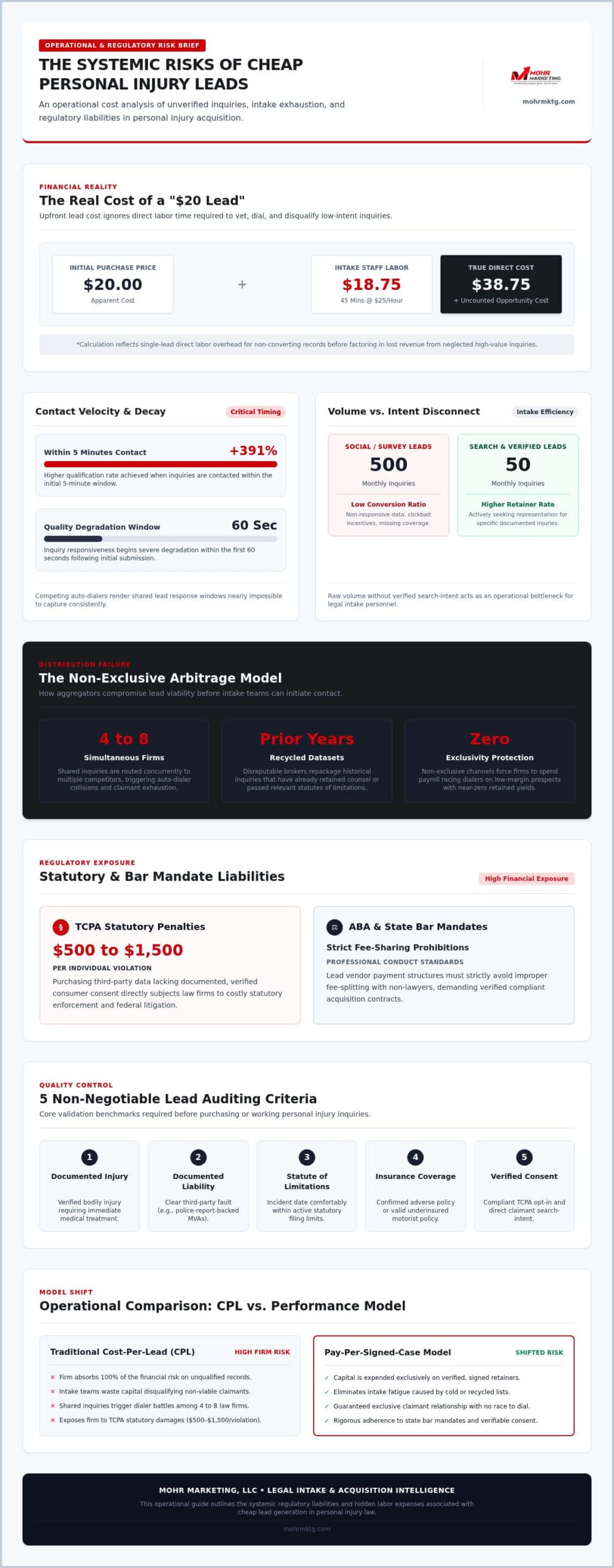
Auditing Lead Quality: 5 Non-Negotiable Criteria for High-Intent Inquiries
Mitigating the risks of cheap personal injury leads requires a rigorous procurement process with strict quality controls. You shouldn’t treat lead generation as a black box. If a provider cannot verify the origin, intent, and exclusivity of an inquiry, they’re selling you a liability rather than an asset. Use these five non-negotiable criteria to audit every acquisition source before committing your marketing budget.
- Step 1: Real-Time Delivery. Inquiries must be delivered to your CRM within seconds of the claimant’s action. Speed is the primary driver of conversion; data that sits in a queue for even ten minutes loses its value rapidly.
- Step 2: Strict Case Criteria. Every lead must meet specific injury, statute of limitations, and liability requirements. Inquiries involving minor property damage or expired statutes should be filtered out before they reach your intake team.
- Step 3: Intent Verification. The provider must confirm the claimant is not already represented by counsel. Signing a claimant who is already retained by another firm creates ethical conflicts and wasted labor.
- Step 4: Exclusivity. You must have absolute confirmation that the data has not been sold to multiple parties. Shared leads trigger a race to dial that destroys your intake efficiency.
- Step 5: Data Transparency. Demand full visibility into the ad creative and landing page that generated the lead. You need to know exactly what promise was made to the consumer to ensure it aligns with your firm’s brand and ethical standards.
Leveraging Police-Report-Backed Evidence
Objective evidence is the most effective way to reduce intake friction. Police-report-backed MVA cases represent the gold standard of personal injury leads because they provide third-party verification of liability and accident severity. This level of documentation allows your team to skip basic discovery and move directly toward signing the retainer. Ask lead providers for the specific ‘proof of intent’ captured during the inquiry to ensure the claimant was actively seeking legal help rather than just browsing for information.
Mass Tort vs. Standard PI Criteria
Standard personal injury leads often rely on immediate physical evidence, but mass tort signed cases involve unique qualification hurdles. These inquiries require deep medical record verification to prove usage and subsequent injury. High-value cases, such as toxic mold litigation, require even deeper qualification regarding property conditions and medical causation. Without these rigorous filters, your firm will spend thousands on medical record retrieval for cases that will ultimately be dismissed. Transitioning to a model that verifies these criteria upfront is the only way to protect your firm’s resources.
The Performance Model: Transitioning to Pay-Per-Signed-Case
The performance model represents the definitive solution to the risks of cheap personal injury leads by fundamentally altering the financial relationship between law firms and marketing partners. Traditional lead generation forces you to gamble on raw inquiries, paying upfront for contact data that may never convert. In contrast, a Pay-Per-Signed-Case model ensures you only pay for fully executed retainer agreements. This shift places the burden of marketing efficiency, intake speed, and initial qualification on the partner. By utilizing a turnkey ecosystem provided by Mohr Marketing, LLC, you eliminate the gap between inquiry and acquisition, ensuring every dollar spent results in a tangible legal asset.
To evaluate a performance-based partner, you must look beyond the cost per signed case and examine their intake infrastructure. A high-quality partner should demonstrate direct-to-source origination rather than relying on third-party aggregators. Verify that they possess the internal capacity to handle real-time qualification and that they provide full transparency into the ad creative used to generate the claimant’s interest. Relying on a performance-based partner effectively eliminates the systemic risks of cheap personal injury leads by ensuring you only invest in verified outcomes that meet your firm’s specific litigation criteria.
Eliminating Marketing Waste
Paying for signed retainers is objectively more cost-effective than managing a raw lead funnel. Traditional SEO and PPC models require firms to pay monthly management fees regardless of whether the traffic converts into a signed client. When metropolitan CPCs for truck accidents reach hundreds of dollars, a firm can exhaust six figures on clicks without securing a single viable case. Transitioning to mass tort signed cases or verified call transfer leads allows for precise budgetary control. Marketing spend is tied directly to converted opportunities, providing long-term stability for firm cash flow and docket growth.
Future-Proofing Your Firm for 2026
The legal market is consolidating toward high-intent ecosystems that prioritize transparency and data integrity. As consumer privacy laws and FCC mandates tighten, firms must rely on partners who possess a 30+ year track record of compliance. Mohr Marketing, LLC provides the necessary infrastructure to scale without the overhead of a massive internal prospecting team. For specialized litigation such as mesothelioma leads for law firms, the precision of a performance model is the difference between a growing docket and a stagnant practice. Transparency and data-driven strategies are no longer optional for firms that intend to lead the market in 2026.
Contact Mohr Marketing, LLC to discuss our Pay-Per-Signed-Case model
Secure Your Firm’s Growth Through High-Intent Acquisition
The transition from raw inquiry volume to high-intent acquisition is the only sustainable path for firms looking to scale in an increasingly regulated environment. By identifying the systemic risks of cheap personal injury leads, you can redirect your team’s energy toward claimants with documented liability and clear legal intent. Adopting a performance-based model allows your firm to bypass the operational friction of unverified data, ensuring that every dollar of marketing spend is tied to a signed retainer rather than a vanity metric.
Mohr Marketing, LLC provides the specialized infrastructure required to achieve this mechanical accuracy. With a 30+ year track record and a commitment to 100% compliance with national bar mandates, we deliver verified opportunities through a turnkey ecosystem. Our direct-to-source methodology eliminates inefficient intermediaries, allowing you to build your docket with absolute confidence and strategic precision.
Protect your firm’s future by choosing a strategic partner that is both protective of your resources and aggressive in pursuing your expansion.
Frequently Asked Questions
What is the average conversion rate for cheap personal injury leads?
Low-end aggregators typically produce conversion rates between 1% and 3% due to multi-buyer distribution and non-intent origination tactics. These risks of cheap personal injury leads result in a real acquisition cost that frequently exceeds $2,500 per viable case despite a low initial price. High-intent models focus on inquiries that convert at significantly higher rates by eliminating unverified data and clickbait strategies that inflate intake overhead without producing signed retainers.
How do I know if a lead provider is compliant with state bar mandates?
A compliant provider must strictly adhere to ABA Model Rule 5.4, which prohibits sharing legal fees with non-lawyers. You should verify that all acquisition costs are billed as fixed administrative or marketing fees rather than percentages of settlement proceeds. Mohr Marketing, LLC maintains a 30+ year track record of adherence to state bar mandates by utilizing transparent, data-driven strategies. Always audit your provider to ensure they don’t analyze legal merits or endorse specific attorneys.
Why is speed-to-lead so critical in personal injury case acquisition?
Speed is the primary driver of conversion because inquiries contacted within five minutes demonstrate a 391% higher qualification rate compared to those reached after 30 minutes. In the personal injury sector, shared leads degrade within the first 60 seconds as competing firms race to auto-dial the same claimant. Verified call transfers eliminate this friction by connecting high-intent inquiries to your intake team in real time, preventing high-value cases from slipping through the cracks.
What is the difference between an exclusive lead and a shared lead?
An exclusive lead is routed to only one firm in real time, while a shared lead is sold to four to eight firms simultaneously. Shared models create an inefficient race to the phone that lowers conversion rates and increases intake payroll. Exclusive inquiries provide absolute confirmation of consumer origin and single-buyer routing. This exclusivity is a core component of a high-intent acquisition model, as it protects the claimant’s experience and your firm’s resources.
Can I get a refund for leads that don’t meet my case criteria?
Most low-cost aggregators don’t offer refunds for poor data, which is one of the primary risks of cheap personal injury leads. However, a performance-based model like Pay-Per-Signed-Case shifts this financial risk away from your firm. Under this structure, you only pay for fully executed retainer agreements that meet your specific injury, liability, and statute of limitations requirements. This ensures your marketing spend is tied directly to converted opportunities rather than raw inquiries.
How does a Pay-Per-Signed-Case model work for mass torts?
The Pay-Per-Signed-Case model for mass torts involves delivering fully executed retainers from qualified claimants who meet rigorous medical and usage criteria. Mohr Marketing, LLC manages the entire turnkey intake ecosystem, including medical record verification and intent qualification, to deliver opportunities ready for litigation. This performance-based approach eliminates the financial risk of buying raw inquiries that may not meet the complex qualification hurdles required for successful mass tort litigation.
What are the risks of buying leads from non-specialized marketing agencies?
Non-specialized agencies often lack the technical infrastructure to verify legal intent or ensure TCPA compliance. They frequently rely on broad affiliate networks and clickbait ads that capture low-quality data without proper consent documentation. These agencies may not understand the strict state bar mandates regarding attorney advertising and fee-sharing. Working with a specialized partner provides access to 30+ years of industry experience and a dedicated intake ecosystem tailored specifically for legal growth.
How do Jornaya and TrustedForm protect my law firm from TCPA lawsuits?
Jornaya LeadiD and TrustedForm provide cryptographic certificates that capture visual, timestamped Session Replays of the consumer’s consent. These certificates prove that the claimant knowingly agreed to be contacted, providing a definitive defense against TCPA statutory damage claims. Under current rules, statutory penalties can reach $1,500 per willful violation. Documenting the chain-of-custody for every inquiry is no longer optional for firms seeking to mitigate the liability of third-party data acquisition.

Recent Posts
- The Hidden Risks of Cheap Personal Injury Leads: A Law Firm’s Guide to Quality Acquisition
- Mass Tort Digital Marketing Agency
- Personal Injury Signed Retainers: The Strategic Guide to Scalable Case Acquisition in 2026
Categories
- AI and Lead Generation
- Business Financing
- Call Verified MVA Leads
- Car Accident Help
- Car Accident Settlements
- Claimant Funding
- Compliance Program
- EMS-EMT Reports
- Geotargeting
- Google Maps Ranking
- Healthcare Practice Growth
- Law Firm Growth
- Law Office Operations
- Lead Generation
- Lead Generation For Attorneys
- Lead Generation For Chiropractors
- Lead Generation For Criminal Attorneys
- Lead Generation For D&A Treatment Centers
- Lead Generation For DUI Attorneys
- Lead Generation For Eye Doctors
- Lead Generation For Family Law Practices
- Lead Generation For PI Law Firms
- Lead Generation For Plastic Surgeons
- Leads For Healthcare Professionals
- Leads For Insurance Industry
- Legal Leads
- Legal Marketing
- Legal Updates
- Mass Tort Leads
- Medicare and Medicaid Leads
- Merchant Funding Leads
- Online Marketing Strategies
- Pre-Settlement Funding
- Signed MVA Cases
- Tort Updates
- Truck Accident Leads and Signed Cases
- Truck Accident Settlements
- Web Design