Personal Injury Signed Retainers: The Strategic Guide to Scalable Case Acquisition in 2026
September 18, 2026 by Mohr Marketing
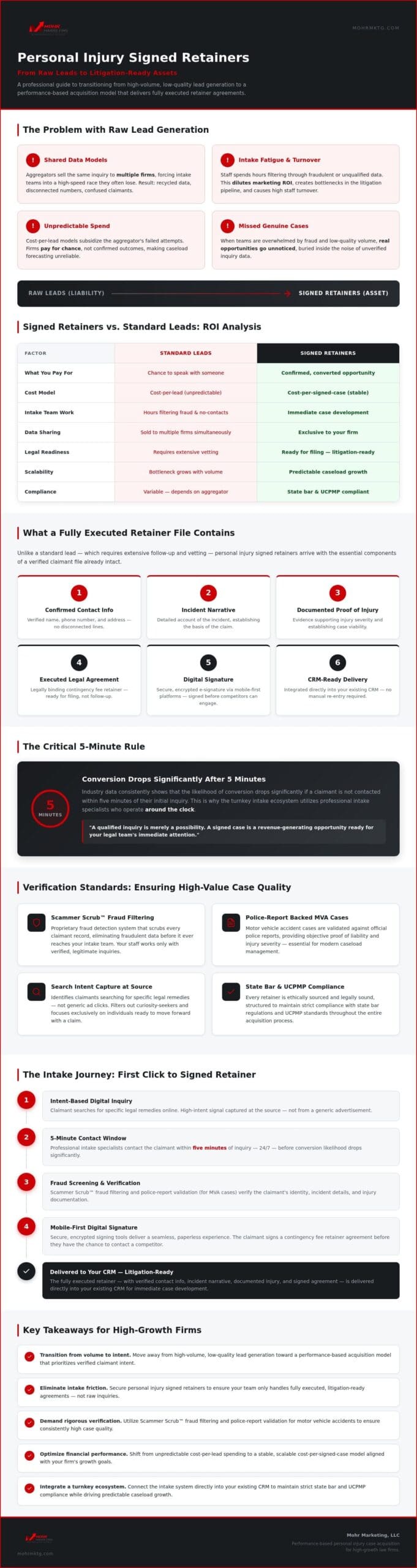
In 2026, raw legal leads are no longer an asset; they’re a liability that drains your firm’s resources. You’re likely tired of paying for inquiries that never pick up the phone or, worse, don’t even qualify as viable cases. It’s frustrating to watch your intake team spend hours filtering through fraudulent data instead of signing actual clients. You know that high-growth firms can’t afford to waste time on low-conversion volume.
This guide demonstrates how to eliminate that friction by switching to a performance-based model centered on personal injury signed retainers. You’ll learn how to transition from the uncertainty of traditional lead sourcing to a system that delivers fully executed agreements directly to your desk. We’ll show you how to secure predictable caseload growth while maintaining strict compliance with state bar and UCPMP standards. We’ll break down the mechanics of a turnkey intake ecosystem and explain the steps to transition from chasing leads to managing a scalable stream of verified, high-value cases.
Key Takeaways
- Transition from high-volume, low-quality lead generation to a performance-based acquisition model that prioritizes verified intent.
- Secure personal injury signed retainers to eliminate intake friction and ensure your team only handles fully executed, litigation-ready agreements.
- Improve case quality by utilizing rigorous verification standards, including Scammer Scrub™ fraud filtering and police-report validation for motor vehicle accidents.
- Optimize financial performance by shifting from unpredictable cost-per-lead spending to a stable, scalable cost-per-signed-case model.
- Integrate turnkey intake ecosystems directly into your existing CRM to maintain strict compliance while driving predictable caseload growth.
The Shift from Raw Inquiries to Signed Personal Injury Retainers
Legal marketing has moved past the era of raw volume. In the past, firms measured success by the number of inquiries hitting their CRM, but this approach is now obsolete. High-growth firms have shifted focus toward intent-based acquisition, prioritizing the quality of the claimant’s motivation over the sheer quantity of data points. By focusing on personal injury signed retainers, firms secure a litigation-ready asset rather than a project for their intake team. This transition ensures that every dollar spent contributes directly to the caseload rather than just the call log.
Search intent plays a critical role in identifying high-value claimants. A person searching for specific legal remedies after a collision has significantly higher intent than someone clicking a generic advertisement. Identifying these individuals requires a strategy that captures intent at the source, filtering out curiosity-seekers and focusing on those ready to move forward with a claim.
The Problem with Standard Lead Aggregators
Most lead aggregators rely on shared data models. They sell the same inquiry to multiple firms, forcing your intake team into a high-speed race they often lose. This model frequently delivers recycled data, disconnected phone numbers, and claimants who have no idea why they’re being called. These inefficiencies create massive intake fatigue and high staff turnover.
The hidden costs of processing these paper leads are substantial. Your staff spends hours filtering through noise, which dilutes your marketing ROI and prevents your firm from scaling. Relying on unverified inquiries creates a bottleneck that slows down your entire litigation pipeline. When your team is overwhelmed by fraudulent or unqualified inquiries, they miss the genuine opportunities hidden in the volume.
The Performance-Based Solution
The solution lies in a performance-based model. Instead of paying for the chance to speak with someone, you pay for a converted opportunity. This shift aligns marketing incentives directly with your firm’s growth goals. You stop subsidizing the aggregator’s failed attempts and start investing in confirmed assets that are ready for your legal team to review.
One way to ensure this quality is through police-report backed MVA cases, which provide objective proof of liability and injury severity. This level of verification is essential for modern caseload management. Within this framework, contingency fee retainer agreements serve as the foundation of the relationship between the firm and the claimant. A signed retainer is a legally binding agreement ready for filing. By integrating personal injury signed retainers into your workflow, you bypass the friction of the traditional intake process and move directly to case development. This cleaner path from intent to intake allows your firm to scale without the typical growing pains of a bloated intake department.
Understanding the Mechanics of a Fully Executed Retainer
A fully executed retainer represents the transition from marketing data to a tangible firm asset. In the context of mass tort and personal injury law, a retainer is the binding legal contract that authorizes your firm to act on behalf of the claimant. Unlike a standard lead, which requires extensive follow-up and vetting, personal injury signed retainers arrive with the essential components of a verified claimant file already intact. This file includes confirmed contact information, a detailed incident narrative, and documented proof of injury. A signed retainer is a legally binding agreement ready for filing.
Digital signatures and mobile-first intake platforms have accelerated this process. Modern claimants expect a seamless, paperless experience. By utilizing secure, encrypted signing tools, firms lock in claimants before they have the chance to contact a competitor. This speed distinguishes a “signed case” from a “qualified inquiry.” A qualified inquiry is merely a possibility. A signed case is a revenue-generating opportunity ready for your legal team’s immediate attention. Securing personal injury signed retainers ensures that every case you acquire is ethically sourced and legally sound.
The Intake Ecosystem: From First Click to Signature
The journey from a digital click to a signature is governed by the 5-minute rule. Industry data consistently shows that the likelihood of conversion drops significantly if the claimant isn’t contacted within five minutes of their initial inquiry. Our turnkey ecosystem manages this urgency by utilizing professional intake specialists who operate around the clock. These experts qualify claimants against strict criteria, such as the statute of limitations and liability factors, ensuring only viable cases reach the signing stage.
Compliance and Ethical Standards
Scaling your firm requires more than just volume; it requires strict adherence to regulatory frameworks. All acquisition methods must meet State Bar and UCPMP mandates to protect your firm from liability. Transparency in sourcing is paramount. High-performance firms avoid the “middleman” markup by working with partners who control the entire intake chain. For a broader look at how these systems integrate with overall growth, consult our guide on personal injury lead generation companies.
Implementing these rigorous standards ensures that every case you acquire is litigation-ready. If you’re ready to audit your current intake workflow, you can speak with a strategic growth partner to identify potential friction points and optimize your acquisition strategy.
Signed Retainers vs. Standard Leads: An ROI Analysis
Cost-per-lead (CPL) is a vanity metric that often masks deep financial inefficiency. In a traditional model, a firm might celebrate a low CPL, only to realize that the conversion rate is abysmal. When you factor in the time your staff spends chasing unresponsive contacts, the “cheap” lead becomes an expensive liability. High-growth firms have moved beyond CPL to prioritize Cost-Per-Signed-Case (CPSC). This metric provides the only true measure of marketing performance. By focusing on personal injury signed retainers, you eliminate the ambiguity of legal marketing and pay only for results that move the needle.
The impact of conversion rates on the total cost of litigation is profound. Every hour an attorney or senior paralegal spends vetting a raw inquiry is “dead time” that could be spent on case development or settlement negotiations. This misallocation of specialized labor is a hidden drain on firm resources. Shifting to a model where you receive litigation-ready files allows your team to focus on their core competency: practicing law. This shift creates a predictable budgeting environment, especially for firms pursuing national case acquisition in competitive spaces like mass torts.
Calculating the Real Cost of Internal Intake
Most firms underestimate the true cost of their internal intake infrastructure. You must factor in more than just salaries. A functional intake department requires sophisticated CRM software, automated dialers, and constant training to maintain compliance. When you add the overhead of office space and the management hours required to oversee these teams, the price of a raw lead skyrockets. Chasing unqualified inquiries carries a heavy opportunity cost. Every minute spent on a “no-case” is a minute lost on a high-value claimant. Acquiring personal injury signed retainers at a fixed price often yields a lower overall cost-per-acquisition because it removes these operational burdens from your balance sheet.
Scalability: Planning Your Caseload Growth
Scalability is impossible without predictability. The “feast or famine” cycle that plagues many personal injury practices is usually the result of inconsistent lead quality. Performance-based models allow for aggressive national scaling because they provide a stable foundation for financial planning. You can project exactly how many cases you’ll add to your docket based on your acquisition budget. This level of precision is essential for firms that need to staff up or secure litigation funding. Refer to our analysis on the ROI of legal intake services to see how efficiency metrics directly impact your firm’s bottom line. By securing fully executed agreements, you ensure that your growth is built on verified assets, not just potential inquiries.
Verification Standards: Ensuring High-Value Case Quality
Verification is the barrier between a profitable caseload and a docket full of dead weight. High-value case acquisition requires a methodical approach to data validation. When your firm invests in personal injury signed retainers, you aren’t just buying a signature. You’re securing a file that must withstand the scrutiny of insurance adjusters and defense counsel. Official documentation serves as the objective truth in this process. We prioritize medical treatment history and official incident records to ensure every case meets your specific criteria.
Liability validation starts with the first contact. Many firms struggle with “professional claimants” who recycle stories across multiple agencies. We eliminate this risk by cross-referencing inquiries against known fraud patterns. We verify specific treatment milestones, such as ER visits or specialist referrals, to confirm that injury severity aligns with your firm’s intake requirements. This level of scrutiny ensures that your paralegals don’t spend their time on unworkable files. Every case we deliver is vetted for injury severity and clear liability, providing a predictable path to settlement.
Intake teams often feel overwhelmed by the sheer volume of unqualified inquiries. This noise hides the high-value cases that actually drive firm revenue. By implementing strict verification standards, you remove the burden of initial vetting from your internal staff. This instructional guide focuses on moving away from self-reported data toward document-backed evidence. This shift ensures that your acquired cases are litigation-ready from the moment they enter your system.
The Scammer Scrub™ Methodology
Fraudulent data is a direct threat to firm efficiency. Our Scammer Scrub™ methodology identifies and filters out bots and duplicate filings in real-time. This proactive defense keeps your CRM clean and your intake team focused on genuine victims. We use AI-supported advertising to refine targeting, ensuring that personal injury signed retainers are based on authentic, verifiable human interaction.
Document-Backed MVA Cases
Official reports provide the evidentiary weight needed for successful litigation. The strategic advantage of police report-backed MVA cases is undeniable during settlement negotiations. We also provide truck accident signed cases verified through FMCSA data, including carrier safety ratings and driver logs. Sourcing cases backed by official documentation allows you to start every file from a position of strength.
Implementing a Performance Model with Mohr Marketing
Implementing a performance-based model removes the guesswork from firm expansion. Transitioning to personal injury signed retainers allows you to treat case acquisition as a predictable line item rather than a marketing gamble. Our system integrates directly with your existing CRM, delivering fully executed files without the need for manual data entry or internal follow-up. This turnkey approach ensures that your legal team can focus entirely on case development from the moment a file arrives. We handle the friction so you can focus on the litigation.
We leverage over 30 years of industry experience, having been founded in 1994, to navigate the complexities of the legal market. This longevity allows us to identify shifts in claimant behavior and regulatory standards before they impact your firm’s bottom line. We act as a strategic partner, helping you set specific case criteria that align with your practice’s strengths. Whether you’re targeting specific injury thresholds or medical treatment markers, our system enforces these standards at the source. This precision prevents your staff from wasting resources on files that don’t fit your litigation model.
Customizing Your Acquisition Strategy
Success in personal injury law requires diversifying your portfolio to maintain steady growth. You can select between high-volume MVA cases, complex mass torts, or niche opportunities like high-value mold case acquisition. Managing your volume to match your firm’s litigation capacity is essential for maintaining service quality. We help you calibrate your acquisition speed, ensuring you have a steady stream of cases without overwhelming your paralegals. This balance is key to maintaining a high level of decorum and professional results for your clients.
Getting Started: The Turnkey Onboarding Process
Initiating a campaign is a streamlined process designed for busy professionals who value efficiency. We provide a 24-hour proposal process for national case acquisition, giving you a rapid path to market entry. Once the criteria are established, we activate our turnkey intake ecosystem to begin securing personal injury signed retainers on your behalf. The onboarding involves three key steps:
- Define your specific case criteria, injury thresholds, and geographic focus.
- Establish secure CRM integration for real-time, paperless file delivery.
- Set up feedback loops to optimize case quality based on your team’s ongoing review.
Continuous optimization is built into our model. We use your feedback to refine our targeting and verification steps, ensuring that every case delivered is of the highest possible value. If you’re ready to move beyond the lead-buying model and start acquiring assets, it’s time to take the next step toward predictable growth.
Request a performance-based proposal from Mohr Marketing
Transition Your Firm to a Performance-Based Growth Model
The evolution of the legal market demands a shift from chasing raw inquiries to acquiring personal injury signed retainers. You’ve seen how a turnkey intake ecosystem eliminates the friction of internal vetting and protects your resources from fraudulent data. By prioritizing litigation-ready files over standard leads, you secure a predictable path to caseload expansion while maintaining strict compliance. This results-oriented approach ensures your intake team remains focused on high-value casework rather than administrative noise.
Mohr Marketing brings over 30 years of industry expertise to your acquisition strategy. Our Scammer Scrub™ fraud filtering ensures every file is verified before it reaches your CRM. We provide direct-to-firm delivery, which means you avoid the inefficiencies and markups associated with third-party resellers. Our process is built on transparency and reliability, ensuring a cleaner path from intent to intake. This model allows you to scale aggressively and dominate your practice area.
It’s time to stop managing lead volume and start managing firm growth. We’re ready to help you build a more efficient and profitable practice.
Frequently Asked Questions
What is the difference between a personal injury lead and a signed retainer?
A lead is raw data that requires your team to perform outreach and vetting; personal injury signed retainers are fully executed legal agreements ready for litigation. While a lead is merely a potential inquiry, a signed retainer is a firm asset that includes a binding contract and verified claimant information. This model shifts the burden of intake from your firm to our turnkey ecosystem, allowing your attorneys to bypass the initial chase and move directly to case development.
How do you ensure the claimants meet my firm’s specific case criteria?
We qualify every claimant against your firm’s specific practice requirements during the initial intake phase. This process includes verifying the statute of limitations, liability factors, and medical treatment history before the signing process begins. By establishing these parameters upfront, we ensure that only cases meeting your high-value thresholds are delivered. This instructional approach prevents your staff from wasting resources on files that don’t fit your litigation model or firm capacity.
Are signed retainers compliant with my state’s bar association rules?
Yes, our acquisition methods are built to maintain strict adherence to state bar associations and UCPMP mandates. We operate with complete transparency regarding sourcing and intake processes to protect your firm’s reputation and professional standing. Our 30 plus years of industry experience ensure that every agreement is ethically sourced. We act as a strategic partner, helping you navigate the regulatory landscape while scaling your caseload nationally without compliance anxiety or intake friction.
How does the Scammer Scrub™ process protect my law firm?
The Scammer Scrub™ methodology protects your firm by filtering out bots, duplicate filings, and fraudulent data in real-time. This proactive defense identifies professional claimants and bad actors before they ever enter your CRM. By scrubbing inquiries at the source, we ensure your intake resources are spent only on authentic, high-intent victims. This process maintains the integrity of your docket and ensures that every delivered file represents a genuine, verified opportunity for successful litigation.
Can I choose specific types of accidents, such as commercial truck or MVA cases?
You have the flexibility to select specific case types that align with your firm’s expertise and litigation goals. Our offerings include motor vehicle accident (MVA) cases, commercial truck accidents, and various mass torts. We utilize specialized sourcing methods, such as FMCSA-informed data for trucking cases, to ensure high-value opportunities are prioritized. This customization allows you to manage your volume and target the specific practice areas where your firm has the highest competitive advantage.
What happens if a signed case is later found to be unqualified?
We utilize a structured feedback loop to handle cases that may be found unqualified after delivery. If a file does not meet the pre-agreed criteria established at the start of your campaign, we review the documentation to optimize future targeting. This collaborative process ensures continuous improvement of the intake funnel. Our goal is to maintain a high-quality caseload, so we work closely with your team to refine verification standards and minimize the delivery of non-viable files.
Do you provide the official police reports with the signed retainers?
We provide official documentation, including police reports, to back our MVA and commercial truck cases. These reports serve as the objective gold standard for verifying liability and injury severity during settlement negotiations. Having these documents attached to your personal injury signed retainers provides an immediate evidentiary advantage. It allows your legal team to start every file from a position of strength, knowing the incident details are confirmed by official law enforcement records.
How quickly can you scale the volume of signed cases for a national campaign?
Our turnkey ecosystem allows for rapid scaling, often initiating national campaigns following our 24-hour proposal process. Because we control the entire intake chain, we can adjust volume to match your firm’s growth goals and litigation capacity in real-time. Whether you are looking to dominate a specific mass tort or expand your MVA docket, our infrastructure supports aggressive expansion. This speed ensures you can capitalize on market shifts and maintain a predictable stream of new cases.

Recent Posts
- Personal Injury Signed Retainers: The Strategic Guide to Scalable Case Acquisition in 2026
- Motor Vehicle Accident Leads: A 2026 Guide to High-Intent Case Acquisition
- Legal Intake Solutions: The 2026 Guide to Maximizing Law Firm ROI
Categories
- AI and Lead Generation
- Business Financing
- Call Verified MVA Leads
- Car Accident Help
- Car Accident Settlements
- Claimant Funding
- Compliance Program
- EMS-EMT Reports
- Geotargeting
- Google Maps Ranking
- Healthcare Practice Growth
- Law Firm Growth
- Law Office Operations
- Lead Generation
- Lead Generation For Attorneys
- Lead Generation For Chiropractors
- Lead Generation For Criminal Attorneys
- Lead Generation For D&A Treatment Centers
- Lead Generation For DUI Attorneys
- Lead Generation For Eye Doctors
- Lead Generation For Family Law Practices
- Lead Generation For PI Law Firms
- Lead Generation For Plastic Surgeons
- Leads For Healthcare Professionals
- Leads For Insurance Industry
- Legal Leads
- Legal Marketing
- Legal Updates
- Mass Tort Leads
- Medicare and Medicaid Leads
- Merchant Funding Leads
- Online Marketing Strategies
- Pre-Settlement Funding
- Signed MVA Cases
- Tort Updates
- Truck Accident Leads and Signed Cases
- Truck Accident Settlements
- Web Design