Using EMS Reports to Find and Qualify Personal Injury Clients
September 13, 2026 by Mohr Marketing
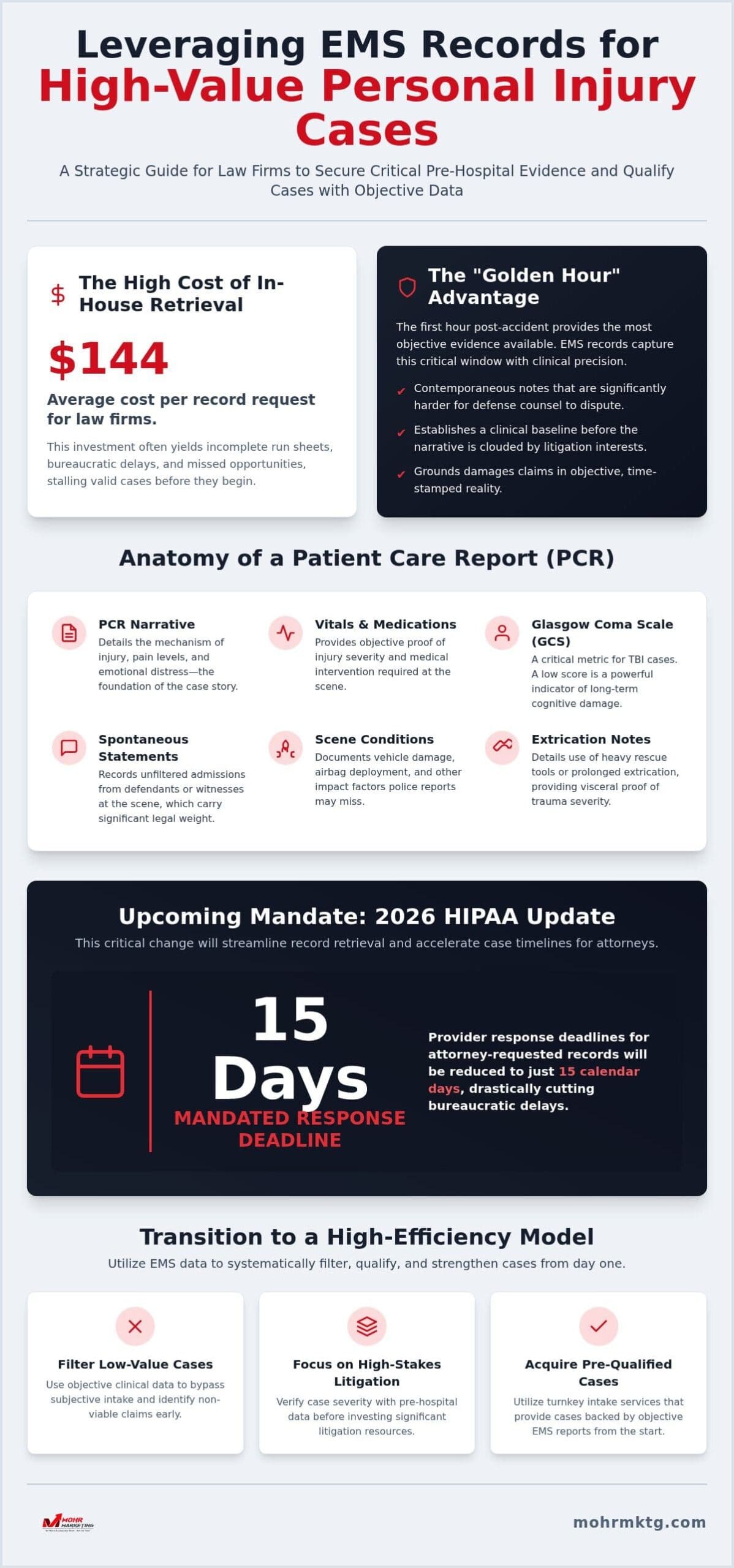
Law firms managing medical record requests in-house spend an average of $144 per request when factoring in labor and provider fees. For many practices, this investment yields nothing more than incomplete run sheets and endless bureaucratic delays. You understand that the first hour after an accident provides the most objective evidence available, yet navigating municipal agencies often feels like a losing battle. Mastering the process of using ems reports to find personal injury clients is the most direct path to filtering out low-value cases and focusing on high-stakes litigation.
This guide delivers the technical and legal requirements for retrieving critical pre-hospital evidence to strengthen your claims and scale your operations. We’ll break down the 2026 HIPAA update that reduces provider response deadlines to 15 days and clarify the fee structures for attorney-requested records. You’ll learn how to secure a complete, legally admissible Patient Care Report (PCR) and establish a streamlined workflow for future evidence gathering. By the end of this article, you’ll possess a methodical strategy for turning raw EMS data into a significant competitive advantage for your firm.
Key Takeaways
- Leverage the “Golden Hour” of evidence by capturing contemporaneous EMS notes that are significantly harder for defense counsel to dispute.
- Differentiate between municipal and private providers to ensure your firm receives a complete Patient Care Report (PCR) instead of a summary run sheet.
- Streamline your firm’s growth by using ems reports to find personal injury clients and navigating the 2026 HIPAA update that mandates a 15-day record delivery deadline.
- Implement technical workflows to bypass common bureaucratic delays and verify case severity before investing significant litigation resources.
- Transition to a high-efficiency model by utilizing turnkey intake services that provide pre-qualified cases and signed retainers backed by objective pre-hospital data.
The Strategic Role of EMS Records in Personal Injury Litigation
EMS records represent the first objective documentation of injury. They capture the mechanism of harm before litigation interests cloud the narrative. These reports act as the critical bridge between the chaos of an accident scene and the structured environment of the emergency room. In personal injury litigation, the “Golden Hour” refers to the period immediately following trauma. Contemporaneous notes taken during this window are significantly harder for defense counsel to dispute. They reflect the plaintiff’s immediate physical and mental state without the filter of time or patient coaching. Understanding the structure of Emergency Medical Services (EMS) in the U.S. is vital for identifying which agency holds these records. Strategically using ems reports to find personal injury clients allows firms to qualify cases based on clinical data rather than subjective intake interviews.
Contemporaneous Evidence vs. Later Medical Reports
Hospital records often focus on long-term treatment and diagnostic coding. EMS notes focus on the raw reality of the injury at the moment of impact. Paramedics record vitals and triage assessments that provide a clinical baseline for the entire case. These notes are less likely to be influenced by litigation bias because they’re generated during active medical intervention. Acute trauma markers in these reports are essential for rebutting pre-existing condition defenses. If a paramedic documents “visible deformity” or “acute neurological deficit” at the scene, the defense cannot easily claim the injury predates the accident. You need these records to ground your damages in objective, time-stamped reality.
Establishing Liability Through Mechanism of Injury
Paramedics often document scene conditions that police reports might miss. They note vehicle damage, airbag deployment, and the exact position of the plaintiff inside the wreckage. Extrication notes are particularly valuable for proving the severity of an impact. When a report mentions the use of heavy rescue tools or prolonged extrication times, it provides visceral proof of the physical trauma involved. Spontaneous statements recorded by EMS personnel also carry significant legal weight. Statements made by defendants or witnesses in the heat of the moment are often more reliable than depositions taken months later. These admissions can be the difference between a contested liability claim and a high-value settlement. Using these reports ensures your firm is investing in police-report-backed MVA cases that have been clinically verified from the start.
Identifying EMS Agency Types and Document Categories
Identifying the correct record custodian is the first hurdle in using ems reports to find personal injury clients. Emergency Medical Services in the U.S. fall into three primary categories: municipal agencies, private contracted providers, and fire-department-based services. Each entity maintains its own independent custodian of records. You must identify the specific agency on the scene to avoid “No Record Found” responses that stall your investigation. The Patient Care Report (PCR) serves as the primary clinical document, but it is not the only source of evidence. Secondary documents often include dispatch logs that provide precise timelines and cardiac monitor strips that offer physiological proof of patient distress. Distinguishing these clinical records from billing statements is essential for building a comprehensive case file.
The Anatomy of a Patient Care Report (PCR)
The PCR Narrative is where the paramedic records the mechanism of injury and the patient’s immediate complaints. This section establishes the legal storytelling for pain levels and emotional distress. Vitals and medications administered provide objective proof of injury severity. For firms handling traumatic brain injuries, the Glasgow Coma Scale (GCS) score is the most critical metric. A low GCS at the scene is a powerful indicator of long-term cognitive damage. To ensure you are meeting all legal requirements when requesting these files, you should Navigate HIPAA for EMS Records through official government channels. These reports provide a level of detail that hospital records, which are often created hours later, simply cannot match.
Billing Records vs. Clinical Records
Billing records are financial documents, not clinical ones. They prove the cost of service but fail to document the depth of pain and suffering. However, they are not useless. Billing codes, specifically ICD-10 codes, provide a roadmap for locating additional clinical evidence. They often list the specific hospital destination and diagnostic impressions that can lead you to other providers. You must request both sets of records for every file. The PCR proves the injury, while the billing statement proves the economic damages. If your firm is struggling with the administrative burden of record verification, consider how professional intake services can deliver pre-qualified cases directly to your desk. This approach allows your staff to focus on litigation rather than chasing municipal paperwork.
Navigating the HIPAA Authorization and Request Process
Precision is non-negotiable when requesting medical evidence from municipal agencies. Most agencies operate under strict administrative protocols and will reject any authorization that contains technical errors. When your firm is using ems reports to find personal injury clients, you must treat the record request as a high-stakes legal filing. Efficiency in this phase prevents the bureaucratic delays that often stall litigation for months. You must establish a standardized intake workflow that identifies the correct custodian and secures a bulletproof authorization from the outset.
Drafting the HIPAA-Compliant Authorization
A valid 2026 HIPAA authorization requires more than a client signature. Agencies frequently reject broad requests that they categorize as “fishing expeditions.” Your authorization form must include these specific elements to ensure acceptance:
- Specific Dates of Service: Do not request “any and all records.” Use the exact date of the incident to limit the scope.
- Entity Identification: Clearly name the EMS agency or the specific fire department that provided care.
- Expiration Date: Include a clear date when the authorization expires, typically one year from the date of signing.
- Right to Revoke: You must include a formal statement explaining the patient’s right to revoke the authorization in writing.
Failure to include these components gives the custodian a legal reason to deny your request, forcing your staff to restart the process and doubling your administrative costs.
Submitting the Request to the Custodian of Records
Identifying the correct Custodian of Records is the most common bottleneck. For municipal agencies, this is often a dedicated records clerk within the city or county clerk’s office. For private providers, it may be a third-party portal like ChartSwap. You should always verify the custodian by calling the agency’s non-emergency line before mailing your request. Always use certified mail with a return receipt requested to establish a verifiable evidentiary paper trail. This documentation is critical if you need to move for a court order to compel production.
Federal law currently mandates a 30-day response window for medical record requests. However, an update to the HIPAA Security Rule expected in 2026 is set to reduce this deadline to 15 days. You must also be prepared to pay reasonable, cost-based fees. While patients may access their own electronic records for a flat fee of approximately $6.50, attorney-requested records are governed by state-specific fee schedules. These state-mandated fees are almost always higher and may include search and certification charges. If your firm wants to bypass these administrative hurdles entirely, investing in police-report-backed MVA cases ensures your team starts with verified data and pre-qualified leads.
Troubleshooting Common Delays and Incomplete Records
Bureaucratic friction is a standard hurdle when using ems reports to find personal injury clients. Administrative errors, such as missing signatures or incorrect incident dates, account for the majority of initial rejections. Municipal departments frequently struggle with significant backlogs, while private ambulance companies may prioritize their billing departments over clinical record requests. If you receive a “No Record Found” response despite confirmed EMS involvement, you must re-verify the responding agency immediately. Cross-referencing the police report is the most efficient way to identify the specific unit on the scene. When persistent informal follow-ups fail to produce results, your firm should issue a *subpoena duces tecum* to compel the production of the complete Patient Care Report (PCR).
Develop a tiered follow-up strategy to manage these delays. For municipal agencies, identify the specific records clerk and maintain a log of every contact attempt. Private providers often require more aggressive oversight, as their record departments are frequently outsourced to third-party vendors. Documenting these efforts creates the necessary foundation for a motion to compel if the agency remains non-responsive beyond the federal window. While the 2026 HIPAA update mandates a 15-day response window, many agencies still operate under legacy standards, requiring your staff to be proactive in their enforcement.
Resolving Discrepancies in EMS Run Times
Timing data provides the foundation for injury severity arguments. You must cross-reference EMS dispatch logs with 911 recordings and police-report-backed MVA cases to build an accurate, defensible timeline. Focus specifically on the interval between “Arrival on Scene” and “Patient Contact.” Significant gaps in this timeline can suggest a delayed response or complications in the field that exacerbated the plaintiff’s injuries. Verifying these timestamps ensures that your medical experts are working with synchronized, objective data rather than estimates. Gaps in the timeline are often the first indicator of potential negligence or a failure in the standard of care.
Addressing Redacted or Incomplete PCRs
Never accept a redacted PCR without a specific legal justification. Agencies often use blanket privacy claims to hide critical narrative details that are legally accessible to the patient’s authorized representative. If the paramedic’s narrative contains factual errors regarding the mechanism of injury or the patient’s statements, you must request a formal addendum or correction. Additionally, ensure the production includes all cardiac monitor strips, EKG data, and scene photographs. These attachments are not optional extras; they are vital clinical evidence. Incomplete records weaken your position during settlement negotiations and provide an opening for defense counsel to question the validity of your client’s claims.
Scaling Case Acquisition and Evidence Management
Internal record retrieval is a notorious bottleneck that limits your firm’s growth. Many practices waste hundreds of hours chasing municipal clerks for incomplete run sheets. Professional intake systems remove this administrative friction by delivering cases that are already vetted. By purchasing signed retainers that include pre-verified data, firms shift their focus from paperwork to litigation. This approach is essential for using ems reports to find personal injury clients at scale. It’s particularly critical for truck accident signed cases where EMS records are often multifaceted and involve multiple responding units across different jurisdictions. Mohr Marketing’s turnkey ecosystem ensures these high-intent opportunities are ready for immediate legal action.
Optimizing Intake to Capture Evidence Early
Train your intake staff to secure the specific ambulance agency name during the very first call. This single data point prevents high-value cases from slipping through the cracks during the investigation phase. Early evidence identification allows your team to issue record requests before municipal backlogs grow or data is purged. You should analyze the ROI of legal intake services to understand how conversion efficiency impacts your bottom line. A structured intake process ensures that every potential client is screened against clinical criteria found in EMS narratives. This proactive approach identifies severe injuries, such as internal bleeding or loss of consciousness, which often command higher settlement values.
Leveraging Performance-Based Acquisition
A Pay-Per-Signed-Case model acts as a primary risk-mitigation strategy for growing firms. This model eliminates the financial uncertainty of traditional lead generation by focusing on tangible outcomes. Verified inquiries for personal injury rely on robust record retrieval and clinical verification to ensure case quality. In the competitive landscape of 2026, a strategic partnership with a lead acquisition expert is a necessity. Mohr Marketing leverages over 30 years of industry experience to deliver pre-qualified cases that meet strict evidentiary standards. This partnership allows your firm to bypass the retrieval bottleneck and focus entirely on maximizing case value. Relying on a professional intake ecosystem ensures your firm remains aggressive in pursuing expansion without being weighed down by the mechanics of record gathering.
Accelerate Your Firm’s Litigation Pipeline
Objective data from Patient Care Reports provides the strongest leverage against insurance defense tactics. By mastering the 2026 HIPAA updates and identifying the correct custodians early, you eliminate the administrative friction that stalls high-value cases. Transitioning to an evidence-first model allows your firm to qualify injuries based on clinical vitals rather than subjective intake notes.
Using ems reports to find personal injury clients is a proven method for filtering out low-impact claims and focusing on catastrophic trauma. Mohr Marketing supports this strategy with 30+ years of legal lead generation expertise and a turnkey intake ecosystem. Our performance-based models allow you to pay only for signed retainers, ensuring every case meets strict compliance with state laws and bar mandates.
You possess the tools to transform raw medical data into a significant competitive advantage. Secure your firm’s growth by implementing these technical retrieval protocols today.
Frequently Asked Questions
How long does an EMS agency keep patient records?
EMS agencies typically retain patient records for six to ten years, though this varies by state law. HIPAA requires that medical providers keep records for a minimum of six years from the date of creation. For pediatric patients, many agencies retain files until the patient reaches the age of majority plus several years. You should verify specific state statutes to ensure you don’t miss the retention window for older claims.
Can I get EMS records if I was not the patient?
You can obtain EMS records for a deceased family member if you are the legally appointed personal representative or executor of the estate. HIPAA grants these individuals the same rights to access medical information as the patient. You must provide the agency with official documentation of your appointment, such as Letters of Administration or a death certificate, to verify your legal standing before the custodian will release the Patient Care Report.
What is the average cost for an EMS agency to produce a Patient Care Report?
Law firms managing the retrieval process in-house spend an average of $144 per request. This total includes $76 in internal labor and $68 in provider fees. These costs vary based on state-mandated fee schedules for attorney-requested records. Using ems reports to find personal injury clients often requires paying these higher third-party fees rather than the lower flat rates available to patients requesting their own electronic files under HIPAA guidelines.
Is a subpoena always required to get ambulance records for a lawsuit?
A subpoena is not always required to obtain ambulance records. A valid, HIPAA-compliant authorization signed by the patient is usually sufficient for an agency to release the Patient Care Report. You only need a subpoena duces tecum if the agency is non-responsive or if you are seeking records from an uncooperative third party. Most municipal and private providers prefer the administrative ease of an authorization over the formal legal process of a subpoena.
What happens if the EMS record contradicts the police report?
If an EMS record contradicts a police report, the clinical observations of the paramedic often carry more weight regarding injury severity. Police officers focus on liability and traffic violations, while EMS personnel document physiological data in real-time. You should use the EMS report to challenge inaccurate police assessments of no injury or minor damage. These contemporaneous medical notes are harder for defense counsel to dispute during settlement negotiations or trial.
Do EMS records show the results of hospital tests?
EMS records don’t show the results of hospital tests like MRIs or CT scans. They only document pre-hospital care and diagnostic assessments performed in the field or during transport. While the report may mention the receiving facility, it won’t include the final hospital discharge summary or lab results. You must request separate records from the emergency department to obtain a complete clinical picture of the patient’s long-term diagnosis and treatment plan.
How do I identify which ambulance company responded to my accident?
You can identify the responding ambulance company by reviewing the Emergency Medical Services section of the police accident report. If the police report is vague, request the 911 dispatch logs or CAD records from the municipal dispatch center. These logs provide a minute-by-minute timeline and identify every unit that arrived on the scene. Using ems reports to find personal injury clients requires this initial verification to ensure you contact the correct custodian.
Are EMS records admissible as evidence in court?
EMS records are generally admissible as evidence in court under the business records exception to the hearsay rule. To ensure admissibility, you must obtain a certified copy of the Patient Care Report directly from the custodian of records. This certification proves that the document was created at or near the time of the incident by someone with personal knowledge of the events. These verified clinical notes provide essential objective proof of the plaintiff’s immediate physical trauma.

Recent Posts
- Using EMS Reports to Find and Qualify Personal Injury Clients
- The Strategic Value of EMS-EMT Accident Reports in Car Accident Lawsuits
- Emergency vehicle response to accident Best Practices and Expert Advice
Categories
- AI and Lead Generation
- Business Financing
- Call Verified MVA Leads
- Car Accident Help
- Car Accident Settlements
- Claimant Funding
- Compliance Program
- EMS-EMT Reports
- Geotargeting
- Google Maps Ranking
- Healthcare Practice Growth
- Law Firm Growth
- Law Office Operations
- Lead Generation
- Lead Generation For Attorneys
- Lead Generation For Chiropractors
- Lead Generation For Criminal Attorneys
- Lead Generation For D&A Treatment Centers
- Lead Generation For DUI Attorneys
- Lead Generation For Eye Doctors
- Lead Generation For Family Law Practices
- Lead Generation For PI Law Firms
- Lead Generation For Plastic Surgeons
- Leads For Healthcare Professionals
- Leads For Insurance Industry
- Legal Leads
- Legal Marketing
- Legal Updates
- Mass Tort Leads
- Medicare and Medicaid Leads
- Merchant Funding Leads
- Online Marketing Strategies
- Pre-Settlement Funding
- Signed MVA Cases
- Tort Updates
- Truck Accident Leads and Signed Cases
- Truck Accident Settlements
- Web Design