The Strategic Value of EMS-EMT Accident Reports in Car Accident Lawsuits
September 12, 2026 by Mohr Marketing
The most critical medical evidence in a car accident case isn’t found in a hospital bed; it’s documented on the asphalt within minutes of the collision. While insurance adjusters routinely downplay injury severity or exploit gaps in treatment, the initial paramedic assessment remains the most authentic record of trauma. Understanding the EMS-EMT accident reports value to car accident law suit is essential for any firm looking to bypass defense objections and secure the maximum settlement. These reports capture the raw, unpolished reality of an accident before litigation filters the narrative or defense strategies take hold.
You’ve likely dealt with inconsistent police reports that focus on liability while ignoring the physiological state of the victim. It’s a common frustration that can stall litigation and devalue legitimate claims. This article provides a clear roadmap for utilizing EMS documentation as a strategic weapon. You’ll learn how to leverage these records to shorten timelines and provide reliable evidence of immediate post-accident trauma. With roughly 50 million EMS activations occurring annually, these reports represent the gold standard for verifying serious injury. We’ll explore how to turn this on-scene data into a decisive advantage that forces adjusters to the table.
Key Takeaways
- Contrast liability-focused police reports with the biological reality documented in EMS records to neutralize common defense objections.
- Identify critical data points within the Pre-hospital Care Report, such as vital signs and immediate interventions, to provide objective proof of trauma.
- Discover the EMS-EMT accident reports value to car accident law suit when correcting police errors and corroborating the mechanism of injury during negotiations.
- Implement PCR data into initial demand letters to establish a high settlement floor and lock in the medical severity of the scene.
- Scale your firm efficiently by prioritizing verified, EMS-backed MVA leads that represent serious-injury cases with significant litigation potential.
Beyond the Police Report: The Overlooked Power of EMS Documentation
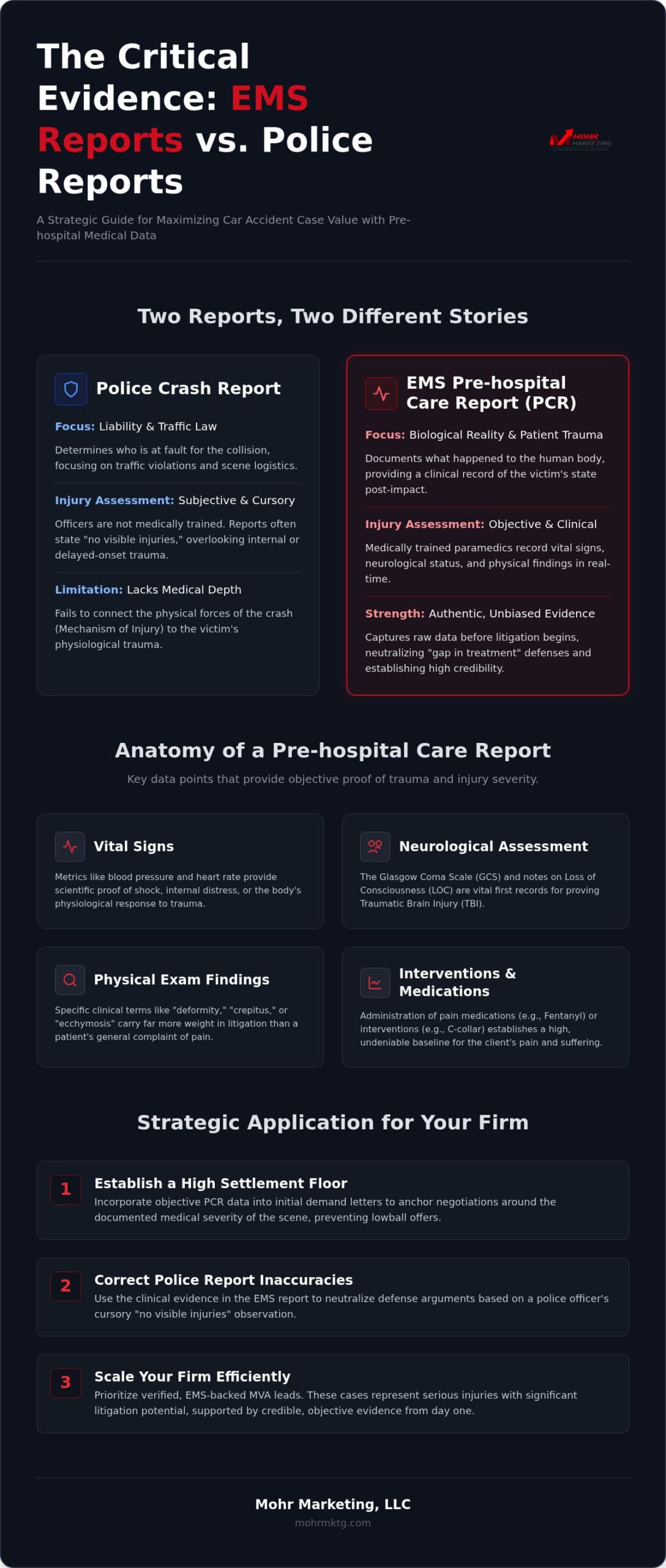
Police reports determine who hit whom. EMS reports determine what happened to the human body. This distinction is the foundation of the EMS-EMT accident reports value to car accident law suit. While an officer scans the scene for traffic violations, paramedics scan the patient for signs of shock, internal bleeding, and neurological deficits. This clinical focus creates a biological record that defense attorneys cannot easily dismiss as litigation-driven. It provides a raw, unfiltered view of the trauma before the legal process begins to shape the narrative.
The Limitations of Standard Crash Reports
Law enforcement officers are trained in scene safety and traffic law, not diagnostic medicine. Their assessments are often cursory and subjective. It’s common to see “no visible injuries” on a standard crash report, only for the victim to be transported via ambulance for a suspected spinal injury or internal trauma. Paramedics document the Mechanism of Injury (MOI), which describes the physical forces at play during the collision. This data bridges the gap between vehicle damage and physiological trauma, providing a scientific basis for injury claims that simple police observations lack.
Clinical Authenticity in Litigation
The systematic documentation of a single patient’s medical history begins the moment the ambulance arrives at the scene. These Pre-hospital Care Reports (PCRs) are generated in real-time, significantly reducing the risk of coached narratives. This immediacy effectively neutralizes the “gap in treatment” defense that insurance adjusters use to devalue claims. If a patient reports severe radiating pain at the scene, that statement is recorded before they ever speak to a legal professional.
These reports often capture “excited utterances” or spontaneous statements that fall under hearsay exceptions in court. When a driver tells an EMT, “I didn’t see him coming,” it carries more weight than a deposition taken two years later. For firms looking to scale, focusing on police-report-backed MVA cases that include EMS documentation ensures the evidence is objective and harder to refute. Juries find EMTs highly credible because they’re first responders, not paid experts. Their observations during the “Golden Hour” of trauma provide a baseline for pain and suffering, documenting the patient’s initial distress and physical limitations with mechanical accuracy.
Anatomy of a Pre-hospital Care Report (PCR): Key Evidence for Litigators
The Pre-hospital Care Report (PCR) serves as the objective medical baseline for all subsequent treatment. It is the definitive clinical account of a patient’s status from the moment of first responder arrival to the hospital handoff. For litigators, this document is a gold mine of objective data. Vital signs like blood pressure and heart rate provide scientific proof of shock or internal distress that a defense expert cannot easily hand-wave away. These metrics offer a snapshot of the body’s immediate physiological response to the collision. As highlighted in a National Academies report on trauma care, standardized documentation is critical for maintaining a high level of care; it is equally critical for maintaining the integrity of a legal claim.
The Glasgow Coma Scale (GCS) and notes on Loss of Consciousness (LOC) are particularly vital in cases involving Traumatic Brain Injury (TBI). If your client cannot remember the crash, the EMT’s assessment of their mental status at the scene fills that evidentiary void. This clinical record is where the EMS-EMT accident reports value to car accident law suit becomes undeniable. It provides the first documented evidence of neurological deficit before any secondary symptoms emerge.
Key Medical Data Points for Attorneys
Physical exam findings in a PCR often include specific descriptors like “deformity,” “crepitus,” or “ecchymosis.” These terms carry more weight than a general complaint of pain. Medications administered on the scene also serve as a proxy for injury severity. If a paramedic administers Fentanyl or Morphine, it establishes a high baseline for the client’s pain levels from the moment of impact. Additionally, the PCR captures “excited utterances” made by the driver or passengers. These spontaneous statements regarding the cause of the crash are often admissible and can contradict later, more polished versions of events. If you need assistance securing cases with this level of documented detail, you can reach out to our team to discuss high-intent lead options.
Understanding the Narrative Section
The narrative section is where the EMT provides context to the raw data. Attorneys must learn to interpret shorthand like “c/o” (complains of) or “SOB” (shortness of breath) to present a clear picture to the jury. Notes regarding “extrication” are also essential. If the PCR mentions the use of hydraulic tools or a “prolonged extrication,” it reinforces the severity of the impact and the violent nature of the crash. This narrative provides the “why” behind the injuries, linking the mechanical forces of the accident to the clinical reality of the patient.
EMS vs. Police Reports: Identifying Contradictions and Corroboration
Police officers are generalists focused on scene safety and traffic violations. Paramedics are clinical specialists focused on the human cost of the collision. The EMS-EMT accident reports value to car accident law suit lies in their ability to either corroborate or correct the standard crash report. While a police officer might misidentify which passenger occupied a specific seat, the EMT patient care record explicitly links clinical findings to a specific individual. This precision is vital. If a police report contains factual errors about the occupants or the point of impact, the medical documentation serves as the primary corrective tool for the court.
EMTs often document environmental factors that police overlook. They record the state of seatbelts, the status of airbag deployment, and the exact position of the patient upon arrival. These details are essential for countering contributory negligence claims. Understanding the legal implications of EMS documentation allows attorneys to build a defense against allegations that a client failed to mitigate their own risk. For firms prioritizing high-value outcomes, focusing on police-report backed MVA cases ensures that these two critical documents work in tandem rather than in opposition.
Neutralizing Defense Tactics
Insurance adjusters frequently use the “minor impact” defense to devalue claims. They point to low property damage as proof that no injury occurred. EMT records neutralize this tactic. When a first responder documents tachycardia, hypertension, or immediate muscle spasms at the scene, the property damage becomes secondary to the biological reality. These are involuntary responses to trauma that cannot be fabricated. Similarly, if a client appears “uncooperative” or “confused” on a police report, the EMS narrative can reframe this as a clinical sign of a concussion rather than a character flaw. This distinction protects the client’s credibility and the case’s overall value.
Building a Cohesive Narrative
A winning litigation strategy requires a 360-degree view of the incident. You must synthesize the police narrative with the medical reality to create an airtight case. Timestamped data from EMS dispatch logs provides a precise sequence of events. It proves response times, the duration of scene management, and the level of chaos handled by first responders. This chronological accuracy prevents the defense from minimizing the event’s severity. By combining these records, you move from a subjective “he-said, she-said” scenario to an objective, data-driven timeline of trauma that justifies the demand.
Leveraging EMT Testimony and Reports During Settlement Negotiations
The EMS-EMT accident reports value to car accident law suit is most evident when converting clinical data into financial leverage during the demand phase. While medical records from a hospital provide a long-term view of recovery, the PCR captures the immediate, high-intensity trauma that justifies significant pain and suffering damages. Incorporating this data into your initial demand letter sets a high settlement floor. It forces the insurance adjuster to confront objective medical facts recorded before the claimant had the opportunity to consult with an attorney. Firms that master this evidentiary strategy often see a higher ROI of Legal Intake Services because they maximize the value of every signed case through superior documentation.
The Demand Letter Strategy
To maximize impact, your demand letter should explicitly cite vital sign abnormalities documented at the scene. If the PCR shows a heart rate of 120 or a respiratory rate of 24, use these figures to prove the patient was in physiological distress. Cross-reference the EMT’s notes on vehicle intrusion or dashboard deformation with the client’s physical symptoms. This connection proves that the force of the impact was sufficient to cause the claimed injuries, effectively neutralizing “low-impact” defense arguments from the outset.
Follow this instructional step to strengthen your filing: Locate the “Primary Impression” section of the PCR and highlight the EMT’s clinical assessment in bold. Use this field as the definitive medical baseline to contrast with any later attempts by the defense to characterize the injuries as minor or pre-existing.
EMT as an Expert Witness
The EMT is often the only unbiased professional who witnessed the victim’s immediate suffering. Unlike retained experts who review files months later, paramedics provide a first-hand account of the scene’s chaos and the patient’s acute pain. Juries tend to trust first responders more than hired medical experts because their primary motivation is life-saving, not litigation. Deposing an EMT allows you to lock in testimony regarding the patient’s orientation, visible trauma, and immediate statements, bridging the gap between the crash site and the emergency room records.
Billing records from the EMS agency also serve as critical evidence. These records prove the medical necessity of emergency transport and the advanced life support (ALS) interventions performed. When an insurance carrier questions the need for an ambulance, the combination of the PCR and the itemized bill provides an unassailable defense of the treatment’s urgency. This comprehensive approach ensures that no part of the client’s trauma is left on the table during negotiations.
Scaling Your Firm with EMS-Report Backed Lead Generation
Serious injury firms must prioritize intake efficiency to scale effectively. The most direct path to growth involves targeting cases where emergency medical services were present at the scene. This is where the EMS-EMT accident reports value to car accident law suit becomes a business asset rather than just a legal one. When a lead arrives with EMS documentation already attached, the firm bypasses the initial uncertainty regarding injury severity. You aren’t just buying a contact name; you’re acquiring a case with built-in medical verification. This precision allows you to allocate firm resources toward cases with the highest probability of a significant settlement.
The difference between raw MVA leads and verified, report-backed inquiries is the difference between a gamble and a strategic investment. Raw leads often lack the clinical foundation necessary to survive early defense motions or aggressive insurance adjusters. In contrast, report-backed inquiries provide immediate proof of trauma, which significantly shortens your litigation timeline. Firms looking for sustained, high-value growth should focus on Mass Tort Signed Cases and high-intent MVA leads that offer a performance-based ROI rather than simple, unverified data sets.
The Mohr Marketing, LLC Intake Ecosystem
Case acquisition efficiency depends on the quality of the verification process. Our ecosystem utilizes Scammer Scrub™ fraud filtering and AI-supported advertising to ensure that every inquiry meets strict quality standards. Mohr Marketing, LLC eliminates the inefficient middleman markup by delivering leads directly to your firm, allowing for more competitive acquisition costs. As documented in our guide to Personal Injury Lead Generation Companies, firms that control their intake through verified data consistently outperform those relying on traditional, unverified lead sources. This direct-to-firm approach ensures data integrity and higher conversion rates.
Securing High-Value Cases in 2026
The competitive landscape of 2026 requires a proactive approach to case acquisition. Strategic growth involves targeting high-value truck accidents and serious MVA cases where the human damages are documented from the first response. Having both police and EMS reports available at the intake stage gives your firm an immediate advantage during the initial vetting process. It allows you to lock in the medical severity of the scene before the defense has an opportunity to minimize the impact or suggest a gap in treatment. This level of procedural precision ensures that the growth of your firm is built on a foundation of solid, unassailable evidence.
Scale your firm with verified MVA leads
Maximize Case Value with Clinical Evidence
Mastering the clinical nuances of Pre-hospital Care Reports transforms raw data into a powerful litigation tool. By documenting physiological distress and immediate trauma, these records neutralize common defense tactics that rely on property damage alone. Understanding the EMS-EMT accident reports value to car accident law suit allows your firm to establish a definitive medical baseline that insurance adjusters cannot ignore. These documents capture the unpolished reality of the accident scene, providing the mechanical accuracy needed to justify high-value pain and suffering demands from the outset.
Mohr Marketing, LLC has served US law firms since 1994, delivering verified, high-intent inquiries backed by rigorous state bar and UCPMP compliance. Our intake ecosystem ensures you receive leads with the medical foundation necessary for aggressive growth. Integrating this level of medical documentation into your intake process eliminates the friction of unverified claims and positions your firm as a leader in serious injury litigation. Secure the evidence required to shorten litigation timelines and increase your firm’s financial performance today.
We look forward to helping you secure the high-value cases your firm deserves through superior medical documentation and verified lead generation.
Frequently Asked Questions
Are EMS reports admissible as evidence in a car accident trial?
Yes, EMS reports are generally admissible as evidence in civil trials. They are typically classified as medical records and often fall under the business records exception to the hearsay rule. These documents provide a contemporaneous account of the victim’s condition immediately following the impact. Because they’re recorded by unbiased first responders during the “Golden Hour,” courts view them as highly reliable indicators of the raw medical reality.
What is the difference between a PCR and a hospital medical record?
A Pre-hospital Care Report (PCR) documents the patient’s status from the scene to the hospital handoff, while hospital records cover subsequent clinical care. The PCR is the only record of the patient’s immediate physiological state and spontaneous statements at the crash site. The EMS-EMT accident reports value to car accident law suit is significant because it captures acute trauma and neurological deficits that hospital tests might miss hours later.
How do I obtain an EMS report if it was not provided in the initial discovery?
You obtain an EMS report by serving a subpoena duces tecum or a formal court order to the specific EMS agency or fire department that responded. Most agencies require a signed HIPAA authorization from the client to release these records. If the report was omitted during initial discovery, check the dispatch logs to identify which specific unit arrived at the scene. This ensures you have the full clinical narrative.
Can an insurance company deny a claim if the police report says “no injuries” but the EMS report says otherwise?
Insurance companies often attempt to deny claims based on “no visible injuries” in police reports, but a clinical EMS report can effectively rebut this. Police officers lack medical training and their assessments are subjective. If a paramedic documents objective signs like tachycardia or neurological deficits, that clinical finding overrides the officer’s casual observation. This evidence is crucial for overcoming defense arguments that injuries were fabricated or simply pre-existing.
What medical codes should I look for in an EMT report to prove trauma?
Focus on specific clinical indicators like the Glasgow Coma Scale (GCS) score, heart rate, and respiratory rate rather than just billing codes. Look for descriptors such as “ecchymosis,” “deformity,” or “crepitus” as these terms provide concrete proof of physical trauma. Additionally, look for the administration of advanced life support (ALS) drugs like Fentanyl. These medications serve as a proxy for the severity of the pain and the intensity of the trauma.
How does the Glasgow Coma Scale impact the value of a car accident settlement?
The Glasgow Coma Scale (GCS) measures a patient’s level of consciousness on a scale of 3 to 15. A score below 15 indicates potential brain trauma or neurological impairment. In a car accident settlement, a low GCS score at the scene is a powerful indicator of a Traumatic Brain Injury (TBI). This objective metric increases case value by providing undeniable proof of cognitive distress that may have long-term impacts on the victim’s life.
Does HIPAA prevent law firms from accessing EMS reports for their clients?
HIPAA doesn’t prevent law firms from accessing EMS reports; it simply regulates the process of disclosure. Firms can legally obtain these records with a signed HIPAA authorization from the client or through a valid subpoena. EMS agencies are “Covered Entities” and must comply with these requests to support legal proceedings. Ensuring your intake process includes a signed authorization allows your firm to secure this critical evidence without unnecessary delays or litigation friction.
Why are EMS-backed leads considered higher quality than standard MVA leads?
EMS-backed leads are superior because they provide verified proof of injury at the scene. Standard MVA leads often rely on self-reported data that may lack medical support. Leads backed by EMS intel have already been vetted for serious injury and immediate medical intervention. This verification reduces the risk of fraud and ensures your firm invests in high-intent inquiries that have a clear path to significant settlement values and successful litigation outcomes.

Recent Posts
- The Strategic Value of EMS-EMT Accident Reports in Car Accident Lawsuits
- Emergency vehicle response to accident Best Practices and Expert Advice
- 2026 Law Firm Marketing Budget: Performance-First Guide
Categories
- AI and Lead Generation
- Business Financing
- Call Verified MVA Leads
- Car Accident Help
- Car Accident Settlements
- Claimant Funding
- Compliance Program
- EMS-EMT Reports
- Geotargeting
- Google Maps Ranking
- Healthcare Practice Growth
- Law Firm Growth
- Law Office Operations
- Lead Generation
- Lead Generation For Attorneys
- Lead Generation For Chiropractors
- Lead Generation For Criminal Attorneys
- Lead Generation For D&A Treatment Centers
- Lead Generation For DUI Attorneys
- Lead Generation For Eye Doctors
- Lead Generation For Family Law Practices
- Lead Generation For PI Law Firms
- Lead Generation For Plastic Surgeons
- Leads For Healthcare Professionals
- Leads For Insurance Industry
- Legal Leads
- Legal Marketing
- Legal Updates
- Mass Tort Leads
- Medicare and Medicaid Leads
- Merchant Funding Leads
- Online Marketing Strategies
- Pre-Settlement Funding
- Signed MVA Cases
- Tort Updates
- Truck Accident Leads and Signed Cases
- Truck Accident Settlements
- Web Design