Navigating Legal Marketing Compliance: Terminology and Strategy Shifts Under CA SB 37
August 9, 2026 by Mohr Marketing
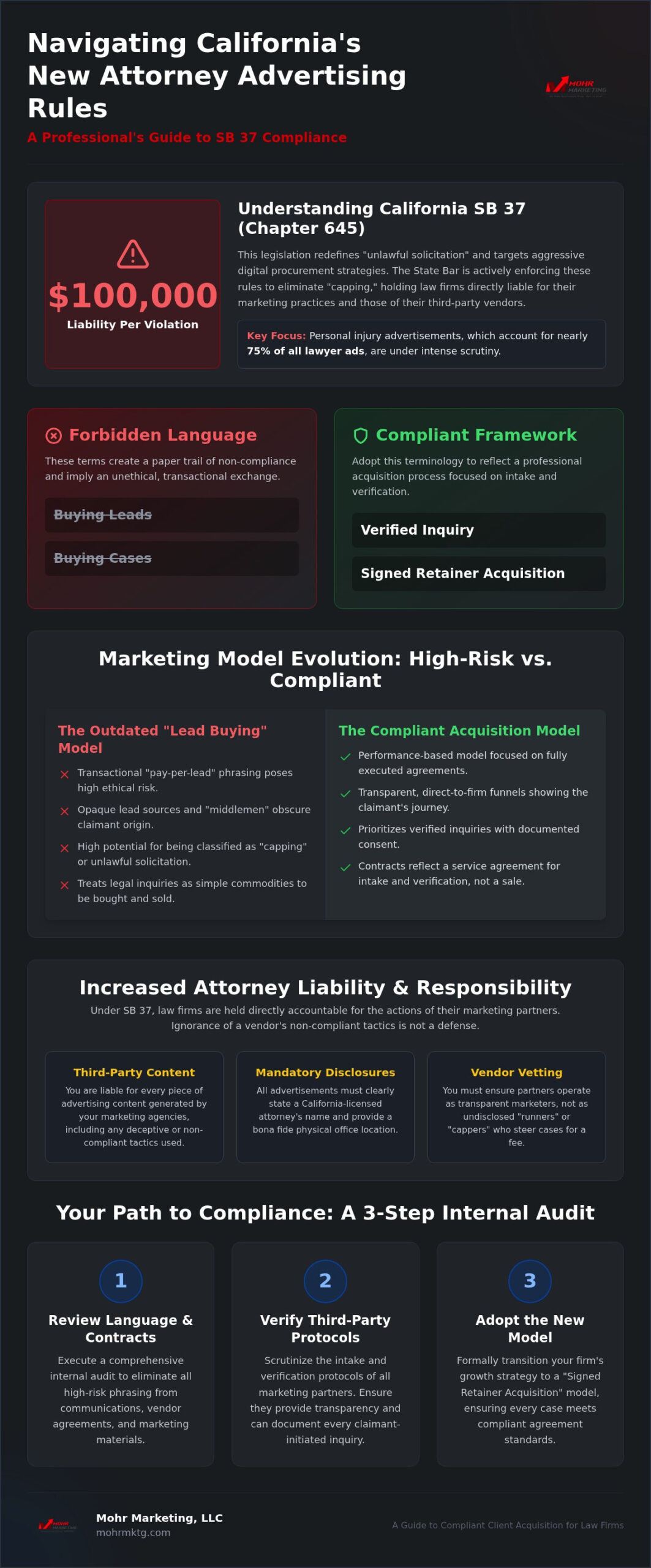
Violating California SB 37 (Chapter 645) is no longer a minor marketing oversight; it is a $100,000 liability per violation. Since personal injury advertisements account for nearly 75% of all lawyer ads, the State Bar has focused its enforcement efforts directly on your growth channels. You’ve likely recognized that you cannot use the terms buying leads or buying cases any more due to state laws (CA SB 37) and bar mandates. This regulatory shift creates a narrow path for firms that want to scale without facing disciplinary action or being accused of “capping.”
We understand the pressure to maintain a high volume of new files while navigating these strict ethical boundaries. It’s frustrating to face potential professional risk simply for trying to grow your practice. This guide from Mohr Marketing, LLC teaches you how to transition your firm from high-risk models to a compliant, performance-based acquisition system that satisfies 2026 bar mandates. We will break down the new terminology framework and the verified inquiry process that protects your license. You’ll learn to secure signed retainers through a transparent ecosystem that eliminates ethical friction and fuels long-term expansion.
Key Takeaways
- Identify the “Verified Inquiry” as the new industry benchmark for maintaining ethical standards under 2026 bar mandates.
- Recognize that practitioners cannot use the terms buying leads or buying cases any more due to state laws (CA SB 37)and bar mandates.
- Execute a comprehensive internal audit to eliminate high-risk “pay-per-lead” phrasing and verify third-party intake protocols.
- Adopt a Signed Retainer Acquisition model to ensure every case meets the requirement for fully executed, compliant agreements.
- Prepare for increased attorney liability regarding third-party advertising content and mandatory office location disclosures.
Understanding CA SB 37: The New Standard for Attorney Advertising
California SB 37, formally codified as Chapter 645, redefined the boundaries of attorney growth. This legislation targets “unlawful solicitation,” a term that now encompasses aggressive digital procurement strategies once considered industry standard. The State Bar of California is actively monitoring the relationship between firms and their marketing vendors to eliminate the practice of “capping.” You must recognize that you cannot use the terms buying leads or buying cases any more due to state laws (CA SB 37)and bar mandates. These phrases suggest a transactional exchange of human beings as inventory, which triggers immediate scrutiny regarding the ethical procurement of legal business.
The history of legal advertising shows a steady move toward transparency and consumer protection. While landmark cases historically permitted commercial speech, SB 37 narrows the path for firms that treat legal inquiries as simple commodities. The law holds attorneys directly responsible for every piece of content generated by their third-party marketing partners. If an agency uses deceptive tactics or fails to disclose a California-licensed attorney’s name and a bona fide office location, the law firm is liable for statutory damages ranging from $5,000 to $100,000 per violation. This shift impacts every referral from non-governmental entities, requiring a rigorous audit of how potential clients are funneled into your practice.
The Legal Definition of a Runner or Capper
Under the 2026 mandate, a runner or capper is any person or entity acting for “consideration” to solicit or procure business for an attorney. Consideration includes any value exchanged for the referral, not just direct cash payments. If an agency steers a claimant to your firm without a verified, non-deceptive process, they risk being classified as an unlawful intermediary. Prohibited scenarios include soliciting individuals at accident scenes, medical facilities, or through electronic communications that lack mandatory disclosures. You must ensure your partners operate as transparent marketing entities rather than undisclosed agents who “steer” cases for financial gain.
Why Terminology Matters for Professional Decorum
Terminology is the primary filter used by bar auditors during compliance reviews. Using transactional language in your contracts or internal communications creates a paper trail of non-compliance. The Bar views the “purchase” of a potential client as an inherent ethical breach. You must shift your internal and external framework to “Verified Inquiry” or Signed Retainer Acquisition models. This isn’t just a matter of semantics. It represents a move toward professional acquisition where the emphasis is on the quality of the intake and the explicit consent of the prospect. Your marketing contracts must reflect a service agreement for intake and verification, not a bill of sale for human beings.
The Shift to Verified Inquiry and Signed Retainer Acquisition
The 2026 regulatory environment demands a departure from transactional marketing models. You must adopt a “Verified Inquiry” framework to ensure strict compliance with the California Rules of Professional Conduct. This model prioritizes the explicit intent of the claimant over the mere volume of contacts. Under the new standards, a verified inquiry is a prospect who has been screened against specific case criteria and has provided documented consent to be contacted by a specific firm. This level of verification is the only way to satisfy bar auditors who are now looking for “unlawful solicitation” in every marketing contract.
It’s clear that you cannot use the terms buying leads or buying cases any more due to state laws (CA SB 37)and bar mandates. Transitioning to a “Signed Retainer Acquisition” model allows your firm to focus on fully executed agreements. This shift ensures that the relationship between the attorney and the client is established through a transparent, compliant process that eliminates the risk of being labeled a “capper.” High-intent opportunities must be backed by data-driven verification to prove the claimant initiated the request for legal services.
Performance-Based Acquisition vs. Lead Aggregation
Traditional lead aggregation often relies on opaque “middlemen” who obscure the source of the inquiry. Performance-based acquisition uses direct-to-firm marketing funnels that provide full transparency into the claimant’s journey. You should structure your marketing fees around the verification service and the intake labor rather than a per-head “referral” fee. This distinction is critical for maintaining professional decorum. By eliminating inefficient intermediaries, you reduce your liability and increase the quality of your case files. If you want to audit your current acquisition strategy, speak with a compliance specialist today.
Case Study: Terminology in Mass Tort Marketing
In high-stakes litigation, such as mesothelioma inquiries, terminology directly impacts claimant trust. A prospect searching for legal help expects a professional intake experience, not a sales pitch from a call center. Your marketing must align with real search intent and rigorous bar standards. Using professional vocabulary like “case acquisition” or “verified prospect” instead of “lead” reinforces your firm’s authority. This approach ensures that every interaction is documented, compliant, and focused on the claimant’s specific legal needs.
Comparing Old ‘Lead Buying’ vs. Modern Verified Acquisition
The traditional pay-per-lead model has become a significant regulatory liability. This legacy approach relies on volume over validity, often delivering unvetted data points that lack a transparent chain of custody. In the current landscape, this triggers audits because it fails to document the claimant’s explicit intent. Modern verified acquisition operates as a performance-based ecosystem where every file delivered to your firm has passed a rigorous screening process. You must recognize that you cannot use the terms buying leads or buying cases any more due to state laws (CA SB 37)and bar mandates. Shifting to a verified acquisition model protects your firm from the statutory penalties of up to $100,000 per violation associated with non-compliant solicitation.
Traditional aggregators often function as “middlemen” who obscure the source of their inquiries. This opacity is a primary target for State Bar auditors. Verified acquisition replaces this with a direct, transparent funnel. Every inquiry is backed by data that proves the claimant initiated the request for legal help. This methodical approach ensures that your firm receives high-intent opportunities rather than raw, unvetted data. By focusing on verified inquiries, you achieve a higher ROI. Your intake team spends less time on “dead-air” calls and more time on high-value files that are ready for litigation.
MVA Case Acquisition: A Compliance Blueprint
Motor vehicle accident litigation requires absolute accuracy to satisfy 2026 standards. Utilizing police-report-backed MVA cases ensures the legitimacy of the accident and the parties involved. There is a critical difference between an “accident inquiry” and a “verified case.” An inquiry is often just a raw name and number. A verified case includes confirmed insurance information, documented injury details, and a validated police report. These verification protocols protect your firm from “runner” allegations by proving the acquisition of a documented legal opportunity rather than a steered referral.
Mass Tort Scalability and Ethical Standards
Scaling your practice requires a high volume of claimants, but this growth must remain within ethical boundaries. You can achieve scalable mass tort lead generation by using turnkey marketing systems that prioritize transparency. These systems utilize a “straight-talk” brand voice to build trust with high-intent individuals. Every claimant inquiry must be treated as a specific legal opportunity rather than a commodity. This ensures that when a prospect reaches your intake team, they have already been screened against strict case criteria. This level of precision eliminates the friction of compliance audits and allows you to focus resources on case resolution.
How to Audit Your Marketing for SB 37 Compliance
Operationalizing compliance requires a methodical review of your firm’s entire growth funnel. It’s not enough to simply understand the law; you must implement a structured audit process to identify and eliminate regulatory red flags. The State Bar of California expects attorneys to exercise direct oversight over their third-party marketing partners. Failure to document this oversight leaves your firm vulnerable to statutory damages and disciplinary action. Use the following five steps to ensure your practice meets the 2026 standards for ethical case acquisition.
- Step 1: Terminology Overhaul. Review every contract, invoice, and internal memo. You must acknowledge that you cannot use the terms buying leads or buying cases any more due to state laws (CA SB 37)and bar mandates. Replace this transactional language with “Verified Inquiry” or “Signed Retainer Acquisition” to align with professional decorum.
- Step 2: Partner Verification. Vet every third-party marketing partner for absolute transparency. Ensure their advertisements include the name of at least one California-licensed attorney and a bona fide office location. If your vendors cannot provide a clear chain of custody for their inquiries, they are a liability.
- Step 3: Claimant Flow Documentation. Map the journey of an inquiry from the initial digital advertisement to the signed retainer. You need a documented audit trail that proves the consumer initiated the contact. This record is your primary defense against “capping” or “runner” allegations.
- Step 4: Intake Script Audit. Ensure all intake services utilize a structured, non-solicitous script. The language must be informative rather than aggressive. Audit recorded calls to verify that intake specialists are not “steering” cases in a way that violates SB 37 mandates.
- Step 5: Ecosystem Integration. Implement a data-driven marketing and intake ecosystem. This turnkey approach eliminates the risk of using unverified intermediaries and provides the transparency required for bar audits.
Optimizing the Intake Ecosystem
The ROI of legal intake services is inextricably linked to ethical conversion. Your intake team must focus on removing friction in the procurement of fully executed agreements while maintaining a high level of professional decorum. This requires a shift from high-pressure sales tactics to a service-oriented model that prioritizes the claimant’s intent. By utilizing structured verification protocols, you ensure that every case entering your firm is compliant and ready for litigation.
Documentation and Record Keeping
Maintaining a clear trail for bar auditors is the only way to protect your license in the 2026 regulatory landscape. A compliant report must include the specific digital source of the inquiry and the exact time the consumer provided consent. This level of detail proves that your firm is acquiring legal business through legitimate, non-solicitous channels. A Verified Inquiry is a data-backed record of consumer intent.
The Mohr Marketing, LLC Solution: Compliant Case Acquisition
Mohr Marketing, LLC provides the structural bridge between aggressive firm growth and strict 2026 compliance. With over 30 years of industry experience, we’ve engineered a turnkey ecosystem that eliminates the risks associated with unverified aggregators. Our model focuses on the delivery of mass tort signed cases through a transparent, documented process. You must recognize that you cannot use the terms buying leads or buying cases any more due to state laws (CA SB 37)and bar mandates. We replace these outdated concepts with a verified inquiry framework that satisfies the most rigorous bar audits. This approach ensures your firm remains competitive without compromising its ethical standing.
Our turnkey intake ecosystem is designed specifically to meet the Chapter 645 requirements. We provide a direct-to-firm funnel that preserves the integrity of the attorney-client relationship from the first point of contact. By integrating marketing and intake, we remove the friction that often leads to “capping” allegations. Your firm receives a fully verified file, complete with a documented chain of custody and explicit consumer consent. This level of procedural precision is essential for firms that want to scale in high-stakes practice areas while maintaining absolute transparency.
High-Value Acquisition Strategies
Our expertise extends to complex litigation, including high-value mold case acquisition and other high-stakes torts. Mohr Marketing, LLC utilizes a “straight-talker” approach to claimant intake, ensuring that every interaction is professional and non-solicitous. Transparency is the core of our business model. We provide a clear record for every inquiry, proving that the consumer initiated the request for legal services. This precision ensures that your firm acquires high-intent opportunities that are ready for immediate litigation. We eliminate the inefficient “middleman” layer that often complicates compliance and inflates acquisition costs.
Next Steps for Your Firm
Evaluating your current acquisition partners against 2026 standards is a critical priority for your firm’s survival. Many legacy providers still operate under models that trigger SB 37 audits and statutory penalties. You must accept that you cannot use the terms buying leads or buying cases any more due to state laws (CA SB 37)and bar mandates. Transitioning to a pay-per-signed-case model offers maximum efficiency and protects your professional license. This shift allows you to focus your internal resources on case resolution rather than intake compliance. It’s time to move away from high-risk procurement. Mohr Marketing, LLC is ready to secure your firm’s future growth.
Secure Your Practice Against Regulatory Shifts
The transition from volume-based lead generation to a verified acquisition model is no longer optional. As discussed throughout this guide, the 2026 mandates place the burden of proof squarely on the attorney to document non-deceptive procurement. You’ve learned that you cannot use the terms buying leads or buying cases any more due to state laws (CA SB 37)and bar mandates. Adopting a compliant terminology framework and a data-backed intake process is the only way to insulate your practice from $100,000 statutory penalties and potential bar audits.
Mohr Marketing, LLC brings 30+ years of industry authority to help you navigate this transition. We provide the transparency required by bar auditors through verified, police-report-backed inquiries and fully documented claimant journeys. Our turnkey ecosystem removes the friction of compliance, allowing you to focus on high-value litigation rather than auditing vendors. Partnering with a veteran strategic partner ensures your firm remains aggressive in its growth while remaining beyond ethical reproach.
Take the proactive step toward a more secure and scalable future for your practice. By aligning your acquisition strategy with current bar standards today, you secure your firm’s competitive advantage for years to come.
Frequently Asked Questions
What does SB 37 mean for law firms using digital marketing?
SB 37 mandates strict transparency and direct attorney responsibility for all third-party advertisements. Firms must ensure every digital marketing asset includes the name of a California-licensed attorney and a physical office location. This law expands the definition of “advertisement” to include social media and email marketing. Every digital touchpoint is now subject to bar audits and potential civil litigation through a new private right of action.
Is it still legal to pay for marketing that results in signed cases?
Yes, paying for marketing services remains legal as long as the payment is for the labor of generating inquiries or managing intake. You must structure agreements around performance-based acquisition models like Verified Inquiry or Signed Retainer Acquisition. This ensures you’re paying for professional marketing and verification services. This approach avoids the risk of participating in unlawful solicitation or capping, which are primary targets of the 2026 mandates.
How do I differentiate between a ‘runner’ and a compliant marketing agency?
A compliant agency provides a transparent audit trail and documents explicit consumer consent for every inquiry. Runners and cappers often operate in the shadows, steering cases through deceptive tactics or undisclosed consideration. If an agency cannot show you exactly how and where a prospect provided their information, they’re likely operating as an unlawful intermediary. This lack of transparency exposes your firm to significant regulatory risk and potential bar disciplinary action.
What terms should I use instead of ‘buying leads’ in my business contracts?
You should adopt professional acquisition language such as “Verified Inquiry Procurement” or “Performance-Based Intake Services.” It is essential to recognize that you cannot use the terms buying leads or buying cases any more due to state laws (CA SB 37)and bar mandates. These legacy phrases imply a transactional exchange of claimants, which bar auditors interpret as a direct indicator of unlawful capping or unethical solicitation practices.
What happens if a law firm is found in violation of CA SB 37?
Violations trigger severe financial penalties and potential bar disciplinary action. Under the new mandate, consumers have a private right of action to file civil lawsuits against firms for non-compliant advertising. Statutory damages can reach $100,000 per violation depending on the severity and frequency. Additionally, the State Bar may initiate a formal investigation into your firm’s procurement practices, which often results in public reproval or license suspension.
Can I still use intake call centers for mass tort acquisition?
You can use intake services if they operate within a structured, non-solicitous framework. The call center must act as a neutral verification layer that screens prospects against specific case criteria. It’s essential that the intake process is documented and focused on gathering information rather than steering or aggressive solicitation. Transparency in the call script and data collection process is mandatory for maintaining compliance with the latest California Rules of Professional Conduct.
How does Mohr Marketing, LLC ensure all inquiries are verified?
Mohr Marketing, LLC implements a multi-point verification protocol that tracks the claimant’s journey from the initial search click through to the intake completion. We provide a comprehensive data report for every inquiry, including the specific digital source and the exact moment of consent. This transparency proves that your firm is acquiring legal business through legitimate, non-solicitous channels that meet strict 2026 standards.
What are the penalties for unlawful solicitation under the new bar mandates?
Attorneys face statutory damages of up to $100,000 per violation and the potential for civil lawsuits under the new private right of action. Because you cannot use the terms buying leads or buying cases any more due to state laws (CA SB 37)and bar mandates, any documentation using this language serves as evidence of non-compliance. Beyond financial loss, the State Bar may impose public reproval, license suspension, or permanent disbarment.
Recent Posts
- NEC Baby Formula Case Acquisition: A Law Firm’s 2026 Guide
- Justifying Marketing Investment to Law Firm Partners: A Data-Driven Framework
- Roundup Cancer Lawsuit Leads: Buying Guide for Law Firms
Categories
- AI and Lead Generation
- Business Financing
- Call Verified MVA Leads
- Car Accident Help
- Car Accident Settlements
- Claimant Funding
- Compliance Program
- EMS-EMT Reports
- Geotargeting
- Google Maps Ranking
- Healthcare Practice Growth
- Law Firm Growth
- Law Office Operations
- Lead Generation
- Lead Generation For Attorneys
- Lead Generation For Chiropractors
- Lead Generation For Criminal Attorneys
- Lead Generation For D&A Treatment Centers
- Lead Generation For DUI Attorneys
- Lead Generation For Eye Doctors
- Lead Generation For Family Law Practices
- Lead Generation For PI Law Firms
- Lead Generation For Plastic Surgeons
- Leads For Healthcare Professionals
- Leads For Insurance Industry
- Legal Leads
- Legal Marketing
- Legal Updates
- Mass Tort Leads
- Medicare and Medicaid Leads
- Merchant Funding Leads
- Mold Leads
- Online Marketing Strategies
- Pre-Settlement Funding
- Signed MVA Cases
- Tort Updates
- Truck Accident Leads and Signed Cases
- Truck Accident Settlements
- Web Design