Vetting Mass Tort Leads: Guide to Case Viability
August 4, 2026 by Mohr Marketing
A massive lead volume is often the fastest way to bankrupt a mass tort marketing budget. If your firm is struggling with non-responsive inquiries or wasted spend on dual-representation claimants, you aren’t alone. You already know that raw data is useless without a strategy to separate legitimate victims from digital noise. Success in this hyper-competitive market depends entirely on vetting mass tort leads for quality before they ever reach your intake team.
You need a system that prioritizes case viability over simple contact information. This article provides a clear roadmap for implementing a rigorous, multi-layered verification process designed to transform raw inquiries into litigation-ready mass tort cases. We’ll examine the specific medical and legal criteria required for modern dockets and show you how to build a predictable cost-per-signed-case model. You’ll learn how to refine your intake process to ensure strict adherence to litigation-specific criteria and maximize your conversion rates from inquiry to retainer.
Key Takeaways
- Stop wasting resources on low-quality data by understanding the hidden costs of intake bottlenecks and staff burnout.
- Implement a rigorous 5-step framework for vetting mass tort leads for quality, focusing on digital intent and core medical criteria.
- Utilize multi-layered verification to cross-reference claimant data with public records, ensuring every inquiry is litigation-ready.
- Maintain strict adherence to ABA Model Rules and state bar mandates to ensure your claimant acquisition is ethical and defensible.
- Transition to a performance-based model that shifts the risk of lead vetting to your marketing partner and streamlines your path to signed retainers.
Understanding the Economics of Vetting in Mass Tort Litigation
The true cost of a mass tort campaign extends far beyond the initial media spend. It includes the hundreds of hours your intake staff wastes chasing non-responsive phone numbers and the inevitable burnout that follows. When your team sifts through a mountain of unqualified inquiries, they lose the capacity to identify and secure high-value cases. This creates a functional bottleneck that stifles firm growth. Vetting mass tort leads for quality is the only strategic way to protect your bottom line from these compounding hidden expenses.
Litigation in 2026 demands a significantly higher standard of data integrity than previous years. The regulatory environment is more restrictive, and major advertising platforms have implemented strict requirements for legal disclosures and landing page transparency. To understand what is a mass tort in the current market, you must view it as a data-driven competition. You aren’t just looking for individuals who were “exposed” to a product. You are searching for litigation-ready claimants who possess documented diagnoses and meet specific legal criteria. Vetting mass tort leads for quality ensures you don’t waste capital on inquiries that will never survive a motion to dismiss.
The ROI Gap: Raw Leads vs. Verified Cases
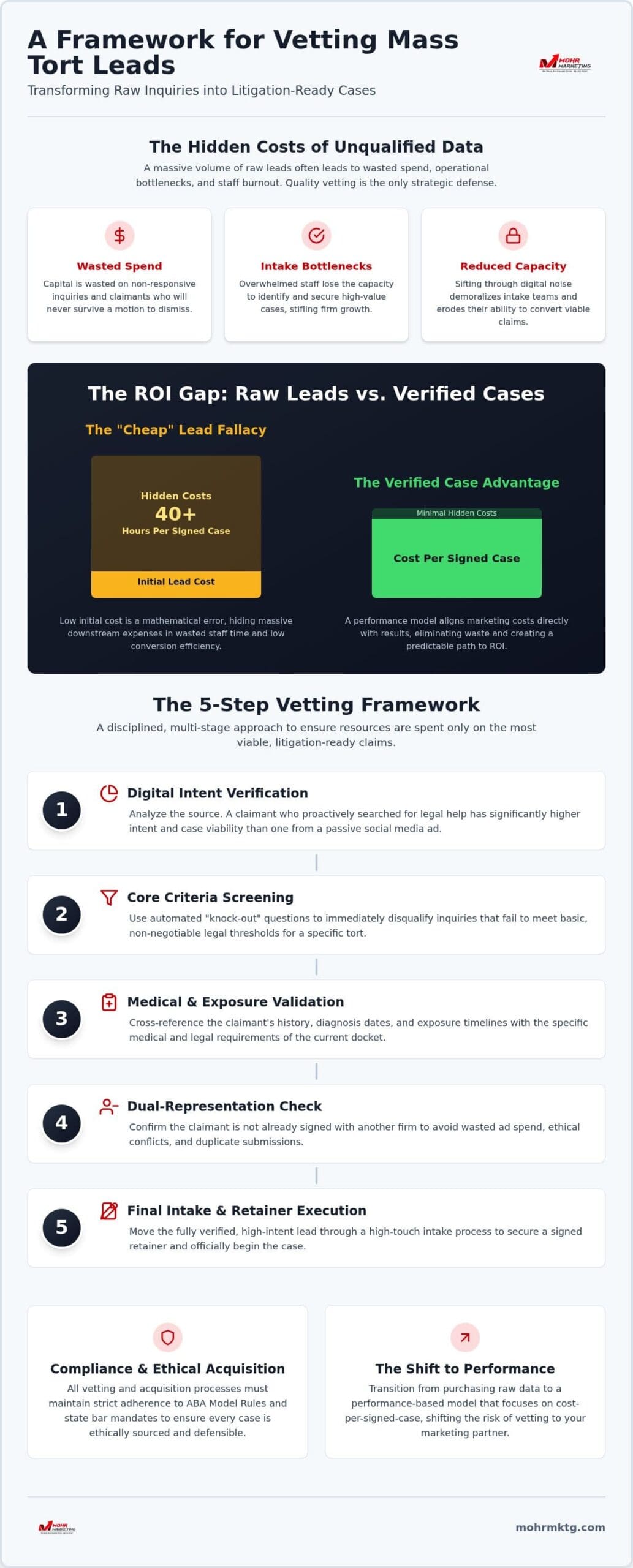
Many firms fall into the trap of purchasing “cheap” leads, assuming that high volume will eventually yield a profitable return. This is a mathematical error. A raw digital inquiry often lacks a confirmed medical diagnosis or a verified exposure timeline. The ROI gap is the measurable distance between the cost of an unverified inquiry and the cost of a fully executed retainer; it’s defined by your conversion efficiency. If your team spends forty hours to sign a single case from a batch of one hundred low-quality leads, that “cheap” lead is actually your most expensive asset.
Market Saturation and the Need for Precision
The digital landscape is currently saturated with aggressive, low-quality advertising tactics that generate high noise and low intent. High-intent claimants are frequently buried under a mountain of duplicate submissions and “dual-representation” inquiries from people who have already signed with other firms. Precision vetting identifies the serious prospect before they are contacted by multiple competitors. By focusing on mass tort signed cases rather than raw inquiries, you eliminate the friction of the initial screening process. This level of precision is your primary defense against diminishing ROI in hyper-competitive tort markets. It ensures your resources are concentrated on claimants who possess the medical evidence required for successful litigation.
A 5-Step Framework for Vetting Mass Tort Leads for Quality
Effective vetting is not a single check. It’s a tactical hierarchy. Each phase of the process must progressively increase the probability of a successful settlement while filtering out liabilities. To maximize your firm’s conversion efficiency, you must implement a standardized sequence that moves from broad digital signals to specific medical evidence. Vetting mass tort leads for quality requires this disciplined, multi-stage approach to ensure your resources are spent only on the most viable claims.
- Step 1: Digital Intent Verification. Analyze the source. A claimant who proactively searched for legal help has higher intent than someone who clicked a generic social media ad.
- Step 2: Core Criteria Screening. Use “knock-out” questions to immediately disqualify inquiries that don’t meet basic legal thresholds.
- Step 3: Medical and Exposure Validation. Cross-reference the claimant’s history with the specific medical requirements of the current docket.
- Step 4: Dual-Representation Check. Confirm the claimant isn’t already signed with another firm to avoid wasted ad spend and ethical conflicts.
- Step 5: Final Intake and Retainer Execution. Move the verified lead through a high-touch intake process to secure a signed retainer.
Establishing “Knock-Out” Questions
Automated disqualification is your first line of defense. You must define non-negotiable criteria for every specific tort to save your intake team from dead-end conversations. For example, when generating mesothelioma leads, your system must immediately verify asbestos exposure windows and diagnosis dates. If the statute of limitations has passed or the exposure doesn’t match the litigation timeline, the lead is discarded instantly. This level of precision allows your team to focus exclusively on high-value opportunities. Evaluate your current intake efficiency by consulting with our strategy team.
The Human Element in Technical Vetting
Technology filters the data, but humans secure the case. Automated forms often fail to capture the nuance of a claimant’s experience. Expert intake professionals are necessary to build rapport and probe deeper into medical histories that a digital form might miss. This human touch is critical for maintaining high sign-up rates. When training your staff, use a script that balances empathy with clinical precision. This ensures the claimant feels heard while you gather the data required by the court. Adhering to ABA guidance on client intake is essential when delegating these tasks to third-party partners. Vetting mass tort leads for quality is a combined effort of mechanical accuracy and professional judgment.
Leveraging Multi-Layered Verification for High-Intent Inquiries
Multi-layered verification is the process of triangulating digital behavior, demographic history, and medical substantiation to confirm a claimant’s legitimacy. Vetting mass tort leads for quality requires more than a simple phone screen or a basic web form. You must cross-reference self-reported data against objective third-party sources to eliminate fraud and ensure every case is litigation-ready. This approach identifies “professional claimants” who rotate through dockets with fabricated injuries, protecting your firm from ethics violations and wasted resources.
Fraudulent claimants often use virtual private networks (VPNs) or spoofed phone numbers to bypass basic filters. Multi-layered verification detects these digital anomalies by analyzing IP addresses and carrier data in real time. If the digital footprint does not match the reported residency or identity, the system should flag the lead for immediate rejection. By combining these technical signals with demographic validation, you create a defensive barrier that only high-intent, legitimate inquiries can penetrate.
Third-Party Data Integration
Real-time data integration is a technical requirement for any firm serious about scale. By utilizing databases like LexisNexis, you can instantly verify a claimant’s identity and litigation history before your intake team even picks up the phone. This ensures the person on the line is who they claim to be and resides in a jurisdiction favorable to the specific tort. For motor vehicle accidents, utilizing police report-backed MVA cases provides immediate, defensible proof of liability and injury. Your system should employ real-time API integration to validate this data the moment an inquiry is submitted, preventing bad data from polluting your CRM.
Verifying Exposure and Injury Links
Validating exposure is particularly challenging in environmental and defective product cases where the injury may manifest years after the event. You must look for specific markers that connect the claimant to the site or product during the relevant litigation window. For specialized dockets, such as high-value mold case acquisition, your screening must include a review of property records and professional remediation reports. Medical link verification is the rigorous procedure of cross-referencing a claimant’s clinical diagnosis against established medical literature and docket-specific causation standards to ensure legal viability. When vetting mass tort leads for quality, this step is non-negotiable for establishing the foundation of a successful claim.
Medical affidavits and pharmacy records serve as the ultimate quality filter in the final stages of verification. These documents transform a verbal claim into a tangible, litigation-ready asset. When you require these records early in the vetting process, you naturally filter out individuals who lack the necessary evidence to survive a motion to dismiss. This methodical approach ensures that your firm only invests in cases with a high probability of settlement or successful trial outcomes.
Compliance Auditing: Ensuring Ethical and Defensible Claimant Acquisition
Compliance serves as the final, most critical filter in your acquisition strategy. If an inquiry is generated through deceptive means or in violation of privacy laws, it is legally worthless to your firm. Vetting mass tort leads for quality requires a rigorous audit of the entire lead generation lifecycle to ensure every claimant is defensible in court. You aren’t just buying data; you are acquiring a legal interest that must withstand intense scrutiny from defense counsel during the discovery phase.
Adhering to the American Bar Association (ABA) Model Rules and specific state bar mandates is a baseline requirement. Your marketing partner must demonstrate a clear understanding of solicitation rules and disclosure requirements. A failure here doesn’t just result in a lost lead; it puts your license at risk. Before committing to a campaign, you must audit a provider’s compliance history and their internal quality control measures. Don’t ignore the fine print. State-specific bar mandates often include unique requirements for disclaimer placement and font size. If your lead provider uses a “one-size-fits-all” approach, you’re likely out of compliance in several jurisdictions.
TCPA and Data Privacy Standards
Documented consent is the only protection against Telephone Consumer Protection Act (TCPA) litigation. Every lead must be generated through clear, unambiguous opt-in procedures. You should never settle for “aged” leads or data that has been scraped from public directories. These methods are inefficient and dangerous. A strategic partner will provide a “certificate of origin” for every batch of inquiries, documenting the timestamp, IP address, and specific disclosure language the claimant agreed to. This audit trail is your primary defense in the event of a regulatory inquiry or a challenge to case validity.
Ethical Advertising and Claimant Expectations
The quality of a lead is often determined by the honesty of the advertisement. Misleading digital creative that promises “instant settlements” or “no-work payouts” attracts low-intent individuals. These people are frequently disqualified during the first minute of intake, driving up your cost-per-signed-case. High-integrity ads focus on the reality of the litigation, ensuring that the inquiries you receive are from individuals who possess a genuine medical need and a realistic expectation of the legal process. This transparency is what leads to mass tort signed cases that actually move the needle for your firm. When vetting mass tort leads for quality, you must insist on seeing the ad copy that represents your firm’s brand.
To perform a thorough compliance audit, request these specific items: a “certificate of origin” for previous batches, samples of current ad copy, and a live walkthrough of the opt-in landing page. If a provider cannot produce these within twenty-four hours, their process is likely flawed. A reliable partner welcomes your scrutiny because their process is built on rigorous verification and ethical standards. They understand that your firm’s reputation is tied to the quality of the leads they deliver.
Transitioning from Lead Vetting to Pay-Per-Signed-Case Models
Internal intake departments are often expensive, high-risk operational burdens. Traditional pay-per-lead models force firms to absorb the costs of non-responsive inquiries and unqualified claimants. Vetting mass tort leads for quality is a burden you can shift to a marketing partner through a performance-based model. This fundamental change aligns your marketing spend with actual case acquisition. It ensures you only pay for litigation-ready assets that have already been verified against strict legal criteria.
The ROI of a raw lead is speculative. Conversely, the ROI of a signed retainer is a measurable financial fact. When your partner assumes the risk of the vetting process, your firm can focus its capital on litigation rather than administrative overhead. This strategy is essential for firms aiming to scale in 2026. Moving away from traditional agencies allows you to bypass the noise of the digital market and receive a steady stream of fully executed agreements.
Eliminating the “Intake Bottleneck”
Turnkey marketing ecosystems manage the entire lifecycle of a claimant. This process begins at the initial digital touchpoint and ends with the final signature. Comprehensive management eliminates the friction points that typically slow down case acquisition. By receiving truck accident signed cases directly, your firm reduces the time-to-file and maximizes staff efficiency. You don’t need a massive call center to filter through thousands of low-intent inquiries. The work of vetting mass tort leads for quality is finished before the data ever enters your practice management software.
Scaling with Predictability
Predictability is the cornerstone of sustainable growth. A pay-per-signed-case model provides a fixed acquisition cost. This allows you to budget with surgical precision. Traditional agencies often leave firms with the burden of conversion, which results in inconsistent monthly sign-up rates. Top-tier firms are increasingly choosing partners who offer a more direct, zero-waste path to success. This results-oriented approach ensures every dollar of your marketing budget is tied to a tangible legal case. If you’re ready to secure your firm’s expansion, Partner with Mohr Marketing to scale your case acquisition with zero-waste vetting.
Optimize Your Case Acquisition Strategy
Success in modern mass tort litigation isn’t measured by the volume of inquiries but by the integrity of your signed retainers. You now understand that a rigorous 5-step framework and multi-layered verification are essential to protect your firm from non-responsive data and fraudulent claims. Vetting mass tort leads for quality remains the most effective defense against staff burnout and wasted advertising spend. By adopting a performance-based model, you shift the operational risk and focus your resources on high-value litigation.
Mohr Marketing provides the strategic advantage of 30+ years of legal marketing expertise. Our system ensures strict state bar compliance standards while delivering verified cases through a performance-based acquisition model. We eliminate the inefficiencies of traditional intermediaries to provide a direct, reliable path to firm expansion. It’s time to replace speculative leads with litigation-ready assets.
Your firm’s growth depends on the precision of your intake process. Start building a more predictable and profitable mass tort portfolio today.
Frequently Asked Questions
What are the most critical vetting criteria for mass tort leads?
The most critical criteria include verified product exposure, a confirmed medical diagnosis, adherence to the statute of limitations, and the absence of an existing attorney-client relationship. These four pillars ensure the inquiry can actually survive a motion to dismiss. Without these, you’re simply buying contact information rather than a viable legal interest that can be successfully litigated in court.
How does multi-layered verification prevent dual-representation issues?
Multi-layered verification prevents dual-representation by cross-referencing claimant data against third-party databases and proprietary litigation lists in real time. This process identifies individuals who have already signed with another firm for the same docket. It eliminates the wasted expense of pursuing claimants who are contractually unavailable to your firm and protects you from potential ethical conflicts during the intake phase.
Why is TCPA compliance essential for vetting lead quality?
TCPA compliance is a fundamental component of vetting mass tort leads for quality because it ensures the legal defensibility of the inquiry. Leads generated without documented, unambiguous consent are a significant regulatory risk and often indicate low-integrity marketing tactics. A compliant lead includes a verifiable certificate of origin that protects your firm from costly litigation and ensures the data was acquired ethically.
Can automated intake systems replace human vetting for mass torts?
Automated systems cannot replace human vetting; they function as a preliminary filter rather than a complete solution. While algorithms effectively disqualify inquiries based on objective data points like age or location, human intake specialists are required to build rapport and probe for medical nuances. This human touch is what ultimately converts a verified inquiry into a signed retainer by addressing claimant concerns directly.
What is the difference between a verified lead and a signed retainer?
A verified lead is a prospect who meets initial screening criteria, whereas a signed retainer is a fully executed legal agreement ready for filing. The difference lies in the level of commitment and the removal of intake risk. Transitioning to a model that delivers signed retainers allows your firm to focus on litigation rather than the administrative friction and staff costs of the conversion process.
How do I audit the quality of leads from a third-party provider?
To audit lead quality, you must demand transparency regarding the source of the inquiry and the specific ad creative used. Vetting mass tort leads for quality requires reviewing the certificate of origin and the exact landing page where the claimant opted in. If a provider refuses to provide a live walkthrough of their acquisition funnel or documentation of consent, their data integrity is likely compromised.
What role do medical records play in the early vetting process?
Medical records serve as the ultimate validation of a claimant’s verbal history during the early vetting stages. Accessing pharmacy records or diagnostic reports early allows you to confirm that the injury matches the specific requirements of the docket. This evidentiary proof transforms a speculative inquiry into a high-value, litigation-ready case with a much higher probability of reaching a successful settlement or trial outcome.
How does the statute of limitations impact mass tort lead quality?
The statute of limitations acts as an immediate knock-out question that determines the fundamental viability of a lead. Inquiries that fall outside the legal filing window are discarded instantly to prevent your intake team from wasting time on dead-end cases. High-quality vetting processes prioritize the filing timeline for each specific jurisdiction to ensure every signed case remains eligible for recovery throughout the litigation lifecycle.

Recent Posts
- Mass Tort Digital Marketing Agency
- Personal Injury Signed Retainers: The Strategic Guide to Scalable Case Acquisition in 2026
- Motor Vehicle Accident Leads: A 2026 Guide to High-Intent Case Acquisition
Categories
- AI and Lead Generation
- Business Financing
- Call Verified MVA Leads
- Car Accident Help
- Car Accident Settlements
- Claimant Funding
- Compliance Program
- EMS-EMT Reports
- Geotargeting
- Google Maps Ranking
- Healthcare Practice Growth
- Law Firm Growth
- Law Office Operations
- Lead Generation
- Lead Generation For Attorneys
- Lead Generation For Chiropractors
- Lead Generation For Criminal Attorneys
- Lead Generation For D&A Treatment Centers
- Lead Generation For DUI Attorneys
- Lead Generation For Eye Doctors
- Lead Generation For Family Law Practices
- Lead Generation For PI Law Firms
- Lead Generation For Plastic Surgeons
- Leads For Healthcare Professionals
- Leads For Insurance Industry
- Legal Leads
- Legal Marketing
- Legal Updates
- Mass Tort Leads
- Medicare and Medicaid Leads
- Merchant Funding Leads
- Online Marketing Strategies
- Pre-Settlement Funding
- Signed MVA Cases
- Tort Updates
- Truck Accident Leads and Signed Cases
- Truck Accident Settlements
- Web Design