Scaling a Multi-State Law Practice: The 2026 Strategy for National Growth
July 29, 2026 by Mohr Marketing
Scaling a multi-state law practice in 2026 is no longer a real estate play; it’s a strategic infrastructure and acquisition play. Most firms stall because they treat expansion like a construction project rather than a data-driven operation. You’ve likely experienced the frustration of inconsistent lead quality across different regions or the high cost of maintaining physical offices that don’t produce a high enough return. These bottlenecks, combined with complex state-specific bar compliance, often make national growth feel like an expensive gamble rather than a calculated move.
You recognize that the traditional model of scaling is inefficient and eats away at your margins. This guide changes that trajectory. You’ll master the infrastructure and acquisition strategies required to expand your firm across state lines without increasing fixed overhead. We’ll outline a predictable system for acquiring signed cases nationwide, show you how to reduce costs through centralized operations, and ensure your firm maintains strict adherence to 2026 multi-state bar mandates. It’s time to stop managing offices and start managing growth.
Key Takeaways
- Learn why scaling a multi-state law practice requires decoupling case volume from physical office presence to ensure revenue grows exponentially while overhead remains flat.
- Discover how a centralized intake ecosystem serves as the nervous system for national expansion, ensuring consistent lead qualification and case quality across every jurisdiction.
- Identify the advantages of performance-based acquisition models that prioritize signed cases over vague brand awareness metrics to transfer financial risk away from your firm.
- Master the complexities of 2026 multi-state bar mandates to ensure every marketing strategy adheres to strict state-specific ethics and advertising rules.
- Leverage thirty years of industry expertise to implement a turnkey case acquisition system for high-intent personal injury and mass tort opportunities.
Growth vs. Scaling: Defining Multi-State Legal Expansion
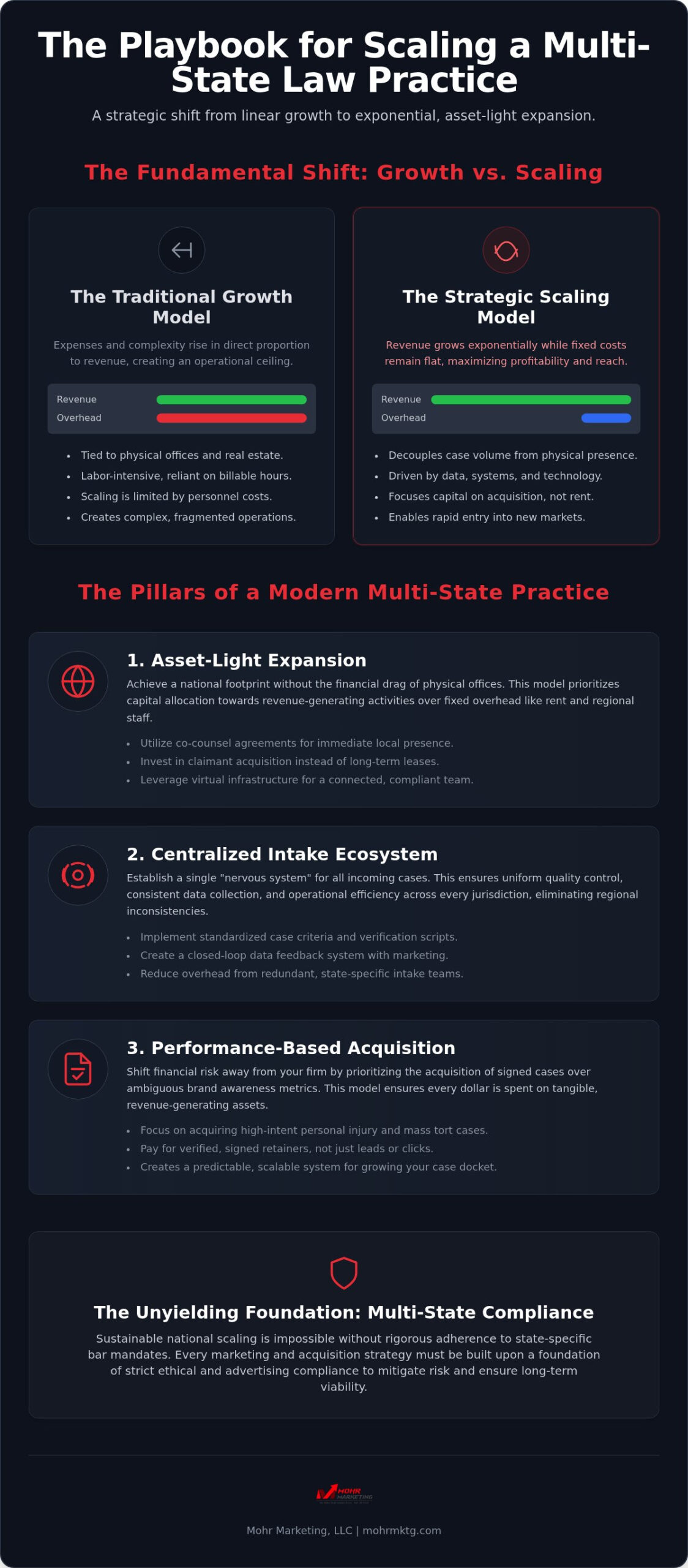
Growth is a trap that many law firms mistake for progress. If your expenses rise in lockstep with your revenue, you aren’t scaling; you’re just getting bigger and more complex. In a traditional growth model, adding ten new cases requires adding more staff and more office space. This linear relationship creates a ceiling. True scaling means decoupling your case volume from your physical office presence. It’s about building a system where revenue grows exponentially while your fixed costs remain relatively flat.
The 2026 legal market demands a decentralized model. Success no longer depends on having a mahogany desk in every state capital. Instead, it relies on digital reach and centralized operational control. The Practice of Law in the United States is shifting toward this asset-light approach. Firms that continue to prioritize regional real estate over efficient acquisition systems will find themselves outpaced by leaner, more aggressive competitors who understand that scaling a multi-state law practice is fundamentally an infrastructure challenge.
The Billable Hour Trap
Labor-intensive models fail when you expand across state lines. If your firm relies solely on the billable hour, you’re tethered to a model that doesn’t scale. You can’t manufacture more time. Scaling requires a shift from a practice-focused mindset to a business-system mindset. You must view your firm as a machine that processes cases rather than just a collection of attorneys. Automation plays a critical role here. By automating the qualification and intake process, you reduce the cost-per-case. This allows your high-value legal talent to focus on litigation and strategy while the system handles the volume. Without this shift, your firm will eventually buckle under the weight of its own personnel costs.
Asset-Light Expansion Strategies
Stop investing in regional overhead. Asset-light expansion allows you to maintain a national footprint without the liability of long-term leases. Use co-counsel agreements to handle the local aspects of litigation. This strategy lets you enter new markets instantly. Focus your capital on claimant acquisition rather than rent. By securing high-intent mass tort signed cases, you build a portfolio of revenue-generating assets. Virtual infrastructure ensures that your team stays connected and compliant regardless of their physical location. This approach minimizes risk and maximizes your ability to pivot when new opportunities emerge in different jurisdictions. Efficiency is the only way to maintain a competitive advantage when scaling a multi-state law practice.
How to Implement a Centralized Intake Ecosystem
Centralized intake serves as the nervous system of any successful operation when scaling a multi-state law practice. Relying on fragmented, local intake teams leads to inconsistent lead handling and data silos that make national oversight impossible. By centralizing this function, you create a unified command center where every inquiry is processed through the same rigorous standards, regardless of the claimant’s location. This structure allows you to maintain total control over the quality of your docket while reducing the overhead associated with redundant staffing in multiple states.
Effective systems for scaling a law firm require a closed-loop communication style between your marketing and intake departments. Your intake team must provide real-time data back to your acquisition partners. If leads from a specific jurisdiction aren’t meeting your qualification threshold, you must have the agility to shift your budget instantly. Regular audits of your intake recordings and CRM data are mandatory to identify bottlenecks and ensure that high-value opportunities aren’t being lost to human error or technical friction.
Standardizing Case Criteria
Consistency is the foundation of quality. You must develop rigorous verification scripts that apply across all target states to ensure that every signed retainer meets your specific litigation requirements. Your intake professionals need specialized training on the nuances of different torts, such as the specific injury markers required for truck accident signed cases. Standardizing these criteria prevents your firm from wasting resources on non-viable files. Understanding The ROI of Legal Intake Services is essential for firms that want to maximize their conversion efficiency during a national rollout.
Speed-to-Lead Protocols
In the 2026 legal market, speed is the primary driver of conversion. Data from Practice Proof indicates that a five-hour delay in responding to inquiries can cost a firm up to 46 clients and $200,000 in annual revenue. You must implement 24/7 response protocols to capture high-intent inquiries the moment they are generated. Automating the initial touchpoint through SMS or email acknowledges the lead instantly while an intake specialist prepares for the live call. This approach eliminates the window of opportunity for a claimant to contact a competitor. If your current intake process is failing to convert at a high rate, it’s time to evaluate a more streamlined acquisition architecture.
Performance-Based Acquisition vs. Traditional Retainers
Traditional agency retainers are fundamentally flawed for firms focused on scaling a multi-state law practice. Most marketing agencies prioritize “brand awareness” and “impressions” because these metrics are easy to achieve but impossible to bank. They demand a monthly fee regardless of whether they deliver a single viable case. This model places the entire financial risk on your firm. If the campaign fails to generate quality leads, you lose your investment while the agency keeps its retainer. This lack of accountability is the primary reason many national expansion efforts stall before they gain momentum.
Performance-based models, specifically a Pay-Per-Signed-Case approach, transfer the financial risk back to the provider. You stop paying for clicks and start paying for results. This shift is critical for sustainable multi-state law firm growth. By paying only for fully executed retainer agreements that meet your specific criteria, you ensure that every dollar of your marketing budget is tied to a revenue-generating asset. This level of predictability allows you to scale faster and with greater confidence across multiple jurisdictions.
The Pay-Per-Signed-Case Advantage
The core benefit of this model is the total elimination of lead waste. Traditional pay-per-click campaigns often result in a high volume of unqualified inquiries that clog your intake system. A performance-based model delivers verified intent. You receive cases that have already been screened against your rigorous standards. This predictability enables precise budget forecasting. You know exactly what your acquisition cost will be for every new file. It allows your firm to focus its energy on high-stakes litigation rather than micro-managing a marketing agency’s ad spend. Securing mass tort signed cases through a performance model ensures that your growth is built on a foundation of actual dockets, not just potential inquiries.
Evaluating Lead Quality Metrics
Vanity metrics like cost-per-click or cost-per-lead are irrelevant in a multi-state environment. The only metric that matters is the cost-per-signed-retainer. Verified inquiries are the minimum standard. You need to know that every claimant has been vetted for specific criteria, such as exposure dates or injury severity. This is especially true for high-value litigation. For instance, mesothelioma leads built on real intent require deeper verification than a standard fender-bender. When scaling a multi-state law practice, your acquisition partner must provide transparent, data-backed proof of quality for every signed case delivered. This level of precision eliminates the guesswork and ensures that your expansion is both profitable and compliant.
Navigating Multi-State Compliance and Bar Mandates
Compliance is the primary friction point when scaling a multi-state law practice. Every jurisdiction presents a unique regulatory minefield that can halt expansion if not managed with precision. California implemented updated advertising rules in January 2026. New York followed with its own revisions in June 2026. These aren’t suggestions; they are mandates. You must ensure your marketing partner treats national reach as a collection of fifty distinct legal environments. Transparency in lead sourcing protects your firm’s reputation and license. You require a clear audit trail of how every claimant was engaged before they reached your intake team. A compliance-first approach isn’t just about following rules; it’s about mitigating the existential risk of multi-jurisdictional practice.
State-Specific Advertising Rules
The 2026 Edition of the ABA Model Rules, specifically Rules 7.1 through 7.5, provides the framework for professional conduct. However, state-level requirements often exceed these standards. High-regulation states like Florida and Texas have highly detailed rules regarding disclaimers, testimonials, and the reporting of past results. Some jurisdictions even require the submission of advertisements for formal review. You cannot scale nationally using a generic ad template. Your agency must possess deep expertise in legal-sector compliance to navigate solicitation boundaries. This includes understanding the impact of pro hac vice fees, which reached $500 in California as of January 1, 2026, on your overall acquisition strategy. Professional marketing partners eliminate the friction of managing these variations manually.
Data Privacy and Security
Claimant data management must adhere to both federal and state-specific privacy laws. If your firm handles sensitive medical information for mesothelioma leads or other personal injury matters, your entire intake ecosystem must maintain HIPAA compliance. Protecting sensitive inquiries from the initial point of capture to the final signed case is an operational necessity. This requires encrypted data transfers and rigorous verification protocols to prevent breaches that could lead to disciplinary action. Security protocols must be audited regularly to ensure they meet the evolving standards of 2026. When scaling a multi-state law practice, your security infrastructure must be as robust as your litigation strategy. You don’t have the luxury of using unverified intermediaries who might compromise data integrity.
The Mohr Marketing Method: Turnkey Case Acquisition
The methodology utilized by Mohr Marketing, LLC is the culmination of 30 years of industry experience. It’s designed to bypass the traditional hurdles of scaling a multi-state law practice. We’ve eliminated the inefficient intermediaries that dilute your ROI. Our approach is purely performance-driven. We provide a turnkey marketing and intake ecosystem that delivers fully executed retainers directly to your firm. This removes the operational friction discussed in previous sections. You don’t have to build the infrastructure from scratch. We’ve already built it. This allows your firm to transition from a regional player to a national leader without the usual growing pains.
Our system focuses on mechanical accuracy and strategic value. We understand that a law firm is a business that requires predictable inventory to maintain its margins. By providing verified inquiries and signed cases, we allow you to forecast your revenue with precision. This is the only way to achieve exponential growth without a corresponding spike in fixed overhead. You manage the litigation; we manage the acquisition machine. It’s a direct, results-oriented path to market dominance that eliminates the friction of inefficient intermediaries and unverified lead sources.
High-Value Case Acquisition
National dominance requires a focus on high-intent opportunities. You can’t scale on low-value volume alone. Our system targets specific niches where the returns justify the expansion. For example, we deliver Truck Accident Signed Cases that meet strict liability and insurance criteria. If your firm focuses on motor vehicle accidents, we provide Police Report-Backed MVA Cases to ensure your docket is built on verified data. For those pursuing large-scale litigation, our Mass Tort Signed Cases allow you to enter the national arena with immediate volume. This specialization ensures that your resources are always allocated to the most profitable files regardless of the jurisdiction.
Strategic Growth Partnership
The legal market is crowded with agencies that offer vague promises and “brand awareness.” Mohr Marketing, LLC is the straight-talker. We don’t hide behind impressions or clicks. We focus on signed retainers because that’s the only metric that drives revenue. Moving from a vendor relationship to a strategic growth partnership is essential for scaling a multi-state law practice. We act as your protective partner. We’re aggressive in pursuing your expansion while remaining protective of your resources. This relationship is built on transparency and mechanical accuracy. If you’re ready to start your national expansion, you need a partner that understands the mechanics of growth. We provide the path. You provide the legal expertise.
Secure Your National Competitive Advantage
Scaling is a strategic imperative. You’ve learned that national growth depends on decoupling case volume from physical infrastructure. Success requires a centralized intake ecosystem and a shift toward performance-based acquisition models that transfer financial risk away from your firm. These systems ensure that every new jurisdiction you enter adds revenue without bloating your fixed overhead.
Mastering the complexities of scaling a multi-state law practice demands precision. You require a partner with 30 years of legal marketing expertise to navigate 2026 state bar mandates and deliver direct access to high-intent signed retainers. This isn’t just about getting more leads; it’s about building a predictable, compliant, and highly profitable national docket.
Don’t let operational bottlenecks or outdated agency models stall your expansion. Implement these strategies today to secure your firm’s position as a national leader in high-stakes litigation.
Frequently Asked Questions
What is the difference between growing and scaling a law practice?
Growth is a linear increase where revenue and expenses rise at the same rate. Scaling is an exponential increase where revenue outpaces costs through efficiency and automation. When scaling a multi-state law practice, you must decouple your firm’s revenue from its physical footprint. This allows you to handle a higher volume of cases without a proportional increase in administrative overhead or regional office space.
Is it legal to use a lead generation service for multi-state expansion?
Lead generation is legal across state lines as long as the provider complies with ABA Model Rules and specific state bar ethics. The service must function as a marketing tool rather than a prohibited referral scheme. You’re responsible for ensuring your partner maintains transparency in lead sourcing. A compliant partner will provide a clear audit trail showing how every claimant was engaged before the signed retainer was delivered.
How do I ensure compliance with different state bar rules when advertising nationally?
You must verify that every advertisement contains the specific disclaimers required by each target state. High-regulation states like Florida and New York have stringent rules on testimonials and reporting past results. Working with a specialized agency ensures your campaigns are tailored to these local mandates. This compliance-first approach protects your reputation while scaling a multi-state law practice across diverse regulatory environments.
What is a Pay-Per-Signed-Case model and how does it benefit my firm?
A Pay-Per-Signed-Case model is a performance-based acquisition strategy where you pay only for fully executed retainer agreements. This model eliminates the financial risk of traditional pay-per-click marketing. It provides your firm with predictable acquisition costs and high-intent dockets. By focusing on signed retainers rather than raw leads, you ensure that your marketing budget is strictly tied to revenue-generating assets.
Do I need a physical office in every state I practice in?
A physical office is rarely required in every state, though you must verify local “bona fide office” rules. Most firms use co-counsel agreements or virtual infrastructure to maintain a national presence without high fixed costs. This asset-light strategy allows you to focus resources on claimant acquisition. You can effectively manage cases across state lines by leveraging centralized operations and local litigation partners when necessary.
How does centralized intake improve my law firm’s conversion rate?
Centralized intake improves conversion by standardizing the qualification process and ensuring immediate response times. It removes the friction of managing fragmented regional teams. A unified intake center operates 24/7 to capture high-intent inquiries the moment they occur. This consistency ensures that every lead is vetted against the same rigorous criteria, preventing high-value cases from being lost due to human error or slow follow-up.
What are the most profitable practice areas for multi-state scaling in 2026?
Mass Tort, Personal Injury, and Motor Vehicle Accident (MVA) cases remain the most profitable areas for national expansion in 2026. These practice areas benefit from high-volume digital acquisition and standardized intake protocols. They allow firms to build large dockets across multiple jurisdictions without the need for localized marketing campaigns. Focusing on these high-intent niches provides the most direct path to sustainable national growth.
How can I audit my current intake process for scalability?
To audit your intake, measure your speed-to-lead and the percentage of inquiries that convert to signed retainers. Review call recordings to ensure specialists adhere to your verification scripts. Identify where manual processes create bottlenecks or delays. A scalable intake system must be able to handle sudden spikes in volume without a drop in conversion quality or data integrity. Regular audits ensure your infrastructure can support aggressive expansion.

Recent Posts
- Personal Injury Intake Services: A 2026 Guide to High-Conversion Case Acquisition
- Using EMS Reports to Find and Qualify Personal Injury Clients
- The Strategic Value of EMS-EMT Accident Reports in Car Accident Lawsuits
Categories
- AI and Lead Generation
- Business Financing
- Call Verified MVA Leads
- Car Accident Help
- Car Accident Settlements
- Claimant Funding
- Compliance Program
- EMS-EMT Reports
- Geotargeting
- Google Maps Ranking
- Healthcare Practice Growth
- Law Firm Growth
- Law Office Operations
- Lead Generation
- Lead Generation For Attorneys
- Lead Generation For Chiropractors
- Lead Generation For Criminal Attorneys
- Lead Generation For D&A Treatment Centers
- Lead Generation For DUI Attorneys
- Lead Generation For Eye Doctors
- Lead Generation For Family Law Practices
- Lead Generation For PI Law Firms
- Lead Generation For Plastic Surgeons
- Leads For Healthcare Professionals
- Leads For Insurance Industry
- Legal Leads
- Legal Marketing
- Legal Updates
- Mass Tort Leads
- Medicare and Medicaid Leads
- Merchant Funding Leads
- Online Marketing Strategies
- Pre-Settlement Funding
- Signed MVA Cases
- Tort Updates
- Truck Accident Leads and Signed Cases
- Truck Accident Settlements
- Web Design