DPPA Compliance in Legal Marketing: An Evidence-First Approach
March 17, 2026 by Mohr MarketingNavigating the DPPA: How “Evidence-First” Marketing Respects Federal Privacy Laws
In the modern legal landscape, data is the engine of growth. However, for personal injury attorneys, that engine often comes with a warning light: the Driver’s Privacy Protection Act (DPPA). Many firms shy away from innovative data strategies because they fear the regulatory repercussions of mishandling protected information.
At Mohr Marketing, LLC, we believe that compliance isn’t a hurdle to growth—it’s the foundation of it. Our “Evidence-First” Police Report Program is engineered specifically to navigate the complexities of federal and state privacy mandates while delivering the high-fidelity cases your firm needs to scale.
Understanding the DPPA: The Shield and the Sword
Passed by Congress in 1994, the DPPA was designed to prevent the unauthorized disclosure of “personal information” contained in state motor vehicle records. For years, this led to a “black box” in legal marketing, where firms relied on broad, expensive, and often inaccurate digital bidding because they didn’t have a compliant way to utilize incident data.
However, the DPPA was never intended to be a total ban on the use of accident information. Instead, it established “Permissible Uses”—specific lanes where data can be accessed and utilized for legitimate business and legal purposes.
The Mohr Marketing Approach: Data with Integrity
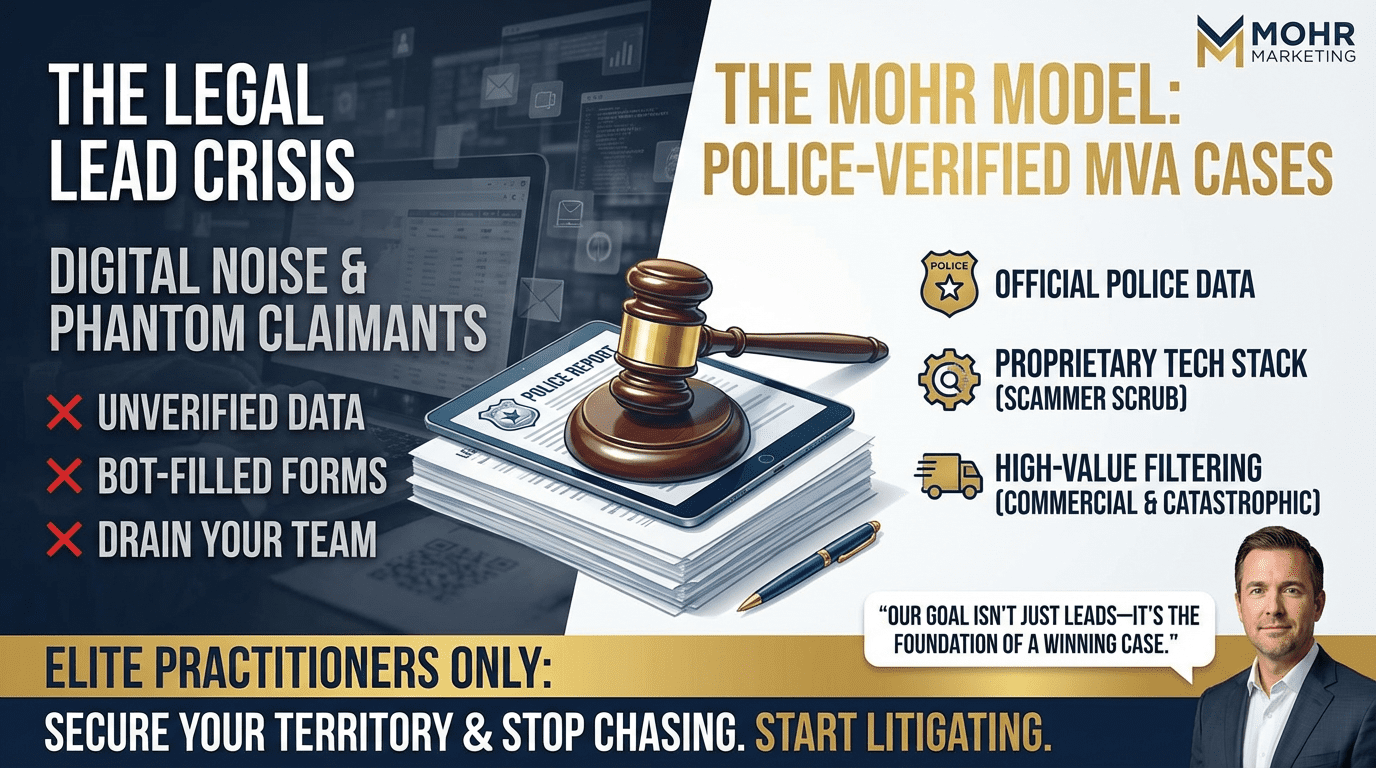
Our program does not rely on “scraped” data or questionable third-party lists. We utilize a strategic partnership with a law enforcement-owned agency to source Motor Vehicle Accident (MVA) data directly from official police reports.
This distinction is critical for three reasons:
- Authorized Sourcing: We access data through legitimate, authorized channels that adhere to state-specific records-release protocols.
- Public Record Alignment: In many jurisdictions, the fact that an accident occurred—and the details surrounding that incident—are matters of public record when documented by a reporting officer.
- Data Minimization: We only extract the variables necessary to confirm the validity of an incident: the date, time, location, and the non-at-fault status of the parties involved.
The “Intent Trigger”: Staying Out of the “Cold Outreach” Trap
The biggest risk under the DPPA and State Bar rules is unsolicited cold outreach. Direct solicitation based on sensitive data is a fast track to a regulatory audit.
This is where our technology changes the game.
Instead of using police report data to “cold call” victims, we use it as a verification filter for our AI WebTracker®.
- Step 1: We identify a “universe” of verified accident victims from official reports.
- Step 2: Our AI monitors for active digital intent. We wait for the individual to voluntarily initiate a search for “car accident help,” “ER wait times,” or “collision repair.”
- Step 3: Only when the prospect demonstrates intent do we deploy your firm’s personalized re-engagement ads.
By anchoring the engagement in the prospect’s own digital action, we shift the model from “intrusion” to “assistance.” You aren’t chasing them; you are appearing exactly when and where they are searching for a solution.
The Compliance Affirmation: A Service-Based Model
To further insulate our partner firms, we have structured our entire business model to satisfy the strictest State Bar interpretations of “lead buying.”
Compliance Sidebar: “In compliance with Bar requirements and federal privacy mandates like the DPPA, the Client is not buying leads or signed cases. All fees paid are for marketing services, media spend, and administrative intake labor.”
By billing for the technology license (AI WebTracker®), the media placement (OTT, Social, Broadcast), and the administrative labor of our bilingual intake specialists in North Carolina and New York, we create a transparent, defensible service agreement.
Why “Evidence-First” is the Only Safe Way to Scale
In 2026, the “Wild West” of legal marketing is closing. Regulators are looking closer at where data comes from and how it is used. Firms that rely on unverified “junk leads” are not only wasting money—they are taking on unnecessary reputational risk.
The Mohr Marketing Police Report Program provides the “Source of Truth” you need. By combining official law enforcement data with predictive AI and a compliance-first fee structure, we allow you to dominate markets like Texas and California with total peace of mind.
If your intake team is frustrated by the quality of your current MVA leads, it’s time to change the source. The police report is the most powerful tool in your arsenal—we just make sure you get it first.
Let’s discuss your specific needs and how our Police Report Backed MVA Cases, Compliance Program, AI Lead Generation Technology, DPPA-Compliant Data, digital marketing, and signed cases can help you achieve your growth goals.
Contact Mohr Marketing today for a custom quote
Best Wishes,
Mohr Marketing Team

Recent Posts
- Tracking Law Firm Marketing: A Practical Guide
- High-Value Mold Case Acquisition: A Strategic Guide
- High-Quality Mold Leads: Scale Your Toxic Tort Practice
Categories
- AI and Lead Generation
- Business Financing
- Call Verified MVA Leads
- Car Accident Help
- Car Accident Settlements
- Claimant Funding
- Compliance Program
- EMS-EMT Reports
- Geotargeting
- Google Maps Ranking
- Healthcare Practice Growth
- Law Firm Growth
- Law Office Operations
- Lead Generation
- Lead Generation For Attorneys
- Lead Generation For Chiropractors
- Lead Generation For Criminal Attorneys
- Lead Generation For D&A Treatment Centers
- Lead Generation For DUI Attorneys
- Lead Generation For Eye Doctors
- Lead Generation For Family Law Practices
- Lead Generation For PI Law Firms
- Lead Generation For Plastic Surgeons
- Leads For Healthcare Professionals
- Leads For Insurance Industry
- Legal Leads
- Legal Marketing
- Legal Updates
- Mass Tort Leads
- Medicare and Medicaid Leads
- Merchant Funding Leads
- Mold Leads
- Online Marketing Strategies
- Pre-Settlement Funding
- Signed MVA Cases
- Tort Updates
- Truck Accident Leads and Signed Cases
- Truck Accident Settlements
- Web Design